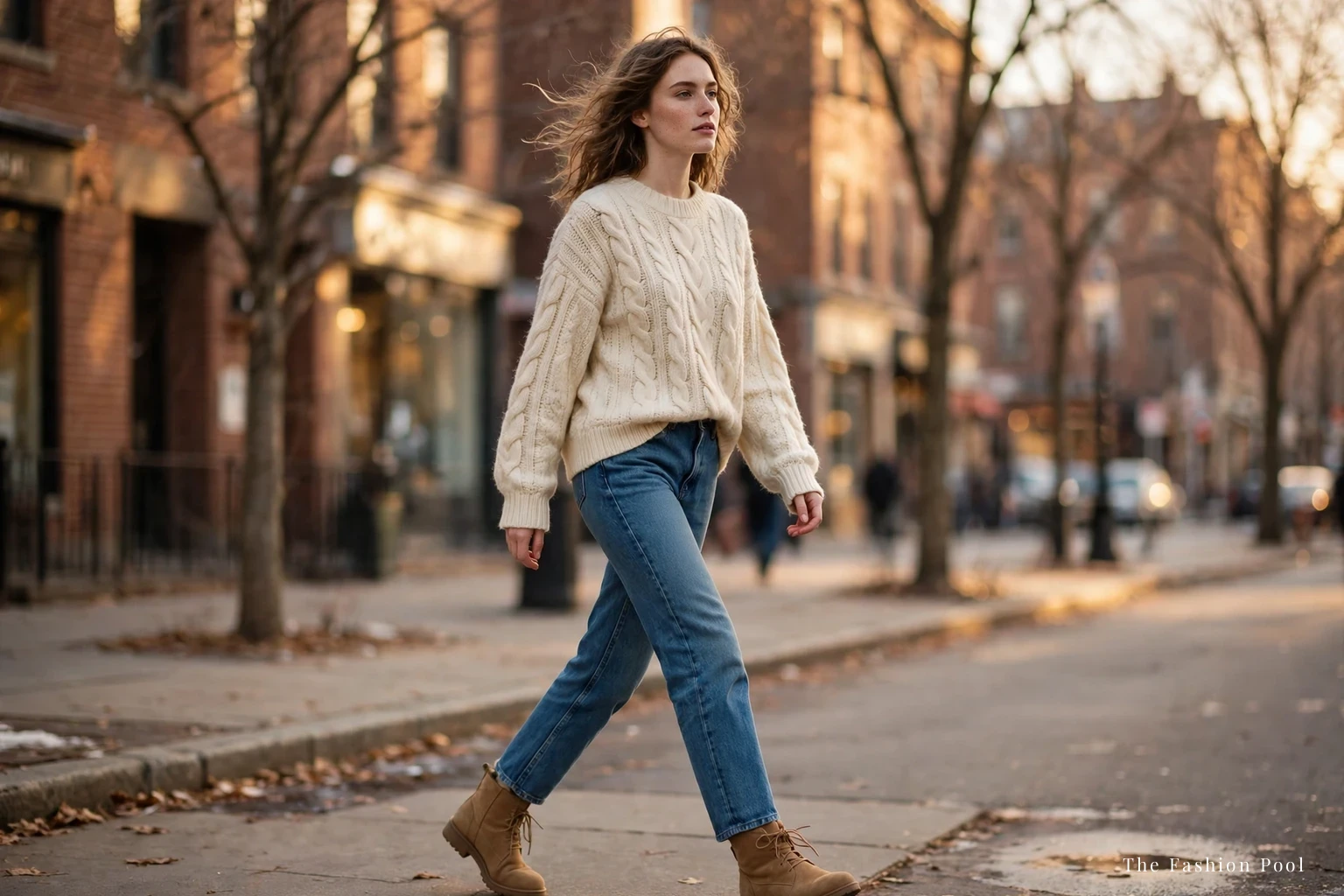
A chunky knit sweater outfit that looks intentional starts with one decision: how much bulk the outfit can carry. A chunky knit is the bulkiest piece most people own — thick yarn, a wide silhouette, sleeves that take up space — and the mistake is treating it like any other sweater. Pair it with wide trousers and a long coat, and the outfit disappears under its own volume. Pair it with one quiet bottom and the knit becomes the point of the outfit instead of the problem.
This guide works from a single rule: one bulky piece per outfit. The knit is the bulky piece, so everything else stays close, smooth and quiet. Then a ladder for choosing the right knit weight, three complete outfits, the coat question, and what not to pair underneath.
The one-bulky-piece rule
The rule is simple: an outfit can carry one bulky piece. The chunky knit is that piece, so everything else in the outfit stays close to the body, smooth in texture, and quiet in color. The moment a second bulky piece joins — wide trousers, a long puffer, a thick scarf — the outfit stops reading as an outfit and starts reading as a pile of clothes.
Volume is a budget, and the knit spends most of it. If the knit is oversized and long, the bottom is slim: straight jeans, a satin midi skirt, tailored trousers. If the knit is cropped and boxy, the bottom can carry a little more shape, because the knit ends above the hip and the waist is visible. Either way, one piece carries the volume and the rest of the outfit frames it.
The mirror test: stand sideways. If the silhouette reads as one big rectangle from shoulder to knee, something has to slim down — usually the bottom, sometimes the sleeves. If you can see a waist, an ankle, and a clear line from shoulder to shoe, the rule is working.
Bulk hides in three places people forget. The sleeves: a wide sleeve adds width at the arms, so push it up to the forearm or choose a knit with a fitted cuff. The hem: a long straight hem erases the waist, so a front tuck — just the front center of the hem into the waistband — defines it again. The neckline: a crew neck adds width across the shoulders, while a V-neck breaks the line and gives the eye somewhere to go.
There is one exception, and it proves the rule. A long chunky cardigan worn open over a slim base works because the bulk is split down the middle: the outfit reads as two vertical lines with a quiet column between them, not one block. The cardigan is still the only bulky piece — the base underneath stays slim.
The knit-weight ladder
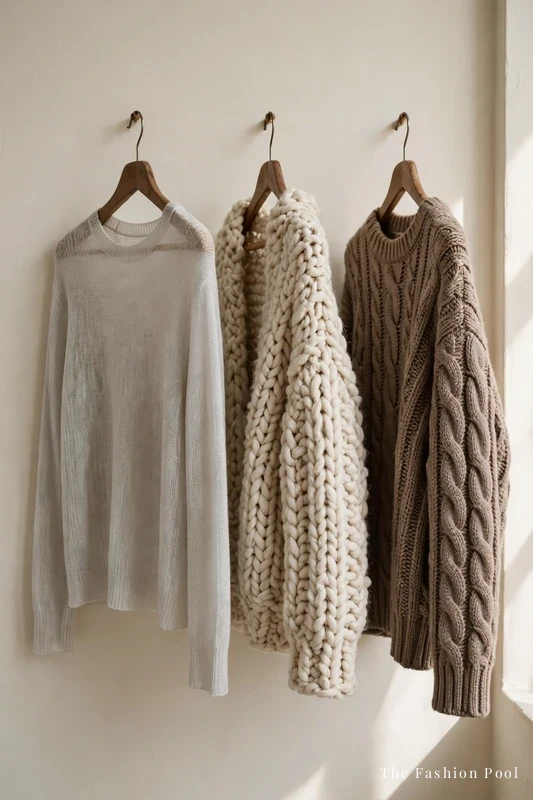
Not all knits are chunky in the same way, and the weight you choose decides the day. Think of it as a ladder with three rungs.
The fine knit is the bottom rung: thin yarn, a close fit, a smooth surface. It is a layering knit, not a statement — it works under coats and blazers and disappears under a scarf. It is not the subject of this guide, but it matters because it is what you wear when the day needs a knit without the bulk.
The chunky knit is the middle rung: thick yarn, visible stitches, some structure of its own. This is the outfit’s main piece, and it is the knit this guide is about. It is warm enough to be the outer layer indoors, structured enough to hold a shape, and bold enough that the rest of the outfit can stay quiet.
The cable knit is the top rung, and the heaviest. Raised cables add visual weight even in the same yarn thickness, because the pattern itself catches light and shadow. One cable piece per outfit, always. A cable sweater with a cable scarf is a costume, not an outfit — the pattern needs plain partners.
Choose by the day. A cold day with an indoor evening calls for the chunky knit: warm, present, easy to dress up with a satin skirt. An all-day outdoor day calls for the cable knit with a proper coat over it. An office day calls for the fine knit under a blazer, with the chunky knit saved for a smart-casual office or the weekend.
The weight test in the shop: hold the knit up to the light. If you can see daylight through the stitches, it is an open knit and will need a layer underneath in real cold. If it stands up on its own when you hold it by the shoulders, it will hold its shape all day. If it drapes like a scarf, it is softer than it looks and will need the front tuck to keep its line.
Chunky knit with straight jeans
The everyday formula is the simplest one: a chunky knit, straight-leg jeans, ankle boots. It works because each piece does one job and none of them fights the others.
Straight jeans are the right bottom for a reason. They balance the knit’s width without adding volume of their own. Skinny jeans make the top look bigger by contrast — the eye compares the narrow leg with the wide knit and the knit wins. Wide-leg jeans add a second bulky piece and break the rule at the first step.
The front tuck is what makes this outfit look finished rather than thrown on. Tuck just the front center of the hem into the waistband: it shows the waistband, shortens the knit visually, and keeps the back long enough to cover the seat. A full tuck fights the knit’s thickness and bunches at the waist; a front tuck is enough.
Ankle boots are the default — heeled or flat, both work, and knee-high boots under straight jeans are the cold-weather version; our guide to wearing knee-high boots with jeans without bunching covers the fit that keeps the line clean. White sneakers work for a casual day, and loafers work when the knit is a solid color and the day is dry.
A cream knit with mid-wash jeans is the classic — warm, bright, and easy to photograph. A charcoal knit with dark jeans is the quieter version for a gray day. A camel knit with black jeans is the sharpest of the three, because the contrast between the warm top and the dark bottom gives the outfit a clear shape.
Chunky knit with a satin midi skirt
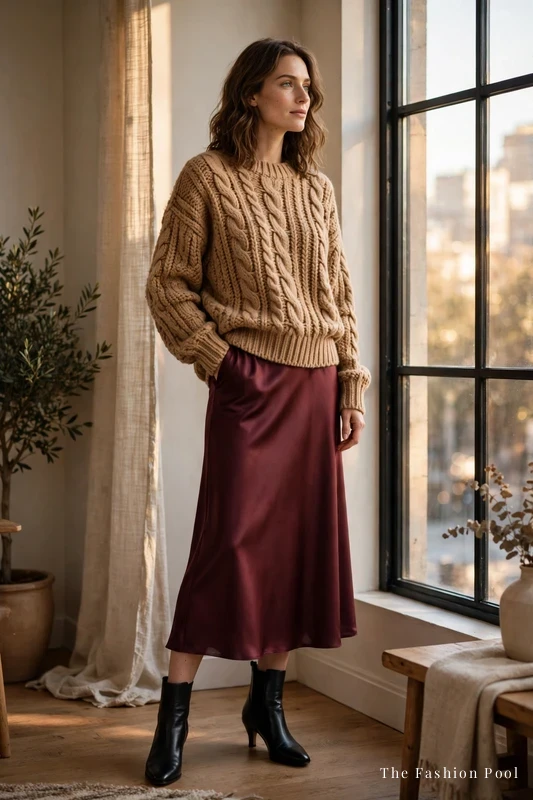
The contrast formula is the most photogenic of the three: a matte knit against a shining skirt. The satin reflects light, the knit absorbs it, and the two textures balance each other in a way two matte pieces never do.
Length matters more here than anywhere else in the guide. Midi, not maxi: a maxi satin skirt plus a chunky knit is too much fabric in one outfit, and the eye has nowhere to rest. A midi skirt shows the ankle and the shoe, and that small break in the silhouette is what keeps the outfit from reading as one block.
The tuck is different here too. A full tuck works with a satin skirt because the skirt’s waistband is smooth — tuck the whole hem in and the waistline is clean. If the knit is long or very thick, a front tuck is the fallback; either way, the waist must be visible, because the skirt’s shine needs a starting point.
Shoes follow the skirt, not the knit. Heeled ankle boots for an evening, pointed flats for the day, opaque tights in cold weather in a color that matches the skirt or the shoe — never a third color that competes with both.
Color pairings that work: a camel knit with a burgundy satin skirt, a cream knit with a black satin skirt, a gray knit with an emerald satin skirt. In each case the knit is the quiet color and the skirt carries the color — never both at full strength.
Chunky knit with tailored trousers
The polished formula is the one that works beyond the weekend: a chunky knit, tailored trousers, loafers or heeled boots. It is the outfit for the day that starts at a desk and ends at dinner.
It works because the trousers give the outfit a vertical line, and the knit’s horizontal bulk needs one. A crease down the front of each leg pulls the eye downward and stops the knit from reading as a single wide block. Without that line, the outfit is a rectangle; with it, the outfit has a shape.
The fit of the trousers decides everything. They should sit at the natural waist — a low rise plus a chunky knit erases the waist entirely, and no tuck can bring it back. The leg should be straight or gently tapered; a wide leg breaks the rule, and a skinny leg makes the knit look bigger by contrast, just as with jeans.
The front tuck is the same as with jeans — tuck the front, leave the back out — but here the crease keeps it looking deliberate rather than undone. The trousers’ structure does the work the jeans’ denim cannot: the outfit reads as chosen, not assembled in a hurry.
This is the only one of the three outfits that works in a smart-casual office. Keep the knit in a solid color, skip the novelty stitches and the oversized cable, and let the trousers and the shoes do the polished half of the job. A fine knit under a blazer is still the right call for a formal office — the chunky knit is for the office that already allows denim on Fridays.
The coat question
The coat is the hardest part of a chunky knit sweater outfit, because most coats do not fit over a chunky knit. A fitted coat crushes the knit and ruins its shape. A puffer adds a second bulky layer and breaks the rule at the door. The coat has to be chosen with the knit on, not imagined over it.
The answer is a coat with a dropped shoulder and room through the body. A tailored wool coat in a size that fits over the knit is the safest version — try the coat and the knit together at home, not at the venue door, because a coat that fits over a fine knit will not fit over a chunky one. A camel coat is the easiest version of that coat: it works over dark knits and cream knits alike, and it looks right in photographs.
A faux fur coat is the festive version — warm, dramatic, and the whole outfit’s statement before the knit is even visible. It works because the faux fur is itself a bulky piece, so it replaces the knit as the outfit’s volume rather than adding to it: the knit underneath should be a finer one, or the coat should be open.
What not to wear over a chunky knit: a fitted blazer, which pulls and gaps across the chest; a short cropped jacket that ends at the knit’s widest point and cuts the outfit in half; a belted coat cinched tight over the knit, which squeezes the bulk into a shape it was never meant to hold.
Gloves and scarf follow the same rule as everything else: one of them, not both. A chunky knit plus a chunky scarf is two bulky pieces at the neck, and the face disappears between them. Gloves are the safer choice — our guide to wearing gloves with a coat covers the pair that works with a heavy coat. If the evening has a coat check, the coat disappears at the door and the knit is the outfit; if it does not, the coat is part of the outfit, so choose it with the same care as the knit.
What not to pair underneath
Some pairings fail before the outfit leaves the house, and they all fail the same way: a second bulky piece, or a detail the knit swallows whole.
Wide-leg trousers or a wide midi skirt are the most common mistake. They add a second bulky piece below the waist, and the outfit becomes two blocks stacked on each other. The knit needs a slim bottom — straight jeans, a satin midi, tailored trousers — and nothing wider.
A second knit is the next mistake: a knit scarf, a knit hat and a chunky sweater together is a costume, not an outfit. Pick one knit accessory at most, and make it the quietest one you own — a plain wool hat, for example. A smooth leather glove does the same job without competing at all.
A long pendant necklace disappears into the stitches. The knit swallows it, the chain catches on the yarn, and the pendant is invisible by noon. Short necklaces or none at all — earrings do the work instead, because they sit above the knit and stay visible all day.
A bulky bag is the same problem at the hip: a big tote plus a chunky knit is two blocks side by side. A small crossbody or shoulder bag keeps the line clean, and it leaves both hands free for the coat and the gloves.
Prints that fight the texture are the last one. A busy print under a chunky knit is invisible anyway — the knit covers it, the pattern competes with the stitches, and neither one wins. Save prints for fine knits, where the fabric is thin enough to let the pattern show.
Frequently asked questions
Can I wear a chunky knit sweater to the office?
Yes, if the office is smart-casual: a solid color, tailored trousers, loafers, and no novelty stitches. Keep the knit neat and the rest of the outfit polished. For a formal office, a fine knit under a blazer is the right call instead.
What jeans go with a chunky knit sweater?
Straight-leg jeans. They balance the knit’s width without adding volume of their own. Skinny jeans make the top look bigger by contrast, and wide-leg jeans add a second bulky piece.
Should I tuck in a chunky knit sweater?
A front tuck, yes — tuck just the front center of the hem into the waistband. It defines the waist and shortens the knit visually. A full tuck only works with a smooth waistband, like a satin skirt.
What coat do I wear over a chunky knit?
A tailored wool coat with room through the body, or a faux fur coat for the festive version. Try the coat and the knit together at home — a fitted coat crushes the knit, and a puffer adds a second bulky layer.
Can I wear a chunky knit with a skirt?
Yes — a satin midi skirt is the best pairing, because the matte knit against the shine balances the outfit. Keep the skirt at midi length so the ankle and the shoe break the silhouette.
How do I stop a chunky knit looking bulky?
One bulky piece per outfit: a slim bottom, smooth textures elsewhere, a front tuck, and sleeves pushed up or fitted at the cuff. If the mirror shows one big rectangle, slim something down.
One bulky piece, everything else quiet. Choose the knit weight for the day, pair it with a straight jean, a satin skirt or a tailored trouser, and let the coat fit over it instead of fighting it. The knit is the outfit — everything else is the frame.