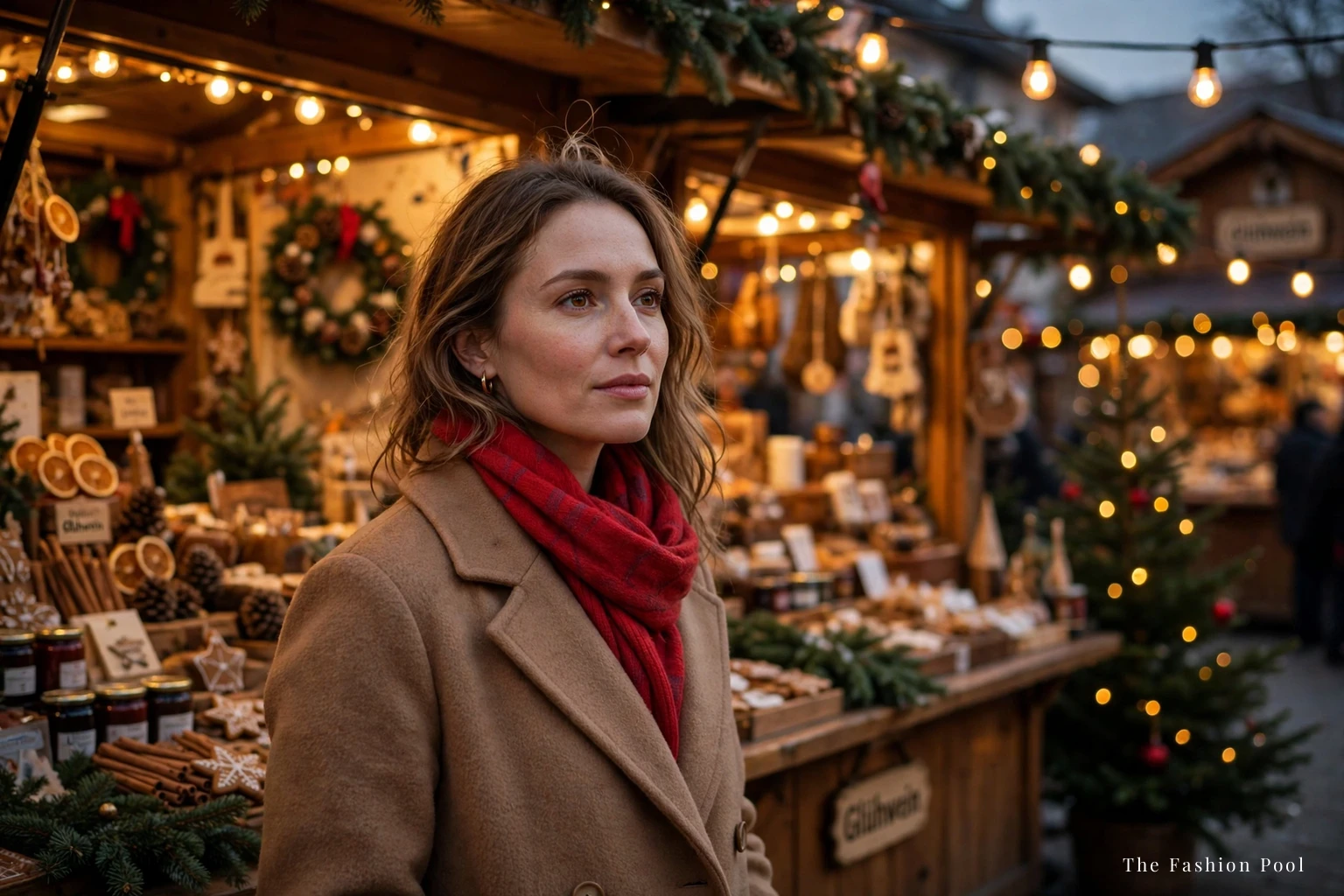
Christmas Market Outfits: Dress for the Queue, Not the Photograph
A christmas market outfit is not a photograph outfit. It is a queue outfit, a walking outfit, and a standing-in-the-cold outfit — and the photograph is the last thing it has to do, not the first. The market is a loop: you arrive, you queue, you walk, you stand, you shop, you drink something hot, you walk again. The outfit that works is the one that survives the loop.
This guide works from one test, and the test has an order: warmth first, walking second, photographs third. Warmth decides whether you stay. Walking decides whether you enjoy it. Photographs decide nothing about either — they are the reward for an outfit that already works, not the reason for it.
The market is an evening plan, and the evening plan starts before you leave the house. The market opens in the late afternoon, the lights come on at dusk, and the crowd arrives after work — the outfit has to work from the first stall to the last, and the last stall is two hours after the first. A market outfit is not a quick outfit; it is a two-hour outfit, and the two hours are outside.
The market test: warmth, walking, photographs — in that order
The market test is the whole guide in one sentence: warmth first, walking second, photographs third. Warmth is first because the market is outside, and outside in December is not a backdrop — it is the weather. A cold outfit ends the evening early, and no photograph is worth an evening that ends at the first stall.
Walking is second because the market is a loop, not a room. You walk the loop twice, three times, once more because you missed a stall. The shoes decide whether the third loop happens, and the third loop is the one where you find the thing you actually came for. A shoe that hurts ends the loop at the first one.
The queue is the market’s hidden test, and the hidden test is the standing. You queue for the food, you queue for the drink, you queue for the photograph — and the queue is standing still in the cold, not walking. A standing outfit is colder than a walking outfit, because walking warms the body and standing does not. The warmth has to work while you stand, and the standing is the part the walking does not warm.
Photographs are third because the market photographs itself. The lights, the stalls, the steam from the mugs — the setting does the work, and the outfit only has to not fight it. A bright accessory photographs well; a complicated outfit photographs badly. The photograph is the last test, and it is the easiest one to pass.
The three layers: base, mid, outer — and what comes off indoors
The three layers are the market’s own rule: base, mid, outer — and each layer has a job. The base layer is the warmth: a fine knit or a thermal top, close to the skin, plain and dark. The base layer is the layer nobody sees, and that is its job — it warms the outfit without changing it.
The mid layer is the outfit: a sweater, a shirt, a dress — the piece the coat covers and the photograph shows. The mid layer is the piece to choose with care, because it is the piece that appears when the coat comes off indoors. A mid layer that only works under a coat is a mid layer that fails at the indoor stall, the heated tent, the shop with the door closed.
The fabric of the mid layer is the next decision, and it is the one that decides whether the mid layer is warm on its own. A knit mid layer is warm on its own; a satin mid layer is cold on its own, and the satin shows the cold. The market is not the place for a fabric that needs the coat to be warm — the mid layer should be warm before the coat goes on, and the coat should be the extra layer, not the only one. A fine knit, a wool sweater, a knit dress — the mid layer’s fabric is what keeps the mid layer warm without the coat.
The outer layer is the weather: a coat that keeps the wind out, long enough to cover the mid layer, plain enough to let one bright accessory do the talking. The outer layer is the piece that decides the silhouette, and the silhouette should be simple — one long line, one color, one bright detail. Our camel coat guide covers the shape that works in camel, and the same shape — a long line, a clean front, no bulk — is what to wear over a market outfit.
What comes off indoors is the outer layer, and the outfit should be ready for it. The indoor stall, the heated tent, the shop — the coat is unbuttoned there, and the mid layer is the outfit then. The mid layer should be complete on its own: a sweater that looks finished, a dress that looks dressed, a shirt that looks intentional. The coat is the weather layer, not the outfit, and the outfit should not need it to be an outfit.
The boots: traction first, warmth second
The boots are the market’s most honest decision, and the decision has an order: traction first, warmth second. Traction is first because the market ground is not a floor — it is cobbles, wet pavement, packed snow, ice where the shade falls. A boot that slips is a boot that ends the evening, and no amount of warmth saves a boot that cannot stand on the ground.
Warmth is second because a warm boot that slips is still a slipping boot, and a boot with traction that is cold is still a cold boot — but the order matters. The traction decides whether you walk; the warmth decides whether you keep walking. A boot with a lugged sole and a low heel walks the loop; a boot with a smooth sole and a high heel walks to the first stall and stops.
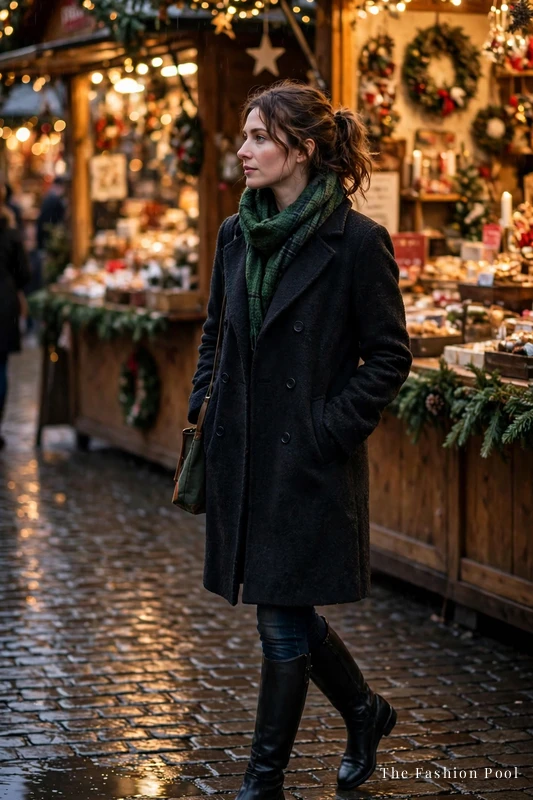
For the taller version, Knee-high boots with jeans is the fit guide — and the boot should stay plain and dark, so the outfit is the only thing the eye follows. A knee-high boot with a market outfit is the cold-weather version of the ankle boot, and the boot is the quiet part of the outfit.
The height of the boot is the last decision, and it is the simplest: ankle boots for a short market, knee-high boots for a long one. The ankle boot is lighter and easier to walk in; the knee-high boot is warmer and covers more leg. The market is a loop, and the loop is long — choose the boot for the loop, not for the photograph.
The sock is the boot’s partner, and the partner matters as much as the boot. A wool sock warms the boot from the inside, and the boot’s warmth is the sock’s warmth as much as the boot’s own. A thin sock in a warm boot is still a cold foot, and a wool sock in a plain boot is a warm foot. The sock should be wool, thick, and plain — and the boot should have room for it, because a tight boot with a thick sock is a boot that pinches, and a pinching boot cuts the loop short.
The bag: hands free for shopping, snacks, and a mug
The bag is the market’s practical piece, and the rule is simple: hands free. The market is a place where the hands are always busy — one hand for the shopping bag, one hand for the snack, one hand for the mug, and that is three hands for two. The bag should be the one thing the hands do not have to hold.
A crossbody bag is the market’s bag: it sits at the hip, it stays out of the way, and it leaves both hands free for the shopping, the snacks, and the mug. A shoulder bag slides off the coat; a tote bag fills the hand that should be holding the mug. The crossbody is the bag that disappears, and the disappearing bag is the one that works.
The size of the bag is the second decision: small enough to forget, big enough for the essentials. The phone, the wallet, the keys, the lipstick — and nothing else. The market has its own bags for the shopping, and the shopping bag is not the outfit’s bag. The outfit’s bag is the small one, the quiet one, the one that stays at the hip while the hands do the work.
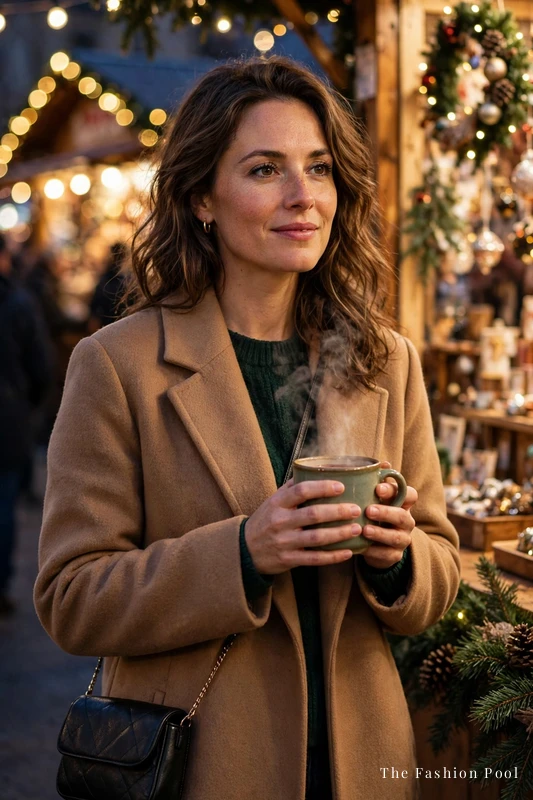
The mug is the market’s own hand-warmer, and the hand-warmer is the reason the hands stay warm. The mug is hot, the hands are cold, and the mug warms the hands while the hands hold the mug. One hand for the mug, one hand for the shopping, and the bag stays at the hip — the crossbody is what keeps the hands free, and the mug is what keeps them warm while they work.
Gloves with a coat are the cold-weather finish — leather gloves, dark, plain — and the gloves are the detail that keeps the hands warm without adding a second pattern. The gloves should be warm enough to hold the mug and thin enough to hold the phone, and the phone should stay in the bag until the photograph.
The photograph: one bright accessory against the lights
The photograph asks the least of the outfit, and the rule is simple: one bright accessory against the lights. The market is already bright — the lights, the stalls, the steam — and the outfit only has to add one bright thing. A red scarf, a burgundy hat, a green glove — one bright touch, and the photograph has its subject.
The bright accessory should be the only bright thing in the outfit. A red scarf with a red coat is two reds, and two reds argue. A red scarf with a camel coat is one red, and one red is the photograph. The accessory is the subject, and the subject should be alone.
The light is the photograph’s own rule, and the rule is dusk. The market’s lights come on at dusk, and dusk is the hour when the lights are brightest against the dark — the photograph’s hour. A photograph taken at dusk has the lights behind the outfit and the dark behind the lights, and the outfit is the bright thing in the middle. A photograph taken in daylight has no lights at all, and the market without its lights is a market without its photograph.
Our faux fur coat guide covers the shape that works over a party dress, and the same shape — one statement piece, everything else quiet — is what to use for a market photograph. The coat is the frame, the accessory is the subject, and the photograph is the two of them together.
The photograph should be taken where the lights are, not where the stalls are. The lights are the market’s own backdrop, and the backdrop does the work — the outfit only has to stand in front of it. One bright touch, one photograph, and the evening is remembered the way it should be.
What not to wear to a market
What not to wear to a market is decided the same way as the market test: by the loop, not by the photograph. The wrong outfit is worse than no outfit at all, because the wrong outfit is the one that sends you home early — and the market notices the outfit that leaves.
Do not wear a heel you cannot walk in: no stiletto, no high block heel, no shoe with a smooth sole. A heel that hurts stops the loop at the first stall, and the loop is the market. Do not wear a coat that does not close: no coat that flaps open in the wind, no coat that leaves the mid layer to the cold. A coat that does not close is not a coat — it is a cape, and a cape is not warm.
Do not wear a bag you have to hold: no tote, no clutch, no bag that fills the hand. A bag that fills the hand is a bag that takes the mug’s hand, and the mug’s hand is the one that holds the evening. Do not wear a white coat: no white, no cream, no pale color that shows every splash. The market ground is wet, the stalls are crowded, and the white coat is the one that comes home dirty.
Frequently asked questions
What should you wear to a Christmas market?
A christmas market outfit that passes the market test: warmth first, walking second, photographs third. Three layers — base, mid, outer — a boot with traction, a crossbody bag, and one bright accessory against the lights.
How do you stay warm at a Christmas market?
Layers, not bulk: a fine knit base, a mid layer that works on its own, and a coat that closes. Three thin layers beat one thick piece, because the three layers trap the air between them — and the air is the warmth. The warmth is in the layers, and the layers are the outfit — not one thick piece, but three thin ones that work together.
What shoes are best for a Christmas market?
A boot with traction first and warmth second: a lugged sole, a low heel, plain and dark. Ankle boots for a short market, knee-high boots for a long one — and never a smooth sole on wet cobbles.
Can you wear a dress to a Christmas market?
Yes — a knit dress with tights and knee-high boots, under a coat that closes. The dress is the mid layer, and the mid layer should be complete on its own, because the coat comes off indoors.
What bag should you take to a Christmas market?
A small crossbody bag: it leaves both hands free for the shopping, the snacks, and the mug. The shopping has its own bags — the outfit’s bag is the small one at the hip.
Is a Christmas market outfit different from a winter outfit?
Yes — the market is a loop you walk, not a room you stand in. A winter outfit has to be warm; a christmas market outfit has to be warm, walkable, and photographable, in that order. The loop decides the outfit, and the photograph comes last.
A christmas market outfit is a loop outfit, and the loop is the market. Warmth first, walking second, photographs third — and the evening lasts as long as the outfit does.