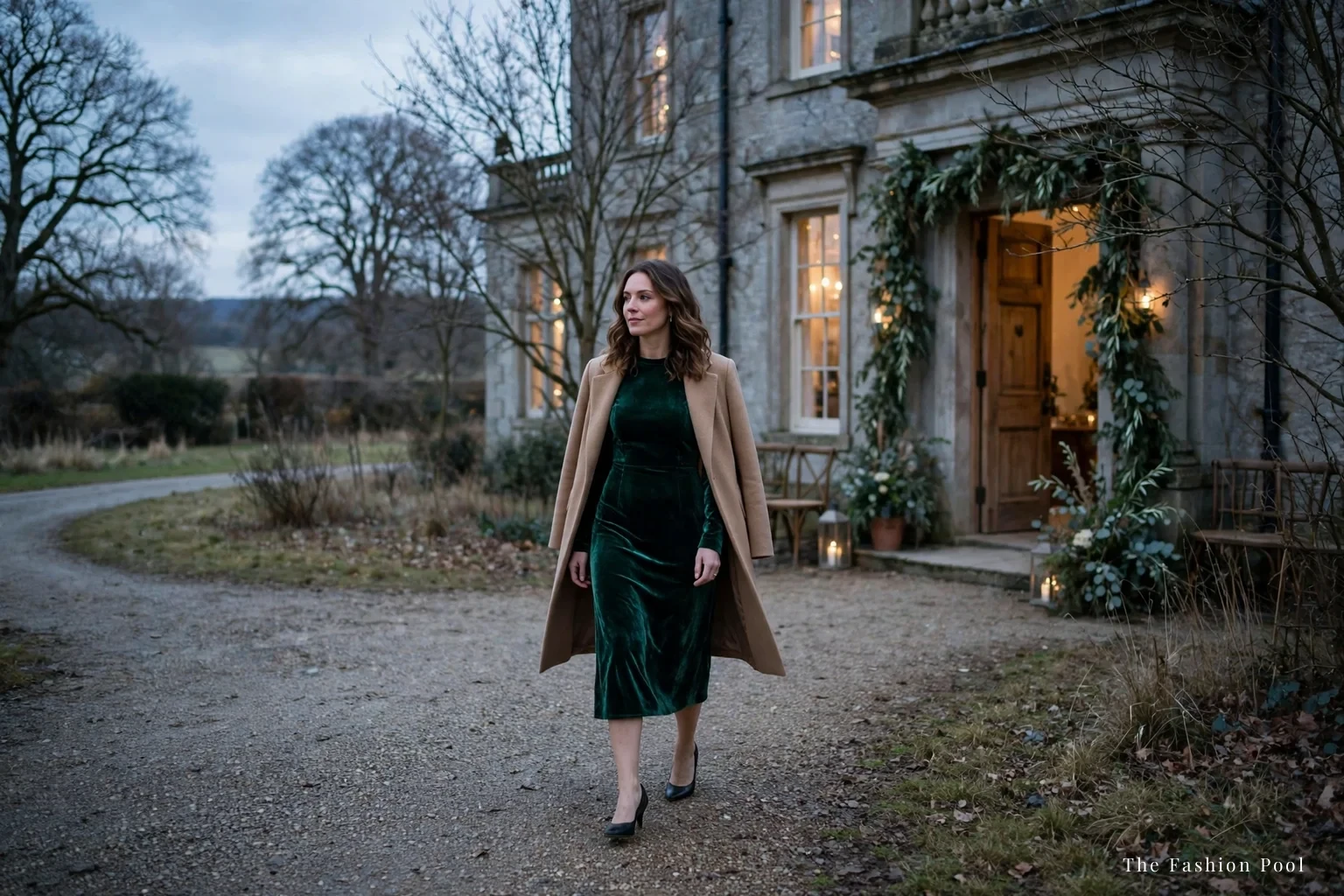
A winter wedding guest outfit has a problem most wedding outfits don’t: it has to look formal in a room heated for dancing and keep you warm on the pavement outside. The ceremony, the photographs, the walk between venues, the drinks in a drafty hall — one outfit, two rooms, and most guests dress for only one of them. This guide works the other way round. Instead of starting with a dress and hoping the weather cooperates, it starts with a five-piece system — dress, warmth layer, legwear, shoes, one accessory — and a decoder that explains what each invitation means in December. Build the five pieces in order and the outfit holds together from the car to the last dance.
The two-room problem
Every winter wedding takes place in two rooms. The first is cold: the pavement outside the venue, the church steps, the garden where the photographs happen, the queue for taxis at midnight. The second is warm: the ceremony room, the dinner, the dance floor. Most wedding-guest advice is written for the warm room only, which is why so many winter wedding outfits fail before the first dance.
The fix is to plan for both rooms in the right order: decide what the outfit looks like in photographs first — the dress above all — then build the warm pieces in order: the layer, the legwear, the shoes, the one accessory, and the coat over everything.
Before you choose anything, find out whether the ceremony is indoors or outdoors, whether there is a coat check, and how much of the day happens outside — two minutes with the couple or the venue’s website decides the whole outfit.
The 5-piece outfit system
The system is five pieces, and only five. Each one has a job, chosen after the one before it. Skip a piece and something fails: no warmth layer and you freeze between venues; no thought to shoes and you spend the evening standing still. Build them in order — each piece narrows the next one.
Piece 1: The dress
The dress sets the formality of everything else, so it comes first. In winter, two things about a dress matter more than the color: the sleeves and the fabric. Long sleeves are worth more than extra length — a long-sleeved velvet midi is warmer than a sleeveless floor-length dress in chiffon, and it photographs as more considered, because the outfit looks finished rather than layered in a hurry.
Fabric is the second decision. Velvet, crepe, heavy satin and wool blends hold their shape in cold air and keep some warmth in. Chiffon, thin silk and linen go limp in the cold and do nothing for you between venues. A lighter fabric can still work — but only with a real warmth layer over it, not hope.
Length is the third decision, and it depends on the dress code more than the weather (the decoder below covers this). A midi dress is the most useful winter length: it shows the shoes, it works with tights, and it doesn’t trail through slush. Floor-length belongs at black tie and is welcome at formal; below that, a midi is the better call.
Piece 2: The warmth layer
The warmth layer is the piece most guests get wrong, because they treat it as something to hide. It isn’t. You will be photographed in it — arriving, leaving, standing outside with the couple — so it has to look like part of the outfit, not something grabbed from the hallway.
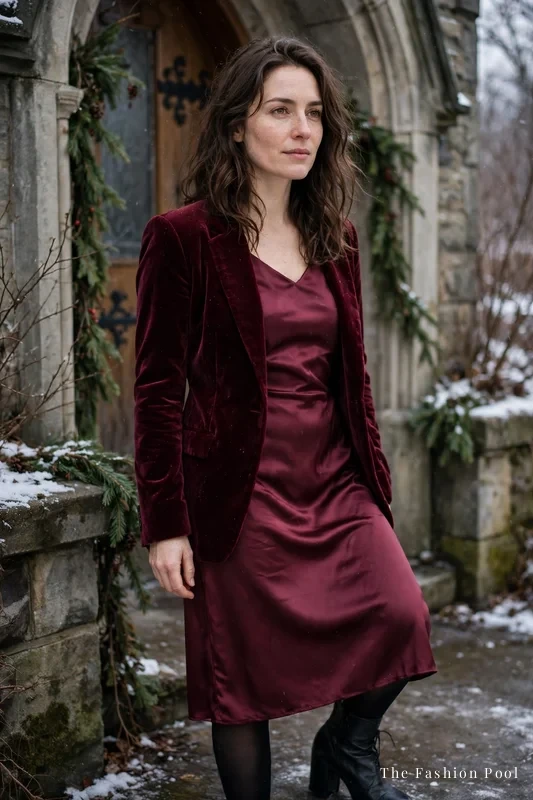
Four versions work at a wedding. A tailored velvet blazer over a slip dress or a satin midi reads as part of the outfit and comes off easily for dancing; it is the most useful version for cocktail and semi-formal dress codes. A soft wrap or pashmina works when the dress is simple — drape it, don’t knot it, and let it be the accessory too. And a structured shawl works over a long-sleeved dress when the evening turns cold. A cropped jacket works over a long-sleeved midi when the dress does the talking and the layer only needs to take the edge off.
What doesn’t work is the office cardigan, the chunky knit, or anything with a hood. They are warm, and they make the outfit look like two different days stitched together. The test is simple: if you’d be happy to be photographed in it, it is a warmth layer. If you’d take it off the moment a camera appears, it isn’t one.
Piece 3: Legwear
Legwear is the quiet hero of a winter wedding outfit: it does the most warming for the least visual effort. Opaque tights in black, navy or deep burgundy are the default — they read as intentional with a midi dress and work with every shoe in this guide. Match the tights to the shoes rather than the dress: black tights with black shoes disappear, while black tights with nude shoes draw a line across the ankle.
For an outdoor ceremony or a long photograph session, fleece-lined tights are worth it; nobody can tell from the outside, and the difference is between enjoying the photographs and enduring them. Skip sheer nude tights in deep winter: they read as bare legs, they warm nothing, and they make the whole outfit look planned for July.
Piece 4: Shoes
Shoes have four jobs at a winter wedding: look right, stay on, handle the ground, and survive the dance floor. Closed-toe heels are the default, and a block heel beats a stiletto for almost every winter venue — it stands on grass, gravel and icy steps without sinking, and it is still comfortable at midnight.
Boots have a place too. Knee-high boots under a long skirt or a midi dress keep the whole leg warm, and they are the right call for a barn, a garden or any venue with ground to cross. If the boots bunch at the knee, the fix is the same as with jeans — our guide to wearing knee-high boots without bunching covers the fit that keeps the line clean. Pack flat shoes for dancing, in your bag or in the car: nobody photographs your feet on the dance floor.
Piece 5: One accessory
One accessory, not five. The dress, the layer and the shoes are already doing the talking, so the accessory’s job is to finish the outfit, not compete with it. Pick the one that suits the dress: statement earrings with a plain neckline, a silk scarf with a simple dress, a small structured bag when the dress has no pockets, or gloves for the walk between venues.
Gloves deserve a note of their own: they are the accessory that actually warms you. Choose a pair that fits the cuff of your coat or your layer — gloves that fit the cuff look deliberate, while gloves that fight the sleeve look borrowed. Whatever you choose, you should be able to take it off indoors without the outfit falling apart. If removing it leaves the outfit unfinished, it was doing too much work.
The dress-code decoder
Invitations use the same words in December as in June, but winter changes what they mean: the “cocktail” that means a bare-shouldered dress in July means sleeves and a layer in December. Here is what each code asks for when it is cold.
Black tie. Floor-length, dark rich colors, closed-toe heels, a proper coat. Velvet and heavy satin read formal after dark; sequins are fine in the evening, too much before it.
Formal. Close to black tie, with one difference: a midi dress is fully at home here, and a floor-length dress is welcome too. Keep the colors dark, the shoes closed-toe, the layer tailored. A long-sleeved midi in a jewel tone is the safest answer.
Cocktail. The most common winter wedding code: a knee-length or midi dress in a richer fabric, sleeves or a real layer, heeled shoes. Cocktail leaves the most room to build warmth in without looking overdressed.
Semi-formal. A midi dress or smart separates, boots acceptable under a long skirt, a wrap or a velvet blazer. Softer is fine, but it is still a wedding — no denim, no trainers.
Casual. The word is a trap in winter: the couple wants you comfortable, not careless — a knit midi dress, tailored trousers with a blouse, smart boots. If you would wear it to run errands, it is not a wedding outfit. Dress one step smarter than you think.
Five outfits for five winter venues
Five complete outfits, each built from the five pieces. Pick the one that matches your venue, then change the color or the fabric — the structure of a winter wedding guest outfit stays the same.
The city ballroom, black tie. Floor-length emerald velvet dress, long sleeves; tailored wool coat over the top; closed-toe heels; one gold cuff; hair up. The coat comes off at the door and the dress does the rest.
The church ceremony with outdoor photographs. Long-sleeved burgundy midi dress; opaque black tights; block-heel ankle boots; a tailored coat covering the hem; leather gloves. Everything here is chosen for the ten minutes outside.
The barn or countryside venue. Long-sleeved navy midi dress; fleece-lined tights; knee-high boots under the skirt; a soft wrap as the layer; a small crossbody as the one accessory. Boots, not heels — the ground decides.
The restaurant or hotel daytime wedding. Knit midi dress in plum; velvet blazer as the warmth layer; opaque tights; heeled ankle boots; simple studs. Daytime means softer colors and less shine.
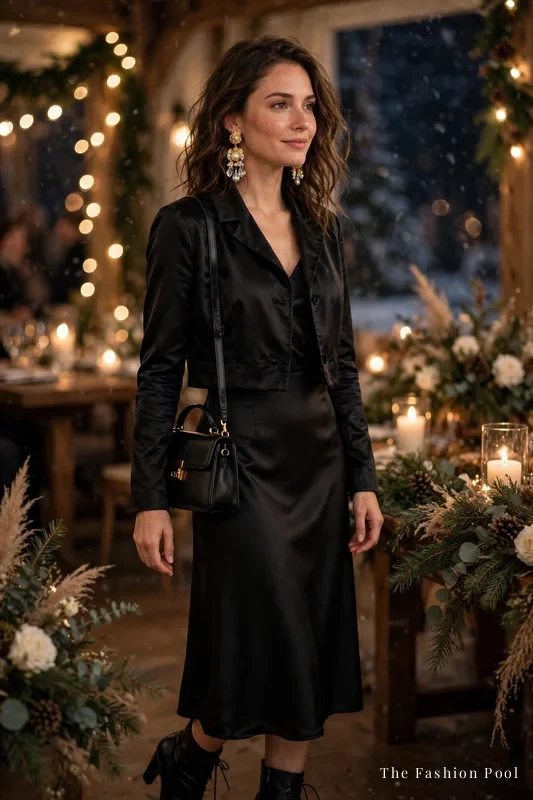
The evening cocktail wedding. Black satin midi, long sleeves; cropped jacket over it; heeled ankle boots; statement earrings. After dark, the shine is the point.
Color and fabric in winter
Winter gives you a palette summer doesn’t: emerald, burgundy, navy, plum, forest green, deep teal. These colors look richer in low light and photograph well against snow and bare trees — worth remembering when the photographs happen outside. Black is fine at a winter wedding: the old rule has faded, and a black dress in the right fabric reads formal, not funereal. It needs something to keep it from looking like work — a texture, a color in the accessory, a shine in the shoe.
What to avoid is simpler: white, ivory and cream in any form, because they read as bridal in photographs even when they don’t in the mirror — and anything pale enough to photograph as white, very light silver or very pale blush, for the same reason. On fabric, velvet is the winter workhorse: warm, holds its shape, catches low light. Crepe holds a clean line and doesn’t crease on the journey. Heavy satin works after dark. Leave chiffon, linen and thin jersey for another season.
The coat
The coat sits outside the five-piece system — outerwear, not part of the outfit — and it is the first thing people see, so choose it with the same care as the dress. It must fit over the dress without crushing it — try the two together at home, not at the venue door — and it should end just below the dress hem — long enough to hide the hem, short enough not to swallow the dress.
A tailored wool coat is the safest choice, and a camel coat is the easiest version: it works over dark dresses without clashing, looks right in photographs, and is warm enough for the walk. Check for a coat check before the day — without one, the coat stays with you all evening. And don’t wear a puffer jacket: even a good one flattens the dress and announces you dressed for the weather, not the wedding.
Hair and makeup that survive the cold
Cold air and heated rooms are hard on hair and makeup in opposite ways: wind undoes loose styles, dry indoor heat fades color. An updo or a low bun holds up better than loose waves and shows the dress’s neckline; if you wear your hair down, pin one side back. For makeup, a slightly stronger lip survives the cold, photographs well, and is the one thing you can refresh in a minute — carry the lipstick, and keep the rest simple.
Mistakes that make a winter wedding outfit fail
- Dressing for the reception and forgetting the arrival: an outfit that works in a heated ballroom and fails on the church steps was planned for one room.
- Bare legs in January: the photograph will show the shiver before the dress.
- A coat that doesn’t fit over the dress, or one so long the dress disappears under it: try them together before the day.
- Stiletto heels on grass, gravel or ice: the ground at a winter wedding is never a dance floor.
- White, ivory or anything that photographs as bridal: the rule hasn’t changed just because it’s December.
- Five accessories competing with the dress: one accessory, chosen on purpose.
- A warmth layer that looks like an afterthought: if you’d take it off the moment a camera appears, it isn’t part of the outfit.
Frequently asked questions
Can I wear black to a winter wedding?
Yes. Black is accepted at most winter weddings now, and a black dress in velvet or heavy satin reads formal rather than funereal. Keep it from looking like work with texture or a shine in the shoe. If the couple asked for bright colors, respect that.
What shoes should I wear to a winter wedding?
Closed-toe heels with a block heel for most venues — they handle grass, gravel and icy steps. Knee-high boots work under a long skirt at a barn or countryside wedding. Pack flats for dancing.
Can I wear a long dress to a winter wedding?
Yes, for black tie and formal a floor-length dress is right. For cocktail or semi-formal, a midi is usually better — a long dress at a casual winter wedding looks overdressed, and it trails through slush.
How do I stay warm at a winter wedding without ruining the outfit?
Build the warmth into the outfit: a real layer (velvet blazer, wrap, structured shawl), opaque or fleece-lined tights, and a coat that fits over the dress. The pieces that warm you should look like part of the outfit, not additions.
What should I wear if the invitation doesn’t state a dress code?
A midi dress with sleeves in a dark, rich color, opaque tights, closed-toe heels and a tailored layer. It sits between cocktail and semi-formal, where most unstated winter dress codes land. When in doubt, ask the couple — it takes a minute.
What coat do I wear over a winter wedding outfit?
A tailored wool coat long enough to cover the dress hem, in a color that works with the dress — camel is the easiest. Try the coat and the dress together at home, and check for a coat check before the day.
Build the five pieces in order, read the dress code for what it means in December, and choose the coat with the same care as the dress. Then the cold is a detail of the day, not the story of it — and the photographs show the outfit you chose, not the weather you endured.