
A brown suede boots outfit works or fails on one decision: the height of the boot. The same brown suede, the same jeans, the same coat — change the boot from ankle to knee-high and the whole outfit changes with it: the leg line, the proportions, the occasion it suits. Get the height right and brown suede looks soft, expensive, and effortless; get it wrong and the outfit fights itself — a boot cutting the leg in the wrong place, a hem meeting the shaft at an awkward point, a silhouette that looks unfinished.
This guide works by height, not by occasion. Four heights — ankle and Chelsea, mid-calf slouch, knee-high, over-the-knee — each with its outfits, hems, and mistakes. Then the tonal-brown wheel, because brown suede demands more thought about color than black leather ever does, and suede care, because a suede boot that isn’t looked after doesn’t last the season.
The height rule
The rule is simple: the boot height sets the leg line, and the leg line sets the outfit. A boot that ends at the ankle shows the most leg and needs the least from the rest of the outfit. A boot that ends at or above the knee hides the most leg and needs the most from it — a hem above the shaft, a coat ending at the right place, a shape that doesn’t fight the boot.
Two checks decide every brown suede boots outfit. First, where does the boot end, and what meets it there? A hem, a bare leg, a tight, a sock — something has to meet the top of the boot, and the meeting point is the whole outfit. Second, how much brown is in the outfit already? Suede is soft and matte and absorbs light; two or three browns in different tones can look rich, but four in the same tone look flat. The height decides the first question. The tonal-brown wheel, later in this guide, decides the second.
One more thing before the heights: suede is not leather. It marks, it stains, it hates rain — and it rewards the person who treats it well. The care section at the end is not optional reading; it is why these boots last more than one winter.
Ankle and Chelsea: the everyday height
Ankle boots and Chelsea boots are the easiest brown suede boots outfit to build, because they ask the least of the rest of the outfit. They end at the ankle, so they work with almost every hem: cropped straight jeans, a midi skirt with a gap of bare leg or tights, tailored trousers that end just above the boot. The leg line stays long because the boot is short, and the outfit stays simple because the boot is quiet.
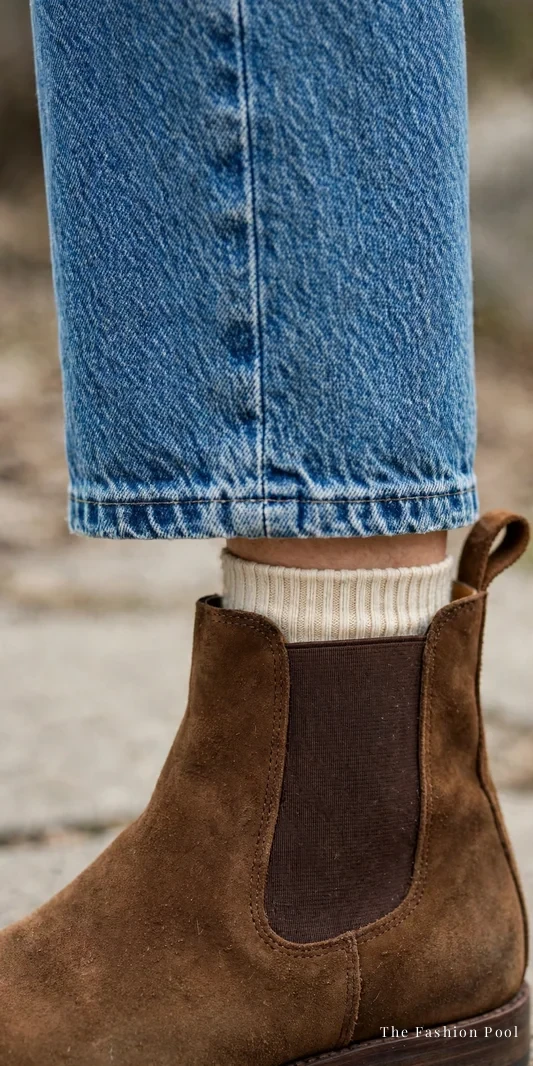
The classic version: brown suede Chelsea boots, straight-leg jeans in a mid-blue or dark wash, a cream knit, a camel coat. Nothing in that outfit competes with anything else — the boots are the warm note, the jeans are the structure, the coat is the frame. It works for the school run, the Saturday market, the walk to the office.
Two details make the difference. First, the gap: between the hem of the jeans and the top of the boot, a finger’s width of ankle or sock is right; a wide gap of bare skin in December looks planned for another season. Second, the sock: a thin ribbed sock in cream or dark brown, just visible above the boot, finishes the leg line and keeps the boot from rubbing. A thick hiking sock bunched at the ankle does the opposite.
Ankle suede boots also take a skirt better than any other height. A suede Chelsea boot under a pleated midi skirt in navy or forest green, with opaque tights, is one of the easiest smart outfits of the season — soft boot, structured skirt, tights tying them together. What doesn’t work is a long skirt that meets the boot at the same point: a maxi hem falling to the ankle hides the boot entirely and leaves a heavy line at the bottom of the outfit.
Mid-calf slouch: the tricky middle
Mid-calf suede boots are the hardest height to wear well, and the most rewarding when they work. They end at the widest part of the calf, exactly where a boot should not end — unless the outfit is built around them. The slouch is the point: a soft suede shaft that folds and wrinkles instead of standing straight. It is a relaxed, bohemian height that needs a relaxed outfit to match.
For mid-calf, the hem must clear the boot by a clear margin. A skirt that ends above the knee, a dress that ends mid-thigh, cropped wide-leg trousers that end above the shaft — anything that leaves a visible stretch of leg or tights between hem and boot. What fails is a hem that ends right at the top of the boot: the two lines meet, the leg looks cut in half, and the outfit looks like a mistake rather than a choice.
The best version is the simplest: slouchy mid-calf suede boots in mid-tan, a knee-length shirt dress or sweater dress in cream or camel, opaque tights in dark brown. The tights matter here more than anywhere — they bridge the gap between hem and boot, and they stop the leg from looking chopped. Bare legs with mid-calf boots only work in early autumn, when the gap reads as deliberate.
Mid-calf suede boots also work with cropped wide-leg jeans, provided the jeans end well above the boot and the leg underneath is covered. The wide leg and the slouchy shaft are both soft shapes, and together they read as relaxed rather than sloppy. Keep the top half fitted: a tucked-in knit, a belt, a velvet blazer as the fitted layer. Two soft shapes on the bottom need one clean shape on top.
Knee-high: the workhorse
Knee-high brown suede boots are the most useful height in this guide, and the most forgiving. They end at or just below the knee, cover the leg, work with skirts and dresses and jeans, and keep you warm. If you buy one pair of brown suede boots, this is the height.
With jeans, the rule is the one our fit guide already covers: the boots go under straight-leg or slim jeans, never over them, and the jeans should fall cleanly to the boot without bunching at the knee. Our guide to wearing knee-high boots with jeans without bunching covers the fit that keeps the line clean — the same fit applies in suede, with one extra note: suede shows every wrinkle, so the jeans need to sit smoothly over the shaft.
With skirts and dresses, knee-high suede boots do the work of tights and shoes in one piece. A suede knee-high boot under a midi skirt in wool or corduroy, with the hem ending just above the boot, is a complete cold-weather outfit — no tights needed on a mild day, opaque tights underneath when it turns cold. The suede softens the whole outfit: where black leather knee-highs can look severe, brown suede reads as warm and approachable.
The one mistake to avoid is the boot that ends exactly at the knee with a skirt that ends exactly at the knee: two lines at the same point, and the leg disappears. The skirt hem should sit clearly above the boot top — a few inches is enough — or clearly below it, with the boot hidden under a long skirt. And keep the coat in proportion: a knee-high boot wants a coat that ends at the knee or below, not a cropped jacket that leaves the outfit in two halves. A camel coat over the whole thing is the easiest version — the tones echo each other without matching exactly.
Over-the-knee: the statement
Over-the-knee brown suede boots are a statement, and they should be worn like one: deliberately, and not every day. They end above the knee, so they need a hem that ends well above them — a mini skirt, a short dress, a long sweater worn as a dress — and a top half that is quiet enough to let the boots do the talking.
The outfit that works is the simplest: over-the-knee suede boots in a deep chocolate brown, a sweater dress in cream or oatmeal that ends mid-thigh, a long coat over the top. The dress is plain, the boots are the event. A faux fur coat over the whole outfit works as the layer — it is festive, it is warm, and it comes off at the door if there is a coat check. What doesn’t work is stacking statements: over-the-knee boots plus a sequin dress plus statement jewelry plus a red lip — four ideas competing, and the photograph will show the competition, not the outfit.
Fit is the whole game with this height. Suede stretches as it warms, so over-the-knee boots that fit snugly in the morning can slip by the afternoon — a boot that slides down and wrinkles at the knee looks tired, not relaxed. Buy them snug, wear thin tights underneath for grip, and check the fit after an hour, not just in the shop mirror. And keep the heel low: a block heel or a flat sole, not a stiletto. Over-the-knee boots in a high heel are an evening look; in a low heel they are a daytime outfit that happens to be dramatic.

The tonal-brown wheel
Brown suede is not one color, and brown-on-brown is not one outfit. The tonal-brown wheel is the simple version: three browns that work together, and one rule about matching them.
The three useful browns are tan, chocolate, and camel. Tan is light and warm, the color of a new suede boot. Chocolate is deep and cool, the color of a boot worn in. Camel is the bridge — lighter than chocolate, warmer than tan. An outfit with two of these browns, in different tones, looks rich: tan boots with a chocolate coat, chocolate boots with a camel coat, camel boots with a chocolate skirt. An outfit with all three works too, provided one of them leads and the others stay quiet.
The rule is about matching, not about variety: never match the boots to the bag, the belt, or the coat in exactly the same brown. Suede and leather in the same shade look like a set, and a set looks dated. A tan suede boot with a chocolate leather bag is right; a tan suede boot with a tan leather bag is a costume. The same applies to the coat: a camel coat over tan suede boots works because the coat is camel and the boots are tan — close, not identical.
The third brown in the outfit should come from the clothes, not the accessories: a chocolate knit, a camel coat, a tan boot — or a tan knit, a chocolate coat, a camel boot. And when in doubt, add a non-brown: cream, navy, forest green, charcoal. Brown suede sits happily next to all of them, and one non-brown in the outfit stops the browns from looking like a uniform.
Suede care: the part that keeps the boots wearable
Suede care is not a chore you do once a year; it is the reason brown suede boots survive more than one winter. Three habits, done regularly, cover almost everything.
First, protect before you wear. A suede protector spray, applied to clean, dry boots before the first wear and reapplied every few weeks, is the most useful thing you can do. It does not make suede waterproof — nothing does — but it stops water from soaking in immediately and gives you time to deal with it. Spray outdoors, let the boots dry completely, and test on a hidden spot first.
Second, brush after every wear. A suede brush — soft bristles, not wire — lifts the nap, removes surface dust, and stops dirt from working into the suede. Brush in one direction, lightly, thirty seconds per boot. It is the difference between suede that looks new in March and tired by December. For scuffs, a suede eraser takes off the mark; for a stain, brush first, then a dedicated suede cleaner — never water on its own, which leaves a ring.
Third, deal with rain and salt properly. If the boots get wet, stuff them with newspaper, let them dry at room temperature, away from radiators and direct heat — heat shrinks suede and stiffens it. Salt stains, the white rings winter leaves on brown suede, come off with a cloth dampened with equal parts water and white vinegar, dabbed, not rubbed, then brushed once dry. And store the boots upright, with a boot tree or rolled newspaper inside, so the shaft doesn’t fold and crease over the summer.
Frequently asked questions
Can I wear brown suede boots in the rain?
Not in heavy rain. Suede absorbs water, and a soaking leaves marks and stiffens the nap even after it dries. A protector spray buys time in a light shower, but it does not make suede waterproof. When rain is forecast, wear leather or rubber boots and save the suede for a dry day.
What color coat goes with brown suede boots?
Camel is the easiest — it works over every brown in this guide without matching any of them exactly. Cream, navy, forest green and charcoal all work too. The one to avoid is a coat in the exact same brown as the boots: suede and wool in identical shades look like a set, and a set looks dated.
Can I wear brown suede boots with black?
Yes, if the black stays small. Black jeans or a black skirt with tan suede boots works because the brown is the warm note and the black is the frame. What fails is a large block of black next to a large block of brown with nothing between them — add cream, navy or camel to bridge them.
Are suede boots warm enough for winter?
Knee-high and over-the-knee suede boots are, especially with opaque tights underneath — they cover the leg and block the wind. Ankle suede boots are less warm and need thick socks and a longer coat. Suede itself is no warmer than leather; the warmth comes from the height and what you wear under it.
How do I clean brown suede boots?
Brush after every wear with a soft suede brush, in one direction. Use a suede eraser for scuffs and suede cleaner for stains — brush first, then clean. Never use water on its own, which leaves a ring, and never dry suede near direct heat. Salt stains come off with a cloth dampened with equal parts water and white vinegar, dabbed, not rubbed.
What jeans go with brown suede boots?
Straight-leg and slim jeans, worn over knee-high boots or ending just above ankle boots. They should fall cleanly without bunching at the knee or the ankle. Wide-leg jeans hide the boot entirely, which wastes the height — save them for leather boots, or wear them cropped so the boot shows.
Start with the height, not the outfit. Ankle for every day, mid-calf for relaxed days, knee-high for the cold ones, over-the-knee for the days you want to be noticed. Keep the browns tonal, never matched, and brush the boots after every wear. Do that, and one pair of brown suede boots carries you through the whole winter.