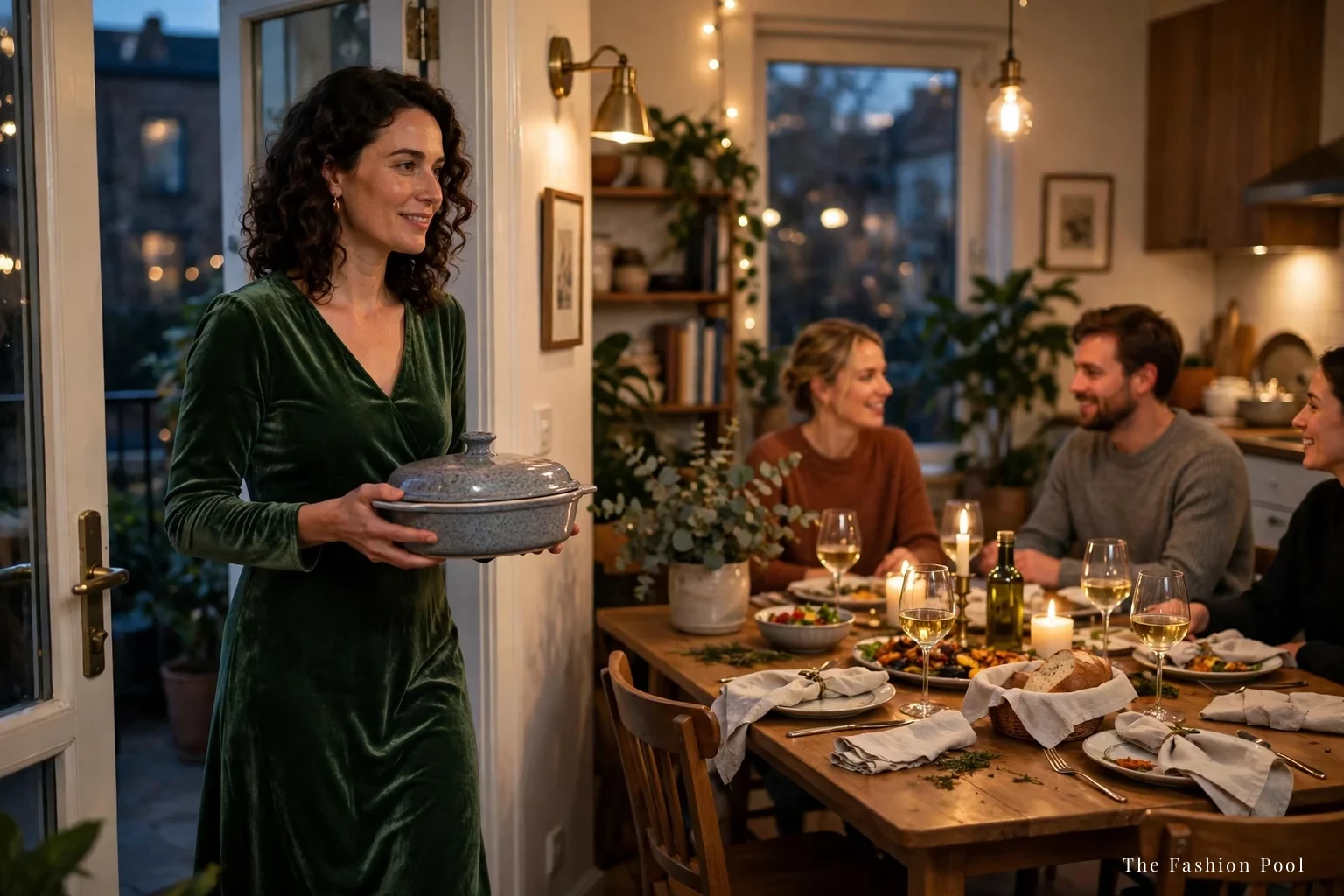
A friendsgiving outfit has a harder job than a Thanksgiving outfit: it has to survive the kitchen, the floor cushions, and the group photo — usually in the same evening, in someone else’s apartment, with no spare room to change. Friendsgiving is the friend-hosted Thanksgiving: a potluck, a crowded living room, everyone cooking and photographing. The outfit that works passes three tests in order: it cooks, it sits, and it photographs. Fail the first and you guard your sleeves all evening; fail the second and you adjust your waistband through dinner; fail the third and the photographs tell the story for years.
This guide is built on that test: first, what makes Friendsgiving different from Thanksgiving; then the three roles — host, dish-bringer, plus-one — with a complete outfit for each; then the three tests in detail. If your outfit passes all three, it is a friendsgiving outfit. If it fails one, change that piece before you leave.
Friendsgiving is not Thanksgiving
Thanksgiving and Friendsgiving share a menu and a month, and almost nothing else about the outfit. Thanksgiving is usually family, a dining table, a house with a spare room, and a host who has cooked all day. Friendsgiving is friends, usually a potluck, usually a small apartment, and everyone arrives carrying something — a dish, a bottle, a dessert that needs oven space. The dress code is looser, the seating is improvisational, and the photographs are the point in a way they aren’t at a family dinner: the group photo is why half the guests dressed up.
That changes the outfit in three ways. First, you are probably cooking or finishing a dish on arrival, so sleeves and fabrics have to survive a kitchen. Second, you are probably sitting somewhere that isn’t a dining chair — a sofa, a floor cushion, a borrowed folding chair — for three hours. Third, the photographs happen constantly, not once: the table before dinner, the group after, the candid shots in the kitchen. An outfit planned for a two-hour family dinner fails at Friendsgiving in the first half hour.
The closest thing the site already has is our Thanksgiving outfits with jeans — denim for the family holiday, including one Friendsgiving jeans idea. This article is the other version: the non-jeans outfits, the roles, and the three-test check. If jeans are your plan, start there.
The cook–sit–photograph test
The test has three parts, in order, and the order matters: an outfit that photographs beautifully but can’t cook is useless at Friendsgiving — you will be in the kitchen before you are in any photograph.
Cook: can you stir, lift a tray out of the oven, and carry a hot dish across a crowded room without the outfit getting in the way? Check the sleeves (do they stay up or fall into the food), the front (does it stain, and can it be covered), and the heat (does the fabric breathe in a kitchen at full temperature). An outfit that passes cook is one you forget you’re wearing while you work.
Sit: can you sit for three hours — at a table, on a sofa, cross-legged on a cushion — and eat a full meal without adjusting anything? Check the waistband (does it dig in after the second helping), the hem (does it ride up or pool on the floor), and the shoes (can you take them off at the door and still feel dressed). An outfit that passes sit still fits after dinner, not just before it.
Photograph: does the outfit read in a photograph taken in warm, low living-room light, from across the room, with five other people in the frame? Check the color (does it register, or wash out), the shine (does it catch the light or glare), and the shape (does the silhouette read at a distance). An outfit that passes photograph is one you are glad to see in the group photo a year later.
Run the test at home before the day: cook in it, sit in it for an hour — long enough to feel the waistband — photograph it in warm light. Fifteen minutes of testing beats an evening of adjusting.
Three roles, three outfits
Every Friendsgiving has the same three roles, and the outfit depends on which you are. The host cooks all day and photographs last. The dish-bringer arrives carrying food and needs both hands free. The plus-one knows the fewest people and needs the outfit to do the introducing. Pick your role first; the outfit follows.
The host
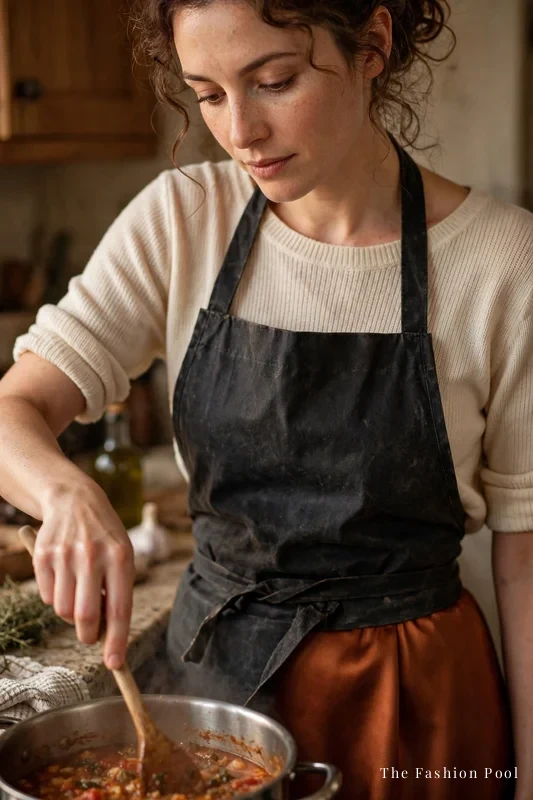
The host’s outfit has to survive a day in the kitchen and still look like the host in the photographs. Start with a base that handles heat and spills: a rust or burgundy midi skirt in satin or a heavy crepe — fabrics that wipe clean and don’t cling in a warm kitchen — with a fine-gauge knit top in cream or charcoal. The knit is the workhorse: finished on its own, layers under anything, and doesn’t trail into the food.
Add an apron for the cooking hours — a half-apron in dark waxed cotton, not a novelty one — and take it off for dinner. It protects the outfit and signals to arriving guests that you are still cooking, which is the truth. Over the top, a velvet blazer for the photographs: it goes on when the cooking stops, and turns the same base into a party outfit in ten seconds.
Shoes: flat loafers or low block-heel ankle boots — you will be on your feet for hours before anyone sits down. Hair: tied back while cooking, re-pinned for dinner. The host’s outfit passes the test when it looks the same at 8 p.m. as it did at 4 p.m., minus the apron.
The dish-bringer
The dish-bringer’s problem is the journey: a hot dish in both hands, a cold walk or drive, a doorway with a dish to hand over — and then, only then, the party. The outfit has to carry, not just dress.
Start with the same principle as the host but with one change: nothing that needs both hands to manage. A forest-green velvet midi dress with long, close-cuffed sleeves is the easiest version — one piece, no tucking, no adjusting, warm enough for the walk. The close cuffs keep the sleeves out of the dish — the dress is the outfit.
Over it, a coat that fits over the dress without crushing it — a camel coat is the easiest version — and shoes you can walk in: block-heel ankle boots, or flats if the dish is heavy. Carry the dish in a tote with a flat base, not balanced on one hand. When you arrive, the coat comes off, the dish goes down, and the dress is the outfit — no change needed.
If a dress isn’t your plan, the trouser version works the same way: dark tailored trousers, a satin blouse in a deep color, and a velvet blazer — pieces borrowed from our casual holiday party formulas, minus the shimmer. Either way: arrive dressed, hands free, nothing to adjust.
The plus-one
The plus-one has the hardest social job and the simplest outfit problem: you know the fewest people, so the outfit has to introduce you before you introduce yourself — and survive an evening of meeting strangers on a sofa that isn’t yours.
The safest version is the most polished of the three: a black satin midi skirt with a fine black knit top, or a navy knit midi dress, with one clear statement — earrings, or a bold lip, not both. The point is to look deliberate without looking dressed-up: a plus-one in a sequin dress reads as overdressed at a potluck, a plus-one in jeans as underdressed. The middle is a dark, clean silhouette with one intentional detail.
Shoes matter more for the plus-one: you will be standing while others sit. Low block heels or polished loafers: comfortable enough to stand in, neat enough for the photographs. Carry a small crossbody bag, not a tote you set down and lose track of. The plus-one’s outfit passes the test when you stop thinking about it by the second conversation.
Cooking in the outfit
Cooking is the test most Friendsgiving outfits fail first, because most outfits are chosen in front of a mirror, not a stove. The rules are about the sleeves, the front, and the heat.
Sleeves: push them up and they must stay up. A fine knit with a close cuff stays; a wide, flowing sleeve falls into the food when you reach for a pan. If the sleeves won’t stay up on their own, the outfit fails the cook test. Roll them to the elbow before you start, and check they stay there while you stir.
The front: assume something will spill. Dark colors and busy textures hide a splash; pale satin shows it across the room. Wear the apron while cooking and take it off for dinner, and choose fabrics that wipe clean: satin and heavy crepe wipe; linen and raw silk stain. An apron in dark waxed cotton is the cheapest insurance in the whole outfit.
Heat: a Friendsgiving kitchen runs hot — oven, stove, a dozen people in a small room. A heavy sweater that felt right in the shop will feel wrong by the time the turkey comes out. Plan the indoor outfit first, then add the layer for the journey: a fine knit is enough indoors; the blazer and coat are for arriving and photographs, not cooking.
Sitting for three hours
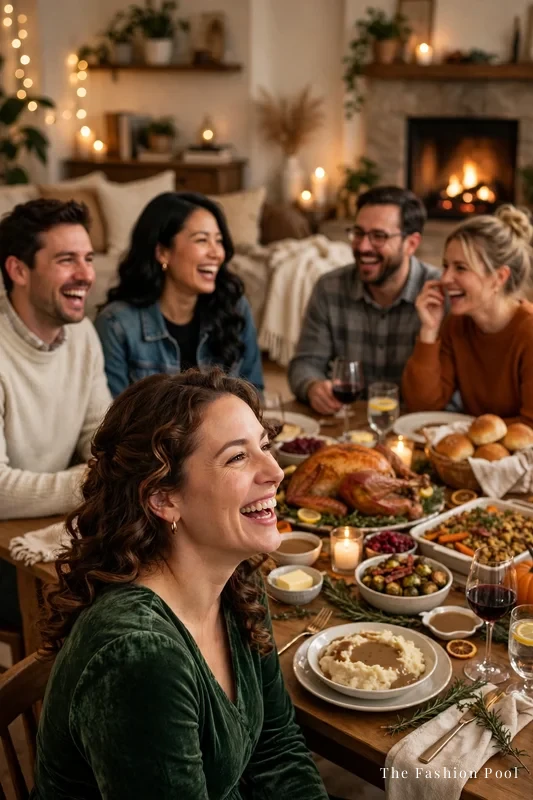
Friendsgiving dinner can run longer than Thanksgiving dinner, because nobody has to drive home to family and nobody is in a hurry. Three hours at a table, on a sofa, or on the floor — and the outfit has to hold up through all of it, second helping included.
The waistband is the first check. A rigid waistband that fit at 6 p.m. will dig in by 8 p.m. — the fix is ease: an elasticated back, a wrap waist, or a dress with no waistband at all. Try the outfit after a large meal at home: sit in it, eat in it, and see whether anything pulls or digs. If it does, change the waist, not the outfit.
The hem is the second check. A midi skirt that looks perfect standing can ride up on a low sofa or pool on the floor cross-legged. Sit on the floor in it at home and check where the hem goes. A dress that needs constant smoothing fails the sit test.
The shoes are the third check: if the host asks for shoes off at the door, your socks or tights are part of the outfit. Wear clean ones that coordinate, and choose shoes you can slip off and on without a struggle. An outfit that only works with the shoes on fails in a shoes-off home.
Photographing well
At Friendsgiving, the photographs are not an afterthought — they are half the event. The group photo, the table before dinner, the candid shots in the kitchen: your outfit will be photographed more in one evening than in most months. Three things decide whether it reads.
Color first: warm, low living-room light flattens pale colors and rewards deep ones. Burgundy, forest green, navy, plum and rust register from across the room; pale blush and cream wash out under warm bulbs. Black reads well if the fabric has texture — velvet, satin, a knit with a visible weave — and as a shadow if it doesn’t. If the color disappears in a photograph taken across the room, it is the wrong color for the room.
Shine second: a little shine photographs beautifully — satin, a metallic thread, a velvet nap catching the light. Too much shine flares: sequins under a camera flash turn white, and a full sequin outfit becomes a bright blur with a person inside it. One shining piece, the rest quiet — the same rule as at the office party.
Shape third: the silhouette has to read at a distance, in a group of five. A clean line — a midi dress, a defined waist, a blazer over a simple base — reads. A complicated outfit with three layers and two patterns blurs into noise. If you can’t describe the outfit in one sentence, the photograph won’t describe it either.
The arrival and the coat
The arrival is the one moment the outfit is judged on its own: the door opens, the dish is handed over, and the coat comes off. Two things matter: the coat fits over the outfit without crushing it, and the outfit underneath is complete the moment the coat comes off.
Try the coat and the outfit together at home, and make sure the dress hem doesn’t catch under the coat and the blazer doesn’t bunch at the shoulders. A camel coat over a dark dress is the easiest version, and it photographs well at the door. Without a coat check, hang the coat somewhere deliberate — not draped over a chair in the photographs.
Three looks that fail the test
Some outfits fail the test in ways obvious only after the fact:
The white shirt. Crisp at the door, stained by the first course, and photographed as the spill for the rest of the evening. Save white for a dinner where you aren’t cooking.
The bodycon dress. It photographs well standing and fails the moment you sit — it rides up, pulls, and needs adjusting every ten minutes. A potluck is not a standing party.
The full sequin outfit. It flares under flash, sheds onto the sofa, and reads as a costume where everyone else is in knits and velvet. One shining piece is festive; a whole shining outfit is a different event.
Frequently asked questions
What should I wear to Friendsgiving as a guest?
A dark midi dress or tailored trousers with a polished top, in a fabric that survives cooking and sitting. One statement detail, comfortable shoes — and run the cook–sit–photograph test before the day.
Can I wear jeans to Friendsgiving?
Yes, if the gathering is casual — dark straight-leg jeans with a satin blouse or a velvet blazer read as intentional. Our Thanksgiving outfits with jeans cover the denim version, including a Friendsgiving jeans idea. Ripped or light-wash jeans read as too casual for most Friendsgivings.
What should the host wear to Friendsgiving?
A base that handles the kitchen — a midi skirt and fine knit, or a long-sleeved dress — plus an apron while cooking and a velvet blazer for dinner and photographs. Flat shoes or low block heels: you will be on your feet for hours.
Is Friendsgiving formal or casual?
Neither, and both: friend-formal. Dressier than a weeknight dinner, more relaxed than a family Thanksgiving. A midi dress or smart separates, one polished detail, no ballgown and no athleisure.
What colors photograph best at Friendsgiving?
Deep, warm colors: burgundy, forest green, navy, plum, rust. They register in warm living-room light; pale colors wash out, and white reads as the spill.
Can I wear a dress to Friendsgiving if I’ll be cooking?
Yes, if the sleeves stay up and the fabric wipes clean — a long-sleeved velvet or heavy-crepe midi with an apron over it. Avoid wide sleeves, pale satin, and anything that trails.
Run the test before you leave: cook in it, sit in it, photograph it. If it passes all three, it is a friendsgiving outfit — and the photographs will show the evening, not the outfit you fought.