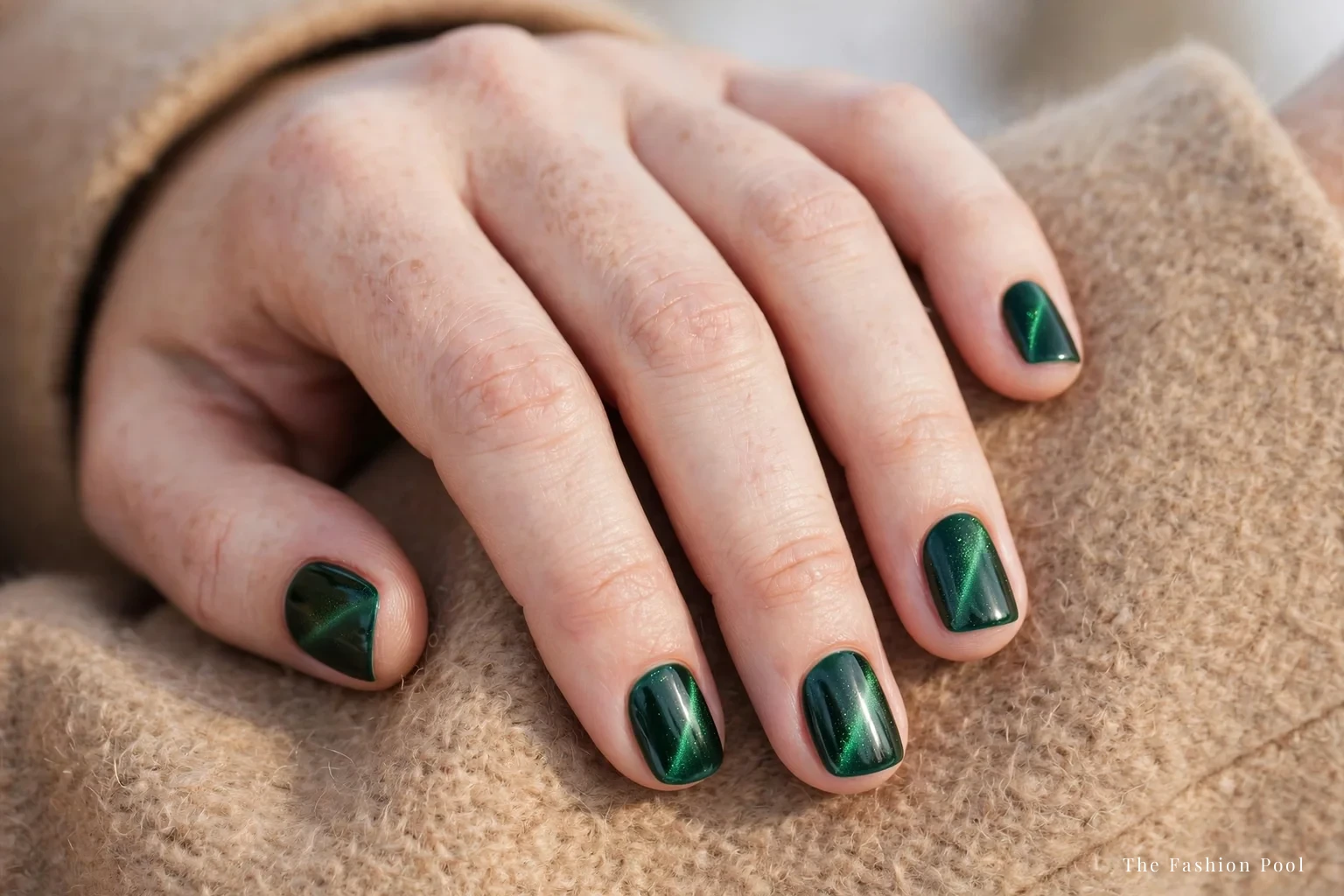
Short winter nail designs work best when the finish does the work. On a short nail there is no room for a painted scene or a long gradient — what you see is the finish itself: the magnetic shimmer of cat-eye, the mirror shine of chrome, the soft glow of velvet. Get the finish right and a short nail looks deliberate; get it wrong and the same nail looks flat, no matter how neat the manicure.
This guide is organized by finish, not by color: what cat-eye, chrome and velvet are and how they differ, each finish, then six short winter nail designs to take to the salon, plus shape, aftercare and outfit pairing.
Why short nails suit winter finishes
Short nails and statement finishes are a better match than long nails and statement finishes, and the reason is proportion. On a long nail, a strong finish competes with the length — the eye reads the shape first and the finish second. On a short nail, the finish is the whole design: a small, clean surface, and a magnetic shimmer or a mirror shine has nowhere to hide. That is why cat-eye, chrome and velvet all look at their best on short nails.
Short nails also survive winter better. Long nails chip at the corners, catch on knitwear and break on coat zippers; short nails flex less, snag less, and hold a gel finish longer. If your nails are short because they break, because you type all day, or because you simply prefer them that way, winter rewards you for it.
The three finishes, compared
Cat-eye, chrome and velvet all shimmer, but they are three different effects made three different ways.
Cat-eye is a magnetic gel polish: tiny metal particles in the polish are pulled into a line by a magnet held over the wet nail, leaving a band of light that moves when you tilt your hand. Dark green reads as malachite, dark blue as sapphire. On a short nail the stripe is the design, so the color underneath should be deep enough to make it stand out.
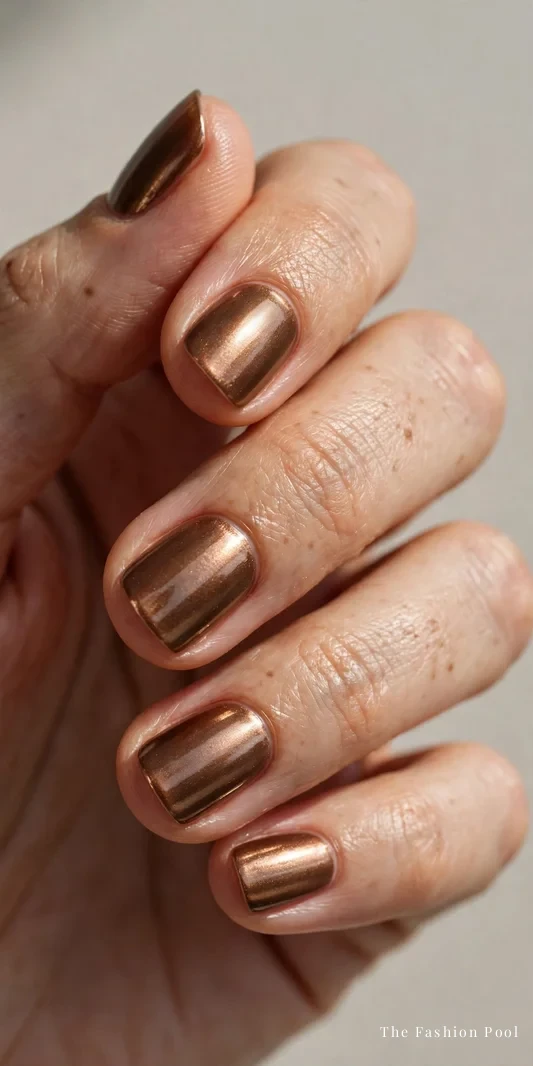
Chrome is a powder, not a polish: the tech cures a base color, rubs a fine metallic powder over the nail until it turns into a mirror, and seals it with top coat. The result is a solid reflective surface — silver, gold, rose-gold, or a colored chrome like brown or burgundy. Chrome is the boldest of the three, and it shows every ridge, so the nail underneath has to be smooth.
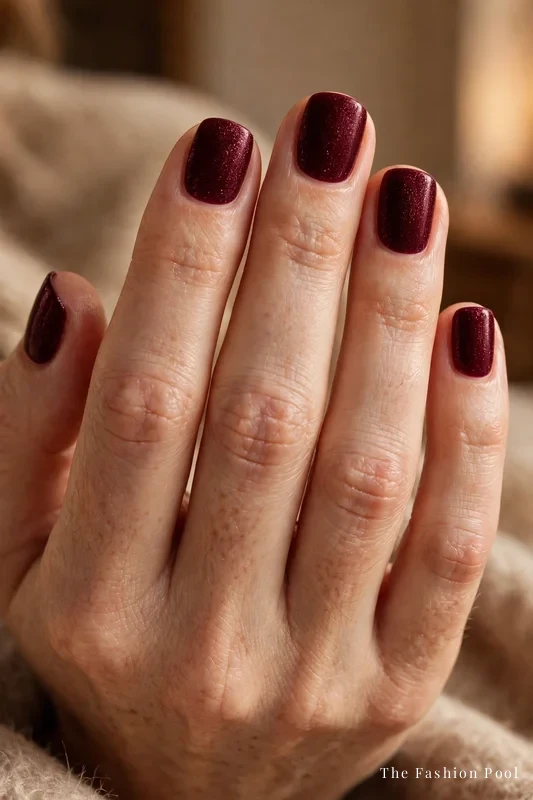
Velvet is the softest of the three: a magnetic polish like cat-eye, but the magnet is held further away, so the particles spread into a fine, even shimmer instead of a sharp line. The result looks like crushed velvet — a deep color with a soft glow and no hard edge. It is the most forgiving finish on a short nail: it hides small ridges and looks good in low light.
The quick way to choose: cat-eye for depth and movement, chrome for shine and impact, velvet for richness without drama.
Cat-eye on short nails
Cat-eye is the finish doing the most work in winter nails right now — Pinterest Trends shows “cat eye fall nails” up 20% month-on-month and “fall cat eye nail designs” up 10% (source: https://trends.pinterest.com, US, signed-out overview, checked 15 Nov 2026). It looks like jewelry, and it changes as you move your hand.
The colors that work best are deep ones: deep emerald, dark sapphire, charcoal, burgundy and near-black plum. Cat-eye needs darkness behind the stripe, or the stripe disappears; pale or pastel cat-eye looks washed out. On a short nail, the stripe should run down the center or diagonally — a centered stripe lengthens the look of the nail.
What to ask for: “a magnetic cat-eye gel in deep emerald, with the magnet held to make a centered stripe, on a short squoval shape.” Ask to see the magnet pattern before the top coat goes on — once cured, the pattern is fixed, and an off-center stripe will bother you for three weeks.
Where cat-eye goes wrong is the base: too light, and the stripe has nothing to stand against; magnet too close, and the stripe becomes a hard white line instead of a soft band of light. Both are fixable before curing. Cat-eye also suits a shorter nail better than a longer one, because the stripe has less distance to travel and stays sharp.
Chrome on short nails
Chrome is the loudest of the three finishes, and on a short nail the most practical: a mirror surface needs no length to make an impression. Pinterest Trends shows “brown nails with chrome” up 6% month-on-month (source: https://trends.pinterest.com, US, signed-out overview, checked 15 Nov 2026) — brown chrome is the winter version, warmer and easier to wear than silver.
The base color decides what the chrome looks like, because the powder is semi-transparent: a black base gives mirror silver, a brown base gives warm bronze-brown chrome, a burgundy base gives a deep wine mirror. For a first chrome manicure, a brown or burgundy base is safer — it reads as a color, not a mirror.
What to ask for: “a brown chrome powder over a dark brown gel base, sealed with a no-wipe top coat, on short squoval nails.” Sealing matters: without a proper top coat, chrome rubs off at the tips within days. Ask the tech to cap the free edge — paint the top coat over the very tip — which keeps the chrome sealed where it wears fastest.
Chrome shows the nail underneath, so preparation matters more than with the other finishes: ridges or an uneven base will show through the mirror. A good tech will smooth the nail and apply a ridge-filling base first — if your nails are ridged, ask for that step by name.
Velvet on short nails
Velvet is the quiet one of the three, and on short nails often the best-looking. It is made like cat-eye — a magnetic polish, the magnet held further away so the particles spread into a soft, even shimmer — but the effect is different: no stripe, no mirror, just a deep color with a glow that moves softly when the light changes.
The colors that suit velvet are the same deep winter palette as cat-eye: burgundy, plum, forest green, navy, charcoal. Velvet burgundy is the classic — rich in daylight, almost black in the evening, the most versatile of the six designs here. Velvet also looks best on a very short nail, because the soft shimmer doesn’t need length to read.
What to ask for: “a velvet magnetic polish in burgundy, magnet held at a distance for a soft, even shimmer, on a short squoval shape.” The magnet distance is the whole technique — held close, the polish becomes cat-eye; held far, it becomes velvet. A hard stripe means the magnet was too close, and it can be redone before curing.
Velvet is the most forgiving of the three: it hides small ridges, doesn’t show tip wear as quickly as chrome, and looks good in the low light of December. If you can only try one finish, try velvet first.
Six designs to ask for
Six designs, each one a finish plus a color — the last pairs two finishes — with the exact words to use at the salon. Every design here is finish-led, and all of them work on short nails.
- Deep emerald cat-eye. A dark green magnetic polish with a centered stripe, on a short squoval nail. Ask for “deep emerald cat-eye, centered stripe.” It looks like malachite and pairs with everything dark in a winter wardrobe.
- Brown chrome. The trending one — “brown nails with chrome” is up 6% month-on-month on Pinterest Trends (source: https://trends.pinterest.com, US, signed-out overview, checked 15 Nov 2026). A dark brown base with bronze-brown chrome powder over it. Ask for “brown chrome over a dark brown base.” The warmest chrome, and the easiest to wear with brown and camel.
- Burgundy velvet. A deep wine magnetic polish with the magnet held far for a soft, even glow. Ask for “burgundy velvet, soft shimmer, no stripe.” The most versatile design here — a color in daylight, a finish in the evening.
- Charcoal cat-eye. Near-black with a silver magnetic stripe, on a short squoval nail. Ask for “charcoal cat-eye, diagonal stripe.” The diagonal stripe makes a short nail look longer. The darkest design in the set, and the one that looks most like jewelry.
- Rose-gold chrome. A warm metallic chrome over a dusty pink-brown base — softer than silver, warmer than gold. Ask for “rose-gold chrome over a warm nude-brown base.”
- Navy velvet with one chrome accent. Nine nails in navy velvet, one accent nail — the ring finger — in silver chrome. Ask for “navy velvet with a silver chrome accent on the ring finger.” The accent gives the set a focal point without making the whole manicure loud — the easiest way to try chrome.
Each is complete on its own — no extra art, no stickers, no gems. On a short nail, the finish is the decoration.
Shape and length: what to ask for
The finishes here were chosen for short nails, but “short” covers three shapes, and the shape changes how the finish reads.
Squoval — square with softened corners — is the best all-round shape for these finishes. It gives the nail a clean edge for the cat-eye stripe, and it is the strongest shape: softened corners don’t catch and break. Ask for squoval if you are unsure.
Almond — tapered with a rounded point — makes a short nail look longer, because the eye follows the taper. It suits cat-eye best, because the taper draws the eye along the stripe. Almond is weaker at the tip than squoval, so it breaks more easily on thin short nails.
Round — the natural shape, following the fingertip — is the shortest-looking shape and the strongest. It suits velvet best, and it is the right choice if your nails break easily or you work with your hands.
Length is simpler: the free edge — the white part past the fingertip — should be about 1–2 millimetres. Longer than that and the finishes compete with the length; shorter and the nail looks bitten rather than shaped. Ask the tech to keep all ten nails the same length — uneven lengths are the first thing the eye notices, before any finish.
Making it last through December
A gel finish on short nails should last two to three weeks, and the difference between two and three is almost entirely aftercare.
Wear gloves for washing up, cleaning and anything involving water or chemicals — water lifts gel from the free edge, where short nails wear first. Cuticle oil once a day is the single most useful product: it keeps the skin around the nail flexible, which stops the gel lifting at the cuticle. Apply it at night, when it has hours to sink in.
Do not use your nails as tools: opening cans, scraping labels and prying at packaging all chip the free edge, and a chip on a chrome nail shows immediately. Keep a short file in your bag and smooth a rough edge the moment it appears — a smoothed edge lasts, a rough one catches and peels.
When the finish grows out, book the removal with the salon. Soak-off removal takes fifteen minutes and leaves the nail intact; peeling takes seconds and takes layers of nail with it. Short nails have less to spare, and a peeled nail takes weeks to recover — longer than the manicure lasted.
What to wear them with
Emerald cat-eye and charcoal cat-eye sit naturally with a camel coat — the green reads against the warm camel without clashing, because the coat is warm and the nail is cool. Brown chrome belongs with brown and camel tones: the same family as the coat, so it reads as part of the outfit.
Burgundy velvet and navy velvet pair with the season’s evening fabrics: a velvet blazer over a dark dress with burgundy velvet nails is the whole outfit in two pieces. Rose-gold chrome works with the same blazer in reverse — the metal in the nail picks up the warmth of the fabric.
For the coldest days, a cream faux fur coat with any of the six designs works, because the coat is neutral and the nails carry the color; a pair of gloves keeps both the hands and the manicure warm. The rule to remember: one strong color besides the nails is enough. If the coat is the statement, keep the nails deep and quiet — velvet, not chrome. If the outfit is plain, the nails can be the statement — chrome or cat-eye.
Frequently asked questions
Do cat-eye nails work on short nails?
Yes — cat-eye works better on short nails than on long ones, because the magnetic stripe stays sharp over a shorter distance. Choose a deep color (emerald, charcoal, burgundy) so the stripe has darkness to stand against, and ask for a centered or diagonal stripe.
How long does chrome last on short nails?
Two to three weeks with a proper gel application and a sealed top coat — usually longer on short nails, because the free edge takes less punishment. Ask the tech to cap the free edge with top coat, wear gloves for washing up, and book a soak-off removal instead of peeling it off.
What is the difference between velvet and cat-eye nails?
Both use magnetic polish, but the magnet is held at different distances. Held close, the particles form a sharp stripe — cat-eye. Held further away, they spread into a soft, even shimmer — velvet. Velvet has no hard line; cat-eye has a band of light that moves when you tilt your hand.
Can I do cat-eye or velvet nails at home?
Yes, with a magnetic gel polish and a magnet — but the magnet distance decides whether you get cat-eye or velvet, and the pattern sets the moment the polish cures. Practice on one nail first, and cure each nail separately. A salon visit is worth it for a first try.
Which winter nail finish is best for fair skin?
Velvet burgundy and rose-gold chrome are the safest: the warmth stops them reading as cold against fair skin. Avoid a full silver chrome manicure on very fair skin — a single silver chrome accent nail is fine — and choose a deep cat-eye (emerald or charcoal) over a pale one, which can look washed out.
Do short nails need a different shape for these finishes?
Squoval suits all three finishes and is the strongest shape. Almond makes a short nail look longer and suits cat-eye best. Round suits velvet best. Keep the free edge to 1–2 millimetres and all ten nails the same length — uneven lengths show before any finish does.
The finish is the design on a short nail — cat-eye for depth, chrome for shine, velvet for richness. Pick the finish first, the color second, and the shape to suit your hands, and the short nail stops being a compromise and starts being the point.