A men’s holiday party outfit is one decision, not ten. The decision is which single festive element the outfit carries — a velvet jacket, a roll neck, a bold knit, one shining detail — and everything else stays quiet. The mistake is trying to carry three: the sequin jacket, the patterned shirt, the statement shoes, all at once, in an outfit that looks like a costume by the second glass.
This guide works from one rule: one festive element per outfit. Pick it first, build a quiet outfit around it, and the party is dressed. Three elements, three outfits, one rule.
The one festive element rule
The rule is simple: an outfit can carry one festive element. The element is the one thing that says “party” — velvet, shine, a bold color, a striking texture — and everything else in the outfit is plain, dark, and well fitted. The moment a second festive element joins, the outfit stops reading as dressed up and starts reading as dressed in costume.
Think of it as a budget. The velvet jacket spends the budget, so the shirt is plain white or black, the trousers are dark and straight, the shoes are simple. The roll neck spends the budget, so the jacket is a plain dark blazer and the trousers are quiet. The knit spends the budget, so the rest of the outfit is the plainest version of itself.
The mirror test: stand back and ask what the eye lands on first. If it lands on one thing — the jacket, the knit, the color — the rule is working. If it lands on three things at once, two of them have to go. The outfit should have one answer to the question “what is the festive part?”, not three.
There is one exception, and it proves the rule. A pocket square in the same family as the festive element — a burgundy square with a burgundy velvet jacket — does not count as a second element, because it echoes the first rather than competing with it. A pocket square in a different color or pattern does count, and it breaks the rule.
The rule also answers the question men actually ask, which is how dressed up to be. The answer is not a dress code — it is the element. A velvet jacket is dressed up. A smart knit is dressed down. The same plain trousers and the same dark shoes work for both, and the element is what sets the level.
The velvet jacket: December’s most useful statement
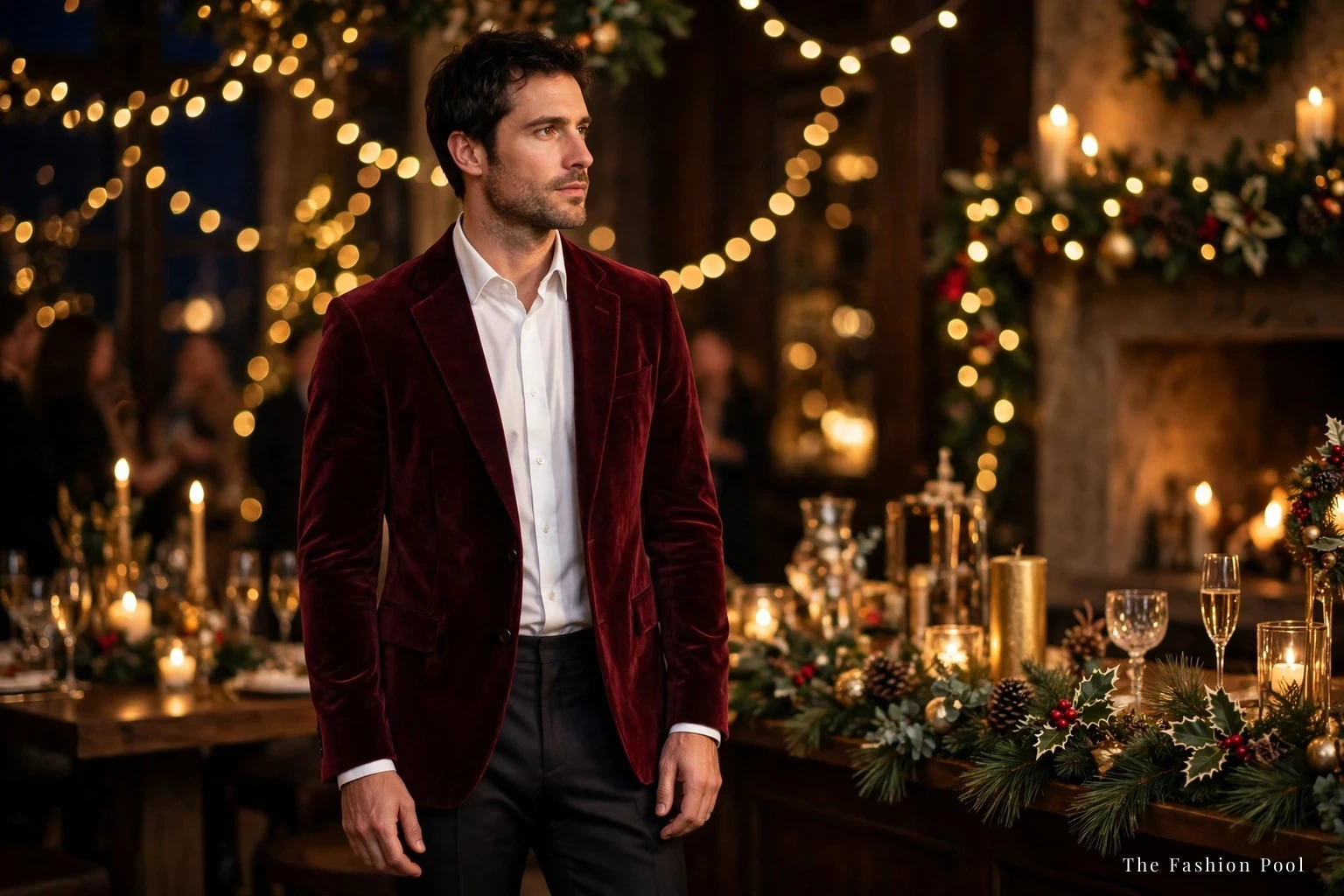
The velvet jacket is the strongest festive element a man can wear, and the most useful, because it does the party’s work on its own: the jacket is the outfit, and everything underneath can be plain.
Choose it in burgundy or dark green for the classic version, or black for the quieter one. Burgundy is the most festive — it reads as Christmas without a single decoration — and it works with a white shirt, a black roll neck, or a plain dark crew neck for a casual party. Black velvet is the safer choice for an office party: it looks like a dinner jacket in a photograph and does not shout in a meeting room the next morning.
Fit matters more here than anywhere else in the guide, because velvet shows every mistake. The shoulders should sit at the shoulders — not drooping, not pulling. The sleeves should show a half-inch of shirt cuff, or end at the wrist over a roll neck. The body should close without pulling at the button. A velvet jacket that is too big looks like a costume; one that is too small looks like a rental.
The shirt underneath is the second decision, and it should be the plainest shirt you own. A white shirt with the top button undone is the classic — the open collar is the party, and the jacket does the rest. A black shirt is the sharper version, and it works when the jacket is burgundy or green. A patterned shirt is the wrong choice: the pattern fights the velvet, and the jacket loses.
Wear it with dark straight trousers and plain dark shoes — loafers for a cocktail party, clean leather shoes for the office version. Our velvet blazer guide covers the shape that works over a dress, and the same shape — structured shoulder, clean lapel, no bulk — is what to look for in the men’s version.
The velvet jacket is also the most photographed festive element, which is the point: in a room full of dark suits, the man in velvet is the one the camera finds. That is the element doing its job.
The roll neck instead of shirt and tie
The roll neck is the easiest festive element, and the one most men already own: a dark roll neck under a plain jacket replaces the shirt and tie entirely, and the outfit gets warmer, simpler, and better looking in the process.
It works because it removes a decision. A shirt and tie need matching — the tie has to work with the shirt, the shirt with the jacket, the jacket with the trousers — and every match is a chance to get it wrong. A roll neck needs nothing matched: a black roll neck under a charcoal blazer, a burgundy roll neck under a navy jacket, a cream roll neck under a dark coat. The neckline is the detail, and the detail is enough.
The color rule: the roll neck should be the darkest thing in the outfit, or the one color in it. A black roll neck with a charcoal blazer and dark trousers is the monochrome version — quiet, sharp, and impossible to get wrong. A burgundy roll neck with a navy blazer is the festive version — one color, one element, everything else dark.
The fit rule: the roll neck should be close, not tight. It should sit against the neck without choking it, and against the chest without pulling. A loose roll neck bunches under a jacket and ruins the line; a tight one shows every breath. Try it with the jacket on, not without — the jacket is what the outfit is judged by, and the roll neck has to work underneath it.
This is the right element for the office party, where a velvet jacket might be too much and a shirt and tie feel like a workday. The roll neck says the evening is different from the day without saying it loudly.

The smart knit: office and casual parties
The smart knit is the festive element for the parties that are not formal — the office drinks, the casual gathering, the friend’s house — where a jacket would be too much and a T-shirt would be too little.
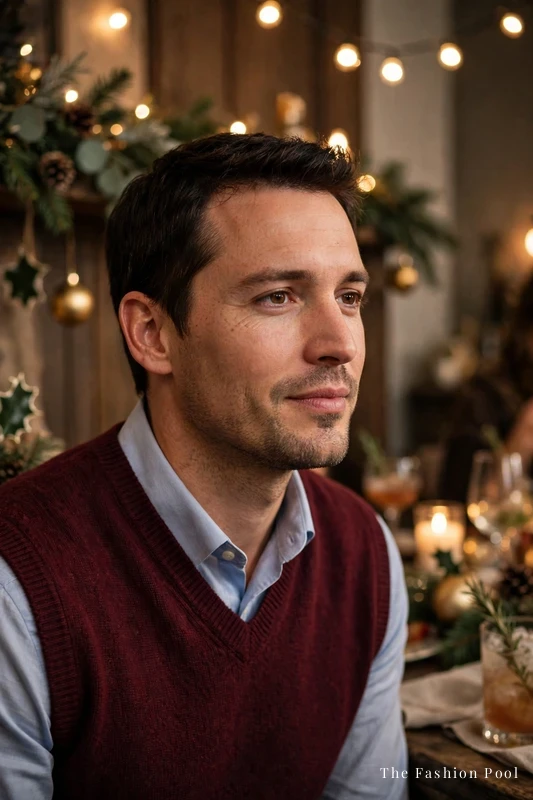
The knit should be a sweater vest, a fine crew neck, or a quarter-zip — never a chunky cable or a novelty pattern. A sweater vest over a collared shirt is the classic version: the shirt collar and the vest’s V-neck give the outfit a shape, and the vest is warm enough to be the outer layer indoors. A fine crew neck in a dark color, over a collared shirt with the collar out, is the simpler version. A quarter-zip in dark green or navy, worn on its own, is the most casual of the three.
The color rule is the same as the roll neck: one color, everything else dark. A burgundy knit with dark trousers, a dark green knit with charcoal trousers, a navy knit with black trousers. The knit is the element — the color is what makes it festive, not a pattern or a logo.
Layering is the practical part. The knit goes over a collared shirt, not a T-shirt — the collar is what makes it smart, and without it the outfit is a sweater and trousers, which is a weekend, not a party. The quarter-zip is the one exception: it is cut to be worn on its own, and the zip is the detail that makes it smart. An overshirt over the knit is the cold-weather version, and it works because the overshirt is plain and the knit carries the color.
This is the outfit for the man who hates dressing up, because it barely is dressing up: a knit, a shirt, dark trousers, clean shoes. The festive element is the color, and the color is doing all the work.
Shoes and the coat: seen first and last
Shoes and the coat bookend the evening: the coat is what the doorway sees, the shoes are what the floor sees, and neither one gets a second chance. They are not the festive element, but they decide whether the element reads as deliberate or as an accident.
Shoes first. The rule is plain and dark: black leather shoes for the formal version, dark loafers for the cocktail version, clean dark boots for the casual version. White sneakers are the one thing that breaks the outfit — they turn a velvet jacket into a costume and a smart knit into a weekend. If the party is a walk from the car, wear the boots for the walk and change into the shoes inside; the shoes go in the bag, not on the pavement.
The coat is the second decision, and it is the same as the shoes: plain, dark, and long enough to cover the jacket. A tailored wool coat in charcoal or camel is the safest choice — it works over velvet, over a roll neck, over a knit, and it looks right in photographs. A faux fur coat is the festive version for a man who wants the arrival to be the statement — warm, dramatic, and the whole outfit’s frame before the jacket is even visible.
What not to wear over a party outfit: a puffer jacket, which buries the jacket under padding and makes the entrance look like a commute; a short cropped jacket that stops at the waist and chops the outfit in two; a coat that will not button over the jacket, which means the jacket is fighting the coat instead of wearing it.
The bag is the last thing to plan, and the rule is the same as the shoes: dark and plain. A leather bag that holds the shoes, the phone, and nothing else. A bulky backpack turns a velvet jacket into a commuter, and a shopping bag is worse. If the party is close enough to walk to, leave the bag at home and carry the shoes in your hand — the walk is short, and the arrival is cleaner without it.
One photograph matters more than the rest: the one taken at the door, in the cold, before the coat comes off. Button the coat, stand straight, let the festive element show. Once you are inside, the coat comes off and the outfit starts clean — but the door photograph keeps the coat.
What not to wear
Some outfits fail at a men’s holiday party before the night starts, and they all fail the same way: they carry more than one festive element, or they carry the wrong one.
The novelty Christmas sweater is the first one. A reindeer, a snowman, a flashing light — it is a joke, not an outfit, and the joke is over by the second drink. If the party is an ugly-sweater party, the sweater is the dress code and the rule does not apply. If it is not, the sweater is the wrong element entirely.
A full sequin or metallic jacket is the second. On a man it reads as a costume — the velvet jacket is the men’s version of the same idea, and it does the job without the glitter. One shining piece is the limit, and for a man that piece is velvet, not sequin.
A patterned shirt with a patterned tie is the third. Two patterns compete, and neither one wins — the eye does not know where to look, and the outfit looks busy in a photograph. One pattern at most, and if the shirt is patterned, the tie is plain and the jacket is dark.
A T-shirt under a blazer is the fourth. It works in summer, and it fails in December: the outfit looks unfinished, the neckline is wrong for the season, and the cold shows. A roll neck or a collared shirt is the fix — the same jacket, a proper layer underneath.
Shorts, sandals, and anything with a logo are the fifth, sixth, and seventh, and they need no explanation: a holiday party is not a beach, not a garden, and not a billboard.
Frequently asked questions
What should a man wear to a holiday party?
One festive element and a quiet outfit around it: a velvet jacket, a dark roll neck, or a smart knit in one color, with dark straight trousers and plain dark shoes. Pick the element first, then build the outfit.
Can a man wear velvet to a holiday party?
Yes — a velvet jacket is December’s most useful festive element. Burgundy or dark green for the classic version, black for the office. Keep the shirt plain, the trousers dark, and the shoes simple.
What do men wear to an office holiday party?
A roll neck under a plain blazer, or a smart knit over a collared shirt — both say the evening is different from the day without shouting. Skip the velvet jacket if the office is formal, and skip the shirt and tie if it is not.
Can men wear a sweater to a holiday party?
Yes, if it is a smart knit: a sweater vest over a collared shirt, a fine crew neck in a dark color, or a quarter-zip. Skip chunky cables and novelty patterns — the knit is the element, and the color is what makes it festive.
What shoes should men wear to a holiday party?
Plain and dark: black leather shoes for the formal version, dark loafers for cocktails, clean dark boots for a casual party. No white sneakers — they turn a velvet jacket into a costume.
What coat should a man wear to a holiday party?
A tailored wool coat in charcoal or camel — plain, dark, long enough to cover the jacket. A faux fur coat is the festive version for the arrival. Skip the puffer, which flattens the outfit.
One festive element, everything else quiet — that is what a men’s holiday party outfit is. Pick the jacket, the roll neck, or the knit — then let the dark trousers, the plain shoes, and the coat do the rest.