
A winter date night outfit is a warmth budget, and the budget is the whole guide. The date sees the outfit, not the coat — the coat is the layer that leaves, and the outfit underneath is the one the date remembers. The warmth has to go somewhere, and the somewhere is the part the date never sees: the tights, the thermal, the boots. Spend the warmth where it hides, and the visible outfit stays slim.
The budget has three spends, and the three spends are the guide. The hidden warmth is the first spend: the tights, the thermal, the boots — the warmth the date never sees. The visible outfit is the second spend: the dress, the blazer, the top — the part the date sees. The removable warmth is the third spend: the coat — the warmth that comes off at the door. The three spends are the budget, and the budget is the outfit.
The walk to the restaurant is the budget’s first test: the cold pavement, the wind at the corner, and the coat doing the work. The outfit underneath stays slim because the warmth is spent where it hides — and the arrival is the payoff: the coat comes off, the outfit is the one the date sees, and the date never knows the budget. The walk is the coat’s job, and the table is the outfit’s.
The warmth budget: spend the warmth where it hides
The warmth budget is the rule that decides the outfit: put the warmth where it hides, and the visible outfit stays slim. The warmth is a fixed amount — the body makes so much heat, and the outfit keeps so much of it — and the spending is the choice of where it goes. A warm outfit is not a thick outfit; a warm outfit is an outfit whose warmth is spent in the right places.
The wrong spend is the visible spend: a thick sweater, a bulky knit, a coat worn indoors. The visible spend makes the outfit thick, and a thick outfit is not the outfit the date wants to see. The right spend is the hidden spend: the tights, the thermal, the boots — the warmth that stays hidden while it warms. A hidden spend keeps the outfit slim, and a slim outfit is the outfit the date sees.
The budget is the whole guide in one line: put the warmth where it hides. The base is the hidden warmth, the visible outfit is the slim part, and the coat is the removable warmth — and the three spends are the outfit. That is the rule, and the rule holds for every winter date.
The budget’s arithmetic is the part to get right: one spend too big, and the outfit tips. A base too thick shows at the neckline; a visible outfit too thin freezes at the table; a coat too heavy swallows the outfit at the door. The three spends should balance — the hidden warmth does the work, the visible outfit does the showing, and the coat does the walking. A balanced budget is an outfit that works on the walk, at the table, and on the walk home — and the three places are the date.
The base: tights and the thermal
The base is the hidden warmth, and the hidden warmth is the first spend. The base is the tights and the thermal — the two layers the date never sees, and the two layers that carry the most warmth. A thermal base layer under the dress, an 80-denier opaque tight under the skirt — the base is the warmth, and the warmth is the base.
The tights are the base’s first layer: 80-denier opaque tights, black, plain, warm. An 80-denier tight is the tight that keeps the legs warm without showing — the warmth stays hidden, and the legs stay warm. A sheer tight is the tight that shows the leg and loses the warmth, and a losing tight is a tight that does not earn its place. The tights should be opaque, plain, and dark.
The thermal is the base’s second layer: a thin thermal top under the dress, a thin thermal legging under the skirt. A thermal is the layer that keeps the body warm without adding bulk — the warmth stays hidden, and the body stays warm. A thick thermal is a thermal that shows at the neckline, and a showing thermal is a thermal that gives the budget away. The thermal should be thin, plain, and dark — nothing underneath shows.
The thermal’s fit is the part that keeps it hidden: no bulk at the waist, no visible line at the hem, no sleeve that peeks past the cuff. A thermal that fits is a thermal that disappears — the dress falls clean, the blazer sits flat, and the base is the warmth the date never sees. A thermal that bunches is a thermal that shows, and a showing thermal is a thermal that breaks the budget.
For the taller version, Knee-high boots with jeans is the fit guide — and the boot should stay plain and dark. The boots are the base’s third layer: a knee-high boot, a warm boot, a boot with a low heel — the warmth stays hidden, and the feet stay warm.
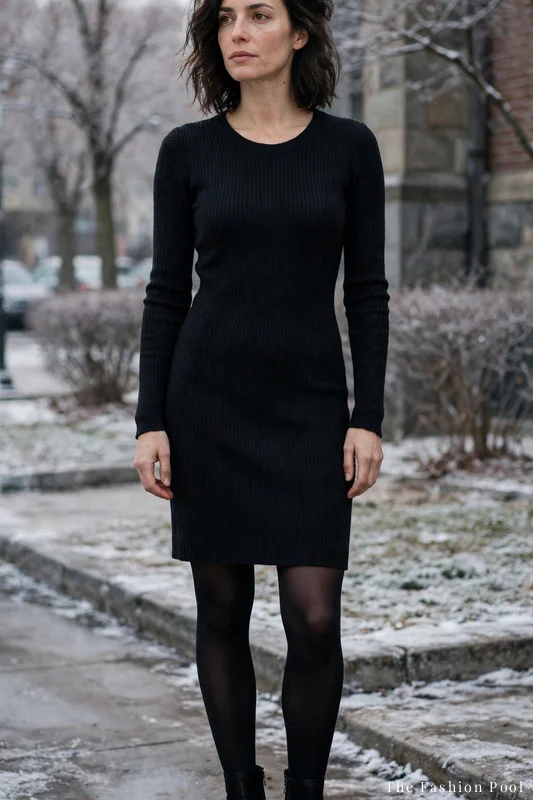
The visible outfit: dinner and drinks
The visible outfit is the slim part, and the slim part is the second spend. The visible outfit is the dress, the blazer, the top — the part the date sees, and the part the budget protects. A dinner date is the visible outfit’s test: the dress, the blazer, the top — and the coat is off, the base is hidden, and the outfit is the one the date sees. A drinks date is the same test: the same outfit, the same slim part, and the same hidden warmth underneath.
The velvet blazer is the visible outfit’s dressy piece: a velvet blazer over a satin top, a velvet blazer over a knit dress. Our velvet blazer guide covers the shape that works in velvet, and the same shape — one rich piece, everything else quiet — is what to wear for a winter date. The blazer is the statement, the top is the quiet, and the two of them agree because only one of them is loud.
The knit dress is the visible outfit’s warm piece: a knit dress, a slim knit, a dress that looks dressed without a coat. A knit dress with opaque tights is the outfit — the dress is the visible part, the tights are the hidden warmth, and the two of them do not compete because only one of them shows. The knit dress should be slim, plain, and dark — nothing in the outfit argues with it.
The satin top is the visible outfit’s shine: a satin top under a velvet blazer, a satin top with a dark skirt. A satin top is the one shine in the outfit, and the one shine is the outfit’s light. The satin should be the only shine — no second shine, no sequins, no glitter — because the shine is the statement, and the statement should be alone.
The satin top’s color is the part that decides the outfit: a deep color — burgundy, forest green, black — that reads rich in candlelight and quiet in daylight. A bright satin top with a bright blazer is two brights, and two brights argue. A deep satin top with a dark blazer is one deep, and one deep is the outfit. The satin should be deep, plain, and dark.
The coat: the removable warmth
The coat is the removable warmth, and the removable warmth is the third spend. The coat is the budget’s biggest spend — the warmest layer, the longest layer, the layer that keeps the cold out — and the coat comes off at the door. The coat keeps the cold out outside, and the outfit holds the warmth inside. The coat is the spend that makes the budget work, because it leaves at the door.
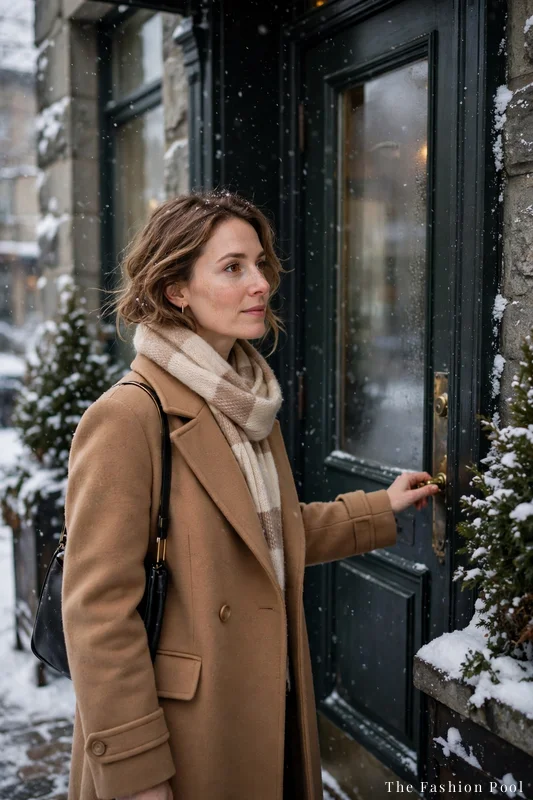
Our camel coat guide covers the shape that works in camel, and the same shape — a long line, a clean front, no bulk — is what to wear for a winter date. The coat is the quiet layer, the outfit is the slim part, and only one of them shows at a time. The coat should be long, plain, and dark, so the outfit underneath is what the date sees when the coat comes off.
Our faux fur coat guide covers the shape that works over a party dress, and the same shape — the coat does the talking, and everything underneath stays quiet — is what to use for a winter date. The coat is the statement outside, the outfit is the statement inside, and the two statements should not meet. The coat is the big spend, the outfit is the slim part, and the budget is the two of them together.
The coat check is the coat’s own test: the restaurant takes the coat, the coat hangs in the check, and the outfit is the one the date sees. A coat that checks well is a coat that comes back dry, and a coat that comes back dry is a coat that keeps working. The coat check is the coat’s aftercare — and the aftercare is the part the outfit never sees.
The swap: one piece for late night
The swap is the one piece for late night, and the late night is the part the budget forgot. The date runs late, the walk home is cold, and the outfit that was warm indoors is the outfit that is cold outside. The swap is the one piece that changes the outfit for the walk: a scarf, a pair of boots, a different shoe — one piece, not two, and the one piece is the swap.
The scarf is the swap that warms the neck: a wool scarf, a long scarf, a scarf that tucks into the coat. The scarf is the piece that goes on for the walk home, and the scarf is the layer the outfit did not have indoors. A scarf that stays in the bag is a scarf that does not earn its place, and a scarf that earns its place is the one that goes on at the door.
The boots are the swap that warms the feet: a flat boot, a warm boot, a boot with a low heel — the boot that replaces the heel for the walk home. The heel is the shoe the date sees, and the boot is the shoe the walk needs. A boot that stays in the bag is a boot that does not help, and a boot that helps is the one that goes on at the door. The swap is one piece, and the one piece is the late night.
The bag is the swap’s ride: a bag big enough for the scarf or the boots, a bag that closes, a bag that does not argue with the outfit. A bag too small is a bag that leaves the swap at home, and a swap left at home is a swap that does not work. The bag should be big, plain, and dark — and the swap rides inside it.
What not to wear on a winter date
What not to wear on a winter date is decided the same way as the budget: by the warmth, not by the photograph. The wrong outfit is worse than no outfit at all, because the wrong outfit is the one the date remembers — and the date remembers the outfit that did not work.
Do not wear a bulky coat that hides the outfit: no coat so thick the dress disappears, no coat so long the outfit is a rumor. A coat that hides the outfit is a coat that wastes the budget, and a wasted budget is a budget that does not work. Do not wear bare legs: no sheer tights, no bare skin, no leg that shows the cold. A bare leg is a cold leg, and a cold leg is a leg that ends the date early. Do not wear a stiletto on ice: no thin heel, no smooth sole, no shoe that slips on the pavement. A stiletto on ice is a shoe that ends the date at the first step, and no winter date is worth a date that ends at the first step. Do not wear a second statement piece: no sequins with satin, no loud scarf with a loud dress, no shine with shine. A second statement fights the first, and the outfit becomes an argument.
Frequently asked questions
What should you wear on a winter date night?
A winter date night outfit that follows the warmth budget: hidden warmth (tights, thermal, boots) underneath, a slim visible outfit (dress, blazer, top) on top, and a coat that comes off at the door. Spend the warmth where it hides, and the visible outfit stays slim.
How do you stay warm on a winter date without looking bulky?
Spend the warmth where it hides: an 80-denier opaque tight, a thin thermal under the dress, and a knee-high boot. The hidden layers keep you warm without showing, so the visible outfit stays slim — the budget puts the warmth underneath, and the part the date sees stays slim.
What coat should you wear on a winter date?
A long, plain, dark coat — camel or faux fur — that comes off at the door. The coat is the budget’s biggest spend and the removable warmth: it keeps the cold out outside, and the outfit underneath is the one the date sees inside.
Can you wear a velvet blazer on a winter date?
Yes — a velvet blazer over a satin top or a knit dress is the visible outfit’s dressy piece. Keep everything else quiet: one rich piece, one shine, no second statement — because the blazer is the statement, and one statement is enough.
What shoes should you wear on a winter date?
A low heel for dinner and drinks, and a flat boot in the bag for the walk home. The heel is for the table, the boot is for the pavement — and a thin heel on ice is a date cut short at the first step.
How do you dress for a winter date when it is snowing?
The same budget, with the coat doing more work: a long coat that closes, the same hidden warmth underneath, and the same slim outfit inside — plus the swap (scarf and flat boots) for the walk. The snow is the coat’s problem, not the outfit’s: the coat is the layer that meets the weather, and the outfit stays dry underneath.
A winter date night outfit is a warmth budget, and the budget is the outfit. Spend the warmth where it hides — and the date sees the outfit, not the coat.