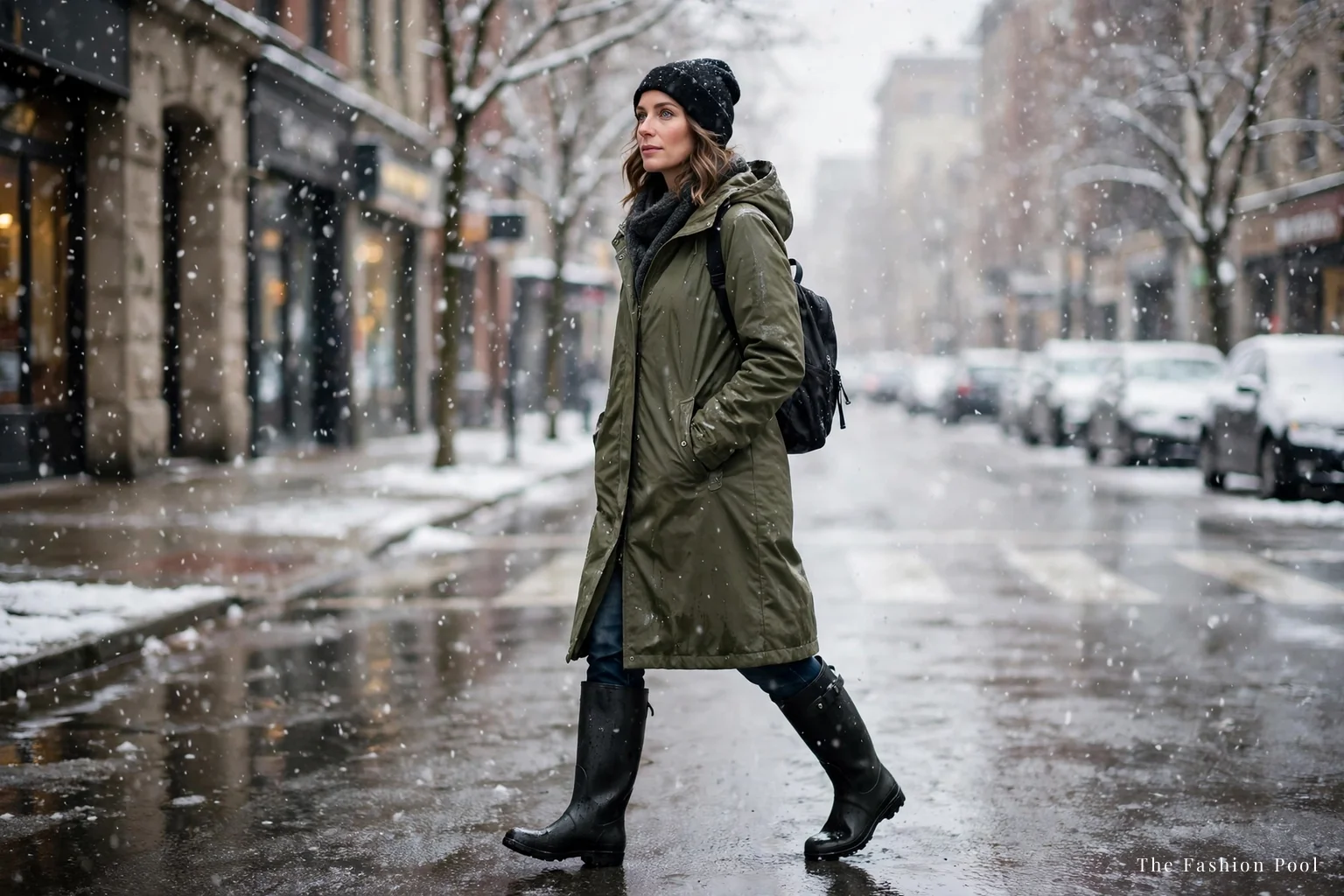
A snow day outfit is not a cold outfit. It is a wet outfit, a slippery outfit, and a standing-still outfit — and the cold is the last thing it has to do, not the first. Snow is a wet problem before it is a cold problem: the snow melts on the coat, it soaks the boots, it turns the pavement to slush. The outfit that works is the one that stays dry.
This guide works from one rule, and the rule has three jobs: warm, dry, steady. Warm decides whether you stay out. Dry decides whether you stay warm. Steady decides whether you stay upright. The three jobs are the whole guide, and every section is one of the three jobs, applied to one kind of snow.
The photograph is the snow’s lie: the snow looks clean, the coat looks warm, and the day looks easy. The reality is the slush at the curb, the wet hem, and the cold that finds the gap between the glove and the sleeve. The outfit that works is the one built for the reality, not the photograph — and the reality is the three jobs, applied to the snow you actually have.
The three jobs: warm, dry, steady
The three jobs are the whole guide in one sentence: warm, dry, steady. Warm is first because the snow is cold, and the cold is the snow’s own weather. A warm outfit is a layered outfit — a base layer, a mid layer, an outer layer — and the layers are the warmth. A cold outfit sends you home early, and no snow day is worth a day cut short at the first hour.
Dry is second because the snow melts, and the melting is the snow’s own problem. A dry outfit is a waterproof outfit — a waterproof coat, waterproof boots, waterproof gloves — and the waterproofing is the dryness. A wet outfit is a cold outfit, because the wetness takes the warmth away. A dry outfit stays warm because it stays dry, and the dryness is the warmth’s guard.
Steady is third because the snow is slippery, and the slipping is the snow’s own danger. A steady outfit is a traction outfit — a lugged sole, a low heel, a flat boot — and the traction is the steadiness. A slipping outfit cuts the day short at the first step, and no snow day is worth a day that ends before it starts. That is the rule, and the rule holds for every kind of snow.
Steady is the job the others forget, and the forgetting is the fall. The snow hides the ice, and the ice hides under the snow — the pavement that looks white is the pavement that is frozen, and the frozen pavement is the one that slips. A steady outfit is a traction outfit, and the traction is the sole: a lugged sole, a rubber sole, a sole that grips the ice instead of sliding on it. The heel should be low, the boot should be flat, and the step should be short — a short step on a lugged sole is a steady step, and a steady step is the day.
Dry snow: light, cold, powder
Dry snow is the easiest snow, and the easiest snow is the one that does not melt. Dry snow is light, cold, and powdery — it brushes off the coat, it does not soak the boots, and it stays on the ground instead of turning to slush. A dry-snow outfit is a warm outfit, and the warmth is the layers: a fine knit base, a wool mid layer, and a coat that keeps the wind out.
The coat for dry snow is the coat that keeps the wind out, not the coat that keeps the water out. A wool coat, a long coat, a coat that closes — the dry snow does not need waterproofing, because the dry snow does not melt. The coat should be long enough to cover the mid layer and warm enough to stand in the cold.
The scarf for dry snow is the scarf that keeps the wind out, not the scarf that keeps the water out. A wool scarf, a long scarf, a scarf that tucks into the coat — dry snow brushes off wool, so the scarf only has to keep the wind out. The scarf should be warm, plain, and dark. A scarf that drags in the snow is a scarf that soaks, and a soaking scarf stops being warm.
The boots for dry snow are the boots that keep the cold out, not the boots that keep the water out. A knee-high boot, a warm boot, a boot with a lugged sole — dry snow brushes off, so the boot only has to keep the cold out. The boot should be warm, plain, and dark — nothing in the outfit argues with it. For the taller version, Knee-high boots with jeans is the fit guide — and the boot should stay plain and dark, so the snow is what you notice.
Wet snow: heavy, sticking, 33–36F
Wet snow is the hardest snow, and the hardest snow is the one that melts. Wet snow is heavy, sticking, and close to freezing — it clings to the coat, it soaks the boots, and it turns the pavement to slush within the hour. A wet-snow outfit is a dry outfit, and the dryness is the waterproofing: a waterproof coat, waterproof boots, waterproof gloves — and the waterproofing is the outfit.
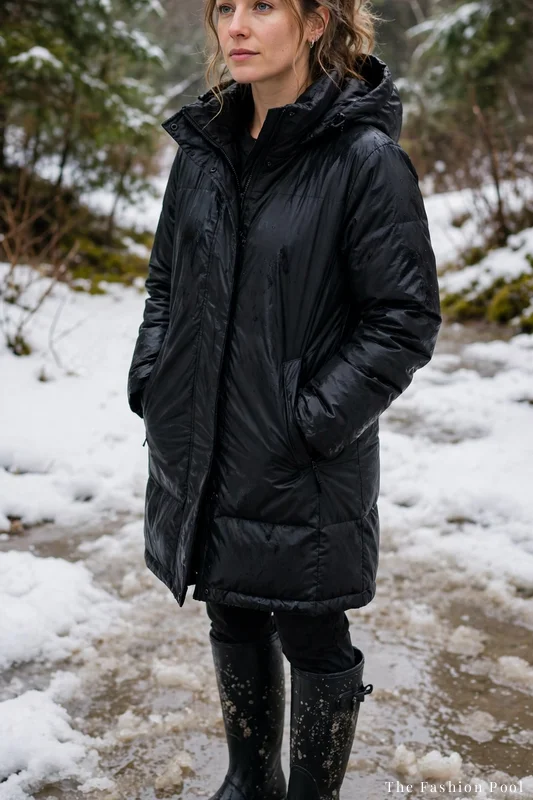
The coat for wet snow is the coat that keeps the water out, not the coat that keeps the wind out. A waterproof coat, a puffer, a coat that closes — the wet snow needs waterproofing, because the wet snow melts. The puffer is the right coat for wet snow, and the puffer’s context is the snow, not the party: the party articles say a puffer is the wrong coat for a party, and that is true for a party — but the snow is not a party, and the snow’s coat is the coat that keeps the water out.
The boots for wet snow are the boots that keep the water out, not the boots that keep the cold out. A waterproof boot, a rubber-soled boot, a boot with a lugged sole — wet snow melts on contact, so the boot has to keep it out. The boot should be waterproof, plain, and dark. A boot that is not waterproof is a boot that soaks, and a soaking boot stops keeping you warm.
The socks for wet snow are the socks that keep the feet dry, and the feet are the part the boots cannot save. A wool sock, a thick sock, a sock that wicks the water away — the wet snow finds the gap between the boot and the sock, and the sock should be the guard. A spare pair in the bag is the wet snow’s insurance, and the insurance is the pair that goes on when the first pair soaks.
Gloves with a coat are the cold-weather finish — leather gloves, dark, plain — and the gloves are the detail that keeps the hands warm without adding a second pattern. Gloves with a coat The gloves should be waterproof enough for the snow and thin enough to hold the phone, and the phone should stay in the bag until the photograph.
Slush: the worst — waterproofing over warmth
Slush is the worst snow, and the worst snow is the one that is neither snow nor water. Slush is wet, gray, and deep — it splashes the coat, it soaks the boots, and it turns the pavement into a puddle. A slush outfit is a waterproof outfit, and the waterproofing is the whole outfit: waterproof boots first, waterproof coat second, warmth third. The slush does not care about the warmth, because the slush takes the warmth away with the water.
The boots for slush are the boots that keep the water out, because slush is wet first and cold second. A tall waterproof boot, a rubber boot, a boot that rises above the slush — the slush is deep, and the boot should be taller than it. A short boot in slush is a boot that fills with water, and a boot that fills with water is a boot that sends you home.
The coat for slush is the coat that keeps the water out, because the splash reaches the coat before the cold does. A long waterproof coat, a coat that covers the legs, a coat that closes — the slush splashes, and the coat should be the shield. The coat should be long, plain, and dark. The slush is the worst snow, and the worst snow needs the most waterproofing.
The hem for slush is the hem that stays dry, and the dry hem is the one that stays above the splash. A long coat’s hem should clear the slush, a wide coat’s hem should not drag, and a coat that drags in slush is a coat that soaks. The hem is the slush’s target, and the target should be high enough to miss. A coat that ends above the knee is a coat that stays dry in slush, and a coat that stays dry is a coat that stays warm.
Standing still: colder than walking
Standing still is the coldest snow, and the coldest snow is the one that does not warm you. Standing still is colder than walking, because walking warms the body and standing does not. A standing-still outfit is a warm outfit, and the warmth is the layers: a thermal base, a wool mid layer, and a coat that keeps the wind out. The standing still is the part the walking does not warm, and the warmth has to work while you stand.
The sledding hill is the standing-still test: you stand at the top, you wait for your turn, and the waiting is the cold. The bus stop is the standing-still test: you stand at the curb, you wait for the bus, and the waiting is the cold. The standing still is the snow’s hidden test, and the hidden test is the standing.
The waiting is the standing still, and the standing still is the part the layers have to do alone. A thermal base under the knit, a wool mid layer under the coat, and a coat that closes at the neck — the waiting is the cold, and the cold finds the gap. The hat should cover the ears, the gloves should cover the hands, and the scarf should cover the neck — the standing still is the test of the gaps, and the gaps are the places the cold gets in.
Our camel coat guide covers the shape that works in camel, and the same shape — a long line, a clean front, no bulk — is what to wear for standing still. The coat is the layer that guards the warmth, and it should be long, plain, and dark.
Our faux fur coat guide covers the shape that works over a party dress, and the same shape — one statement piece, everything else quiet — is what to use for standing still. The coat is the warmth, the outfit is the quiet, and the two of them do not compete because only one of them is a coat.

What not to wear in snow
What not to wear in snow is decided the same way as the three jobs: by the snow, not by the photograph. The wrong outfit is worse than no outfit at all, because the wrong outfit is the one that sends you home early — and the snow notices the outfit that leaves.
Do not wear a smooth sole: no smooth leather, no smooth rubber, no shoe without a lug. A smooth sole slips, and a slipping shoe stops the day at the first step. Do not wear a coat that does not close: no coat that flaps open in the wind, no coat that leaves the mid layer to the snow. A coat that does not close is not a coat — it is a cape, and a cape is not warm. Do not wear suede in slush: no suede boots, no suede gloves, no suede anything. Suede soaks, and a soaking suede is a ruined suede. Do not wear a white coat in slush: no white, no cream, no pale color that shows every splash. The slush is gray, the coat is white, and the white coat is the one that comes home dirty.
Do not wear a scarf that drags: no long scarf that trails in the snow, no scarf that hangs past the coat’s hem. A dragging scarf soaks, and a soaked scarf keeps no one warm. Do not wear a bag that slips: no shoulder bag that slides off the coat, no bag that hangs open in the snow. A slipping bag is a bag that drops the phone in the slush, and the phone in the slush is a phone that is done for the day.
Frequently asked questions
What should you wear on a snow day?
A snow day outfit that passes the three jobs: warm, dry, steady. Layers for warmth, waterproofing for dryness, and a lugged sole for steadiness — applied to the snow you actually have: dry, wet, slush, or standing still.
How do you stay dry in the snow?
Waterproofing, not bulk: a waterproof coat, waterproof boots, and waterproof gloves. The waterproofing is the dryness, and the dryness is the warmth’s guard — a wet outfit loses its warmth, because the wetness takes it away.
What boots are best for snow?
A tall waterproof boot with a lugged sole and a low heel: traction first, waterproofing second, warmth third. Knee-high boots for dry snow, tall waterproof boots for wet snow or slush — and never a smooth sole on snow.
Can you wear a puffer coat to a party?
No — a puffer is the wrong coat for a party, and the party articles say so. A puffer is the right coat for snow, and the snow is not a party. Keep the contexts separate: the puffer is for the snow day, and the party coat is for the party.
What should you wear to stand in the snow?
Layers, not one thick piece: a thermal base, a wool mid layer, and a long coat that keeps the wind out. Standing still is colder than walking, because walking warms the body and standing does not — so the warmth has to work while you stand.
Is snow a wet problem or a cold problem?
A wet problem first, a cold problem second. The snow melts on the coat, it soaks the boots, and it turns the pavement to slush — and the wetness takes the warmth away. A snow day outfit that is dry stays warm; a snow day outfit that is wet does not.
A snow day outfit is a wet-weather outfit, and the wet is the snow. Warm, dry, steady — and the day lasts as long as the outfit does.