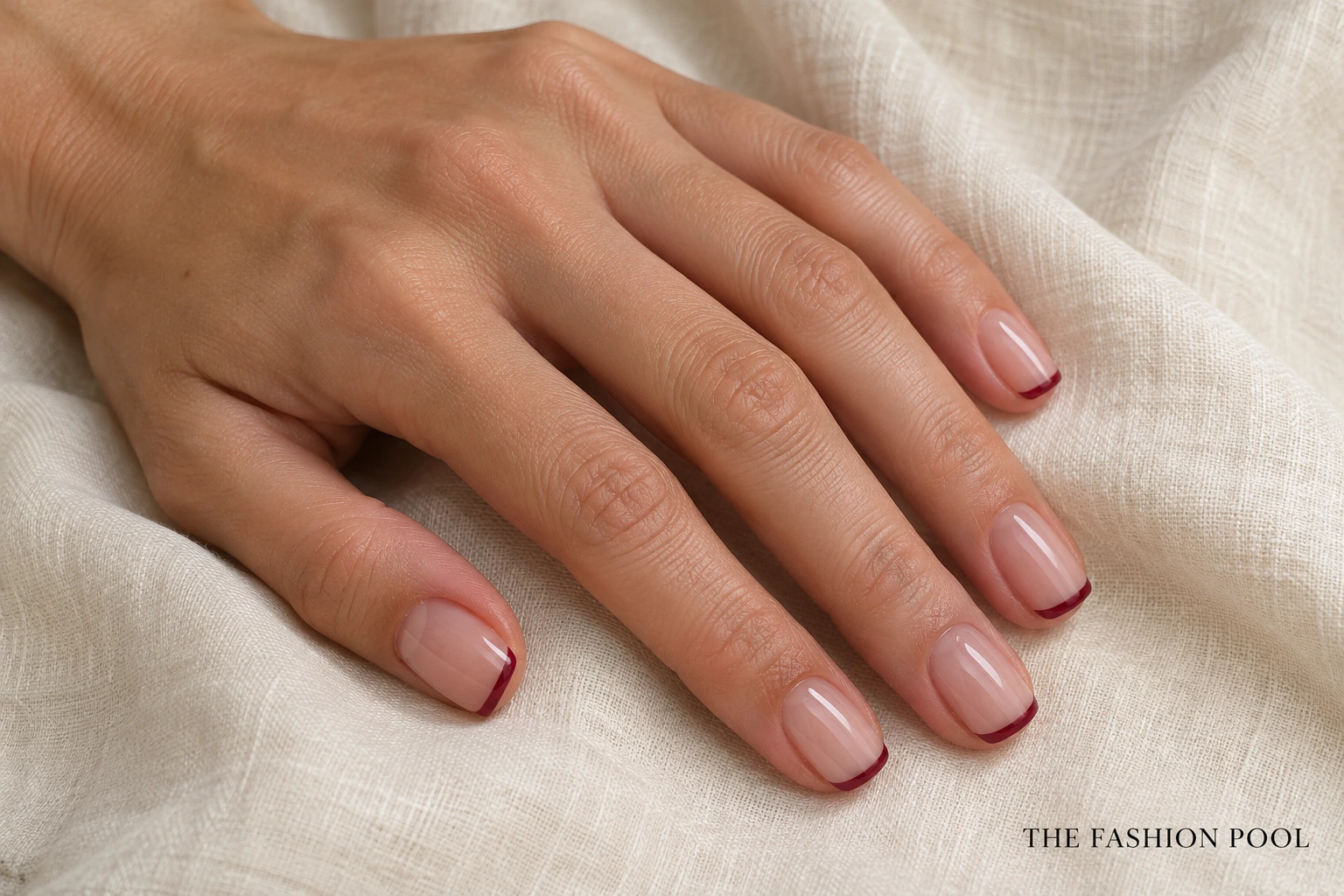
Burgundy French tip nails give a short manicure a defined edge without covering the whole nail in dark polish. The useful choice is the shape of that edge: a fine curved border, a diagonal corner, or two separated lines. Each creates a different result with the same wine-red color.
Start with a translucent pink base and keep enough of it visible that the burgundy reads as a detail. Choose the single curved tip for simplicity, the diagonal for an asymmetric accent, and the double French when your nail has room for two clear lines. You do not need long extensions to explore these designs.
Choose the Burgundy French Tip That Fits Your Nail
- Decide the outline before choosing a polish shade; the three designs use different amounts of space.
- Compare a sample with your hand relaxed, rather than judging only a close-up photograph.
- Keep line weight proportionate across the hand instead of forcing every nail into identical measurements.
| Design | Visual effect | What to request |
|---|---|---|
| Fine curved tip | A quiet border around the free edge | A narrow smile line with a sheer pink base |
| Diagonal corner | Color concentrated at one side | A small wedge with one sloping boundary |
| Open double French | Two distinct arcs with visible space | A fine outer line and separate inner curve |
Here, short means a modest free edge rather than a fixed measurement. Nail beds and starting lengths vary. If the edge barely extends beyond the fingertip, consider the fine border or small corner before attempting two separated curves.
A Fine Curved Tip for a Simple Finish
Pair a translucent neutral pink base with a slim burgundy line following the end of a softly squared nail. Rounded corners keep the outline gentle while the straighter center makes the colored border easy to see. On a rounded nail, follow its curve instead of drawing a flat stripe across it.
The aim is a recognizable border, not a deep block of color. Ask for one sample nail before committing to the full set. Look at it from a normal conversational distance: if you mostly see burgundy, request a narrower band; if the edge disappears, slightly more definition may suit your preference.
This is the simplest choice beside a busy outfit, such as a patterned blouse or textured sweater. Silver jewelry gives the wine shade a cooler companion; yellow gold creates a warmer contrast. Neither metal needs to match every other accessory.
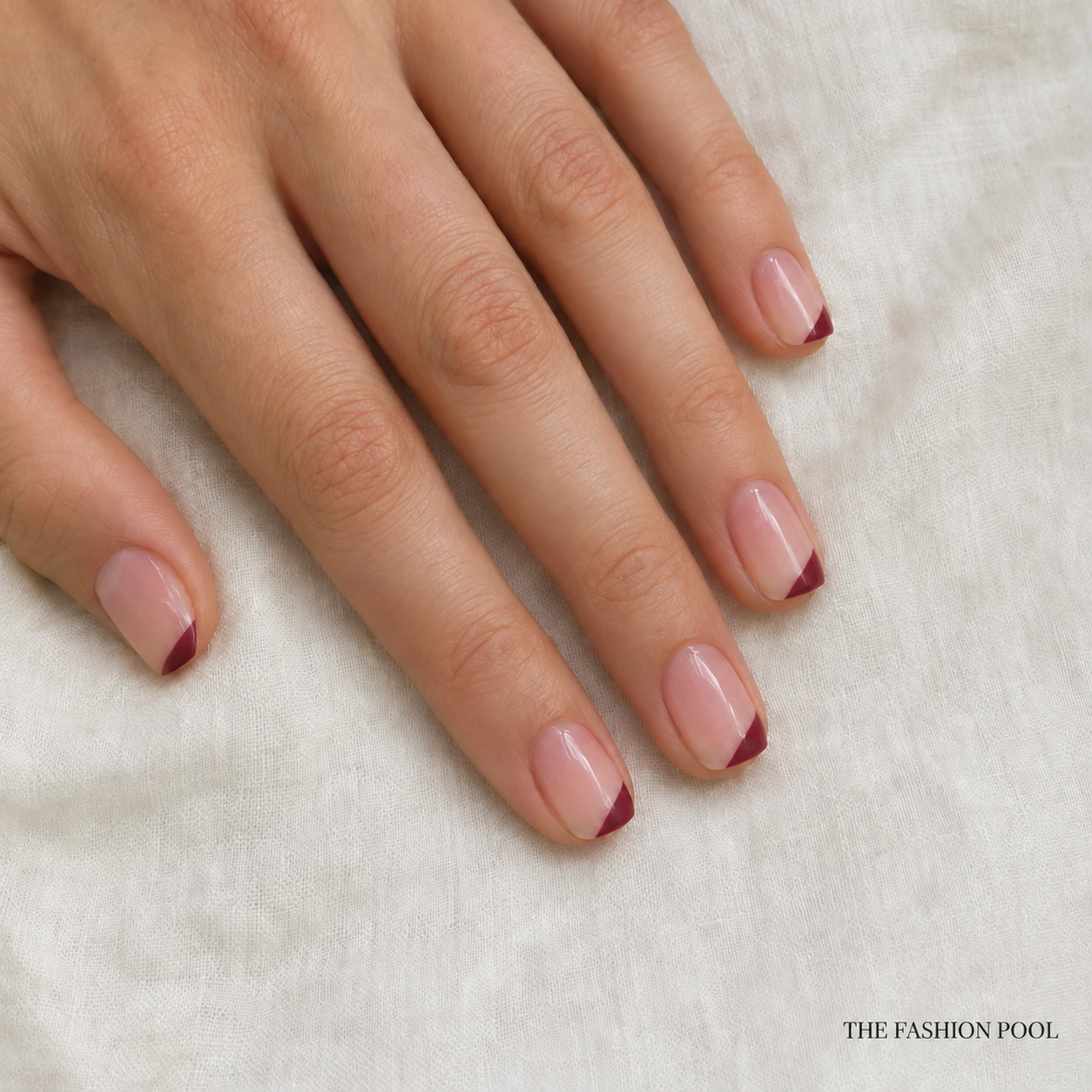
A Diagonal Corner for an Asymmetric Accent
For this version, a small burgundy wedge crosses one corner of each free edge. Most of the pink base remains visible, including the opposite corner. It differs from a sideways stripe: the color sits at the tip and tapers toward one side, rather than cutting across the middle of the nail.
Keep the sloping boundary clean and repeat its general direction across the hand. A wider thumbnail may need a slightly different angle to feel related to the smaller nails. Ask for visual balance rather than identical angles measured on every finger.
A square or softly squared outline makes the corner especially legible. If you prefer rounded nails, use a curved diagonal sweep rather than forcing a sharp triangular point. Pair the manicure with an ivory shirt, dark jeans and burgundy flats for a restrained color echo; a black shoe works when you want the nails to carry the accent alone.
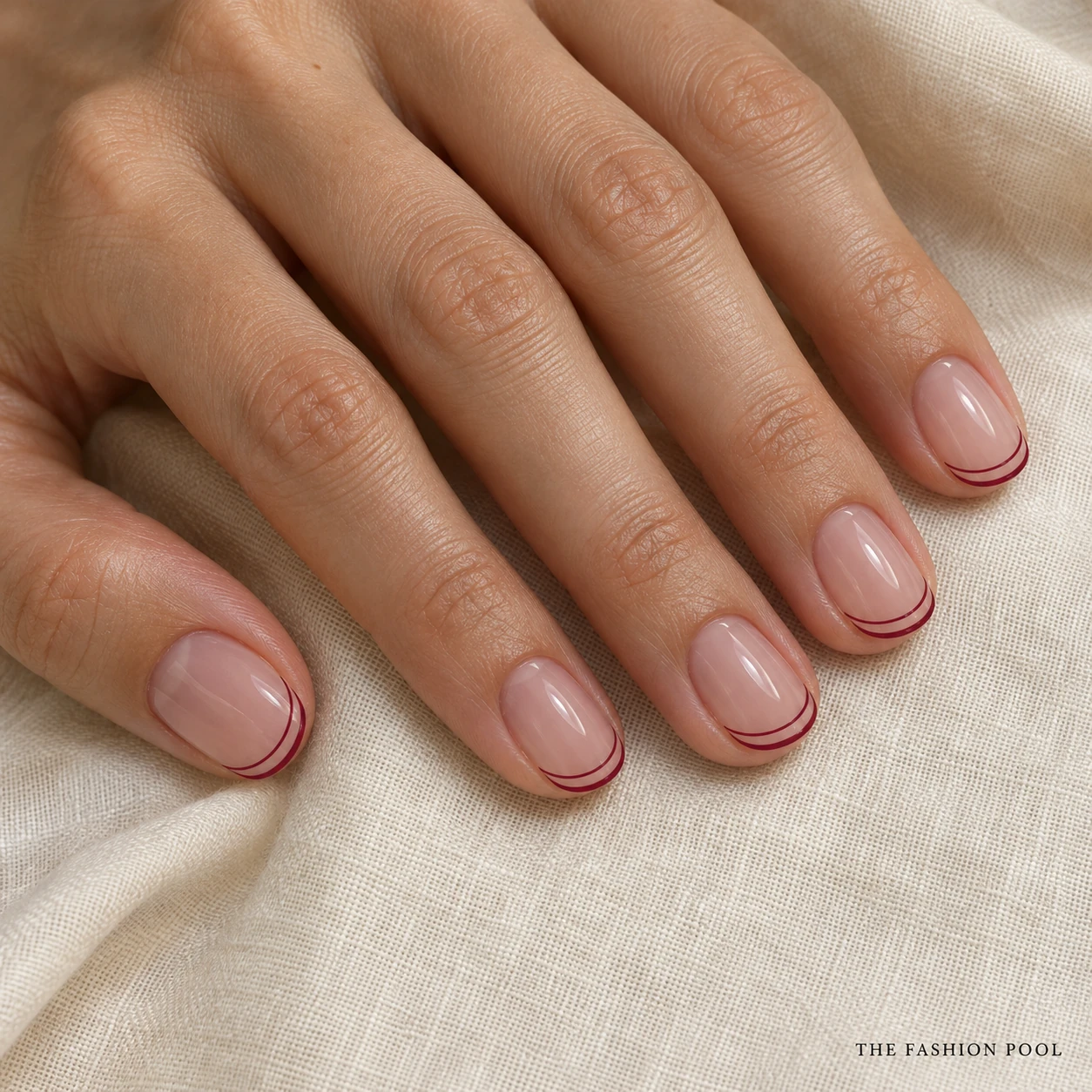
An Open Double French for More Detail
The double French uses two fine burgundy curves: one at the edge and another slightly below it, separated by visible pink. That unpainted-looking gap is the important detail. If the two curves meet, the result becomes a single thick band instead of an open double design.
Choose this when your available nail surface can accommodate both lines comfortably. A short rounded shape can work, but there is no need to extend every nail just to fit the pattern. If the smallest nail looks crowded, simplify the full set to the single curve, or use the double detail on selected accent nails.
For an evening outfit, try the design with a charcoal knit, black pants and a small silver earring. The fine linework contributes detail without requiring glitter. Keep the base translucent if you want the spacing to remain the focus; an opaque pale base creates a stronger graphic contrast.
Settle the Base and Burgundy Together
Burgundy can lean toward red, brown or plum. Compare it next to the actual base color, because a pinker base and a beige base produce different combinations. Choose the pairing you enjoy against your skin rather than relying on a universal undertone rule.
Inspect a sample in diffuse daylight as well as indoor light. A very deep wine shade may look nearly black indoors; a redder burgundy can keep the color distinction clearer. These are aesthetic decisions, not promises that a shade will look identical in every photograph.
If your priority is the base’s opacity rather than colored linework, our milky white nail guide compares sheer and creamy finishes. For coordinating the accent with clothing, these burgundy tights outfits offer complete color combinations; you can borrow a palette without wearing matching tights.
Translate the Reference Into a Usable Manicure
For a salon appointment, show the whole hand and a detail view, then name the shape, base opacity and line arrangement. Say whether the reference is inspiration or an exact design request. Our images are AI-created illustrations, so use them to communicate an idea rather than as evidence of a photographed salon result.
For ordinary air-dry lacquer at home, follow the product’s preparation, coating and drying directions. Use a fine detail brush with a small amount of color. Essie’s French manicure tutorial demonstrates tracing a curved smile line with a detail brush. For the diagonal version, sketch the sloping boundary before filling the corner.
Let each layer dry as directed before adding more linework. A heavily loaded brush can leave a bulky edge; remove excess polish from the brush before approaching the nail. If one curve becomes too wide, redo that nail rather than thickening every other tip to match it. Product-specific instructions govern finishing and removal.
Frequently Asked Questions
Can I use regular polish instead of gel?
Yes, these are design arrangements rather than gel-specific effects. A base color, burgundy lacquer and fine detail brush can create them with an ordinary air-dry system. Follow the chosen products’ instructions for compatible layers, drying and finishing. There is no single drying time or wear duration that applies to every polish.
What if my nails are different lengths?
Keep the overall color placement consistent while adjusting the line to each available edge. A fine curved tip is usually the simplest design to adapt. If one nail cannot fit two separate curves, choose a single-line set or make the double French an intentional accent rather than squeezing it onto every nail.
Do the tips need to follow the natural white edge?
Not exactly: the painted boundary is part of the design. Check how much natural edge remains visible through a sheer base, however, because an uneven underlying line may distract from delicate artwork. Ask for a slightly more covering base if you prefer to soften that contrast without changing the entire design.
How do I choose a reference for a salon appointment?
Choose an image showing a similar starting length and outline, then explain which detail matters most: narrow tips, an asymmetric corner or the gap between two curves. Ask the nail professional what is feasible on your nails. A clear description helps distinguish the intended design from incidental lighting, jewelry or editing in an image.
Must all five nails have the same design?
No. You can combine a single curved tip with one double-line accent, provided that is the result you want. Keep the burgundy shade and base consistent to connect the set. For a first attempt, one repeated design is easier to evaluate than several different patterns competing for a small amount of space.
Conclusion
Choose burgundy French tip nails by the line arrangement first, then refine the shade and base together. A fine curve is restrained, a diagonal corner changes the direction, and an open double French adds deliberate spacing. Bring one clear reference and check a sample nail before repeating the design across the hand.