A plaid skirt outfit is not a skirt outfit. It is a check outfit, and the skirt is the vehicle. The check is the thing people see first, the thing they remember, and the thing that decides whether the outfit works — and the skirt is only the piece that carries it. Choose the check first, and the skirt follows. Choose the skirt first, and the check chooses you.
This guide works from one rule: one check at a time. One check in the outfit, everything else quiet. The check is the statement, and a statement does not need a second statement. A plaid skirt with a plaid coat is two statements, and two statements argue. A plaid skirt with a plain coat is one statement, and one statement is the outfit.
The one-check rule: one check at a time, everything else quiet
The one-check rule is the whole guide in one sentence: one check per outfit, and everything else plain. The check is the pattern, and the pattern is the loudest thing in the outfit — louder than the color, louder than the shape, louder than the shine. A plain knit, a plain coat, plain boots: the check has the room to itself, and the room is the outfit.
The rule works because a check is a pattern with a history: the heritage check, the tartan, the plaid — it carries the school uniform, the scarf, the coat, all at once. A check on its own reads as heritage; a check with another check reads as a costume. The second check is the mistake: the eye does not know which check to look at, and the outfit becomes a competition. One check is heritage; two checks is a uniform.
The scale of the check is the second decision, and it matters as much as the check itself: a large check is the boldest, a small check is the quietest, and a medium check is the easiest. A large check on a midi skirt is the statement piece — the skirt is the outfit, and the rest of the outfit is the frame. A small check on a mini skirt is the detail — the skirt is the quiet part, and the check is the texture. A medium check is the everyday check: visible enough to read as plaid, quiet enough to wear to work.
The color of the check is the third decision, and it is the one that decides the season: forest green and burgundy are winter checks, gray is the year-round check, red is the Christmas check. The check’s color decides the outfit’s color, and the outfit’s color decides the coat, the shoes, and the bag. Choose the check’s color first, and the rest of the outfit follows.
Which check: forest green, burgundy, gray, red
Forest green. Forest green is the easiest check to wear, and the easiest check to get wrong. The green is deep and quiet, and it pairs with everything winter already owns: cream, camel, brown. A forest green check with a cream knit is the outfit — the green is the statement, the cream is the quiet, and the contrast is the point. A forest green check with a black top is the mistake: the black fights the green, and the outfit loses. The green needs cream, not black.
Burgundy. Burgundy is the richest check, and the richest check is the one that photographs best. The burgundy is warm and deep, and it pairs with the season’s own colors: cream, camel, navy, gray. A burgundy check with a camel coat is the outfit — the burgundy is the warmth, the camel is the frame, and the two colors do not compete because only one of them is a check. A burgundy check with a red top is the mistake: the red fights the burgundy, and the outfit becomes a color argument. The burgundy needs camel, not red.
Gray. Gray is the quietest check, and the quietest check is the most useful. The gray is neutral and cool, and it pairs with everything: black, white, navy, burgundy, forest green. A gray check with a black knit is the outfit — the gray is the texture, the black is the quiet, and the check reads as a pattern rather than a color. A gray check with a gray top is the mistake: the gray on gray disappears, and the check is gone. The gray needs a color next to it, not more gray.
Red. Red is the loudest check, and the loudest check is the Christmas check. The red is bright and warm, and it pairs with the season’s quiet colors: cream, navy, black, camel. A red check with a cream knit is the outfit — the red is the statement, the cream is the quiet, and the outfit reads as Christmas without a single decoration. A red check with a green top is the mistake: the red and the green together are the Christmas decoration, and the outfit becomes the decoration. The red needs cream, not green.
The midi: the easy check
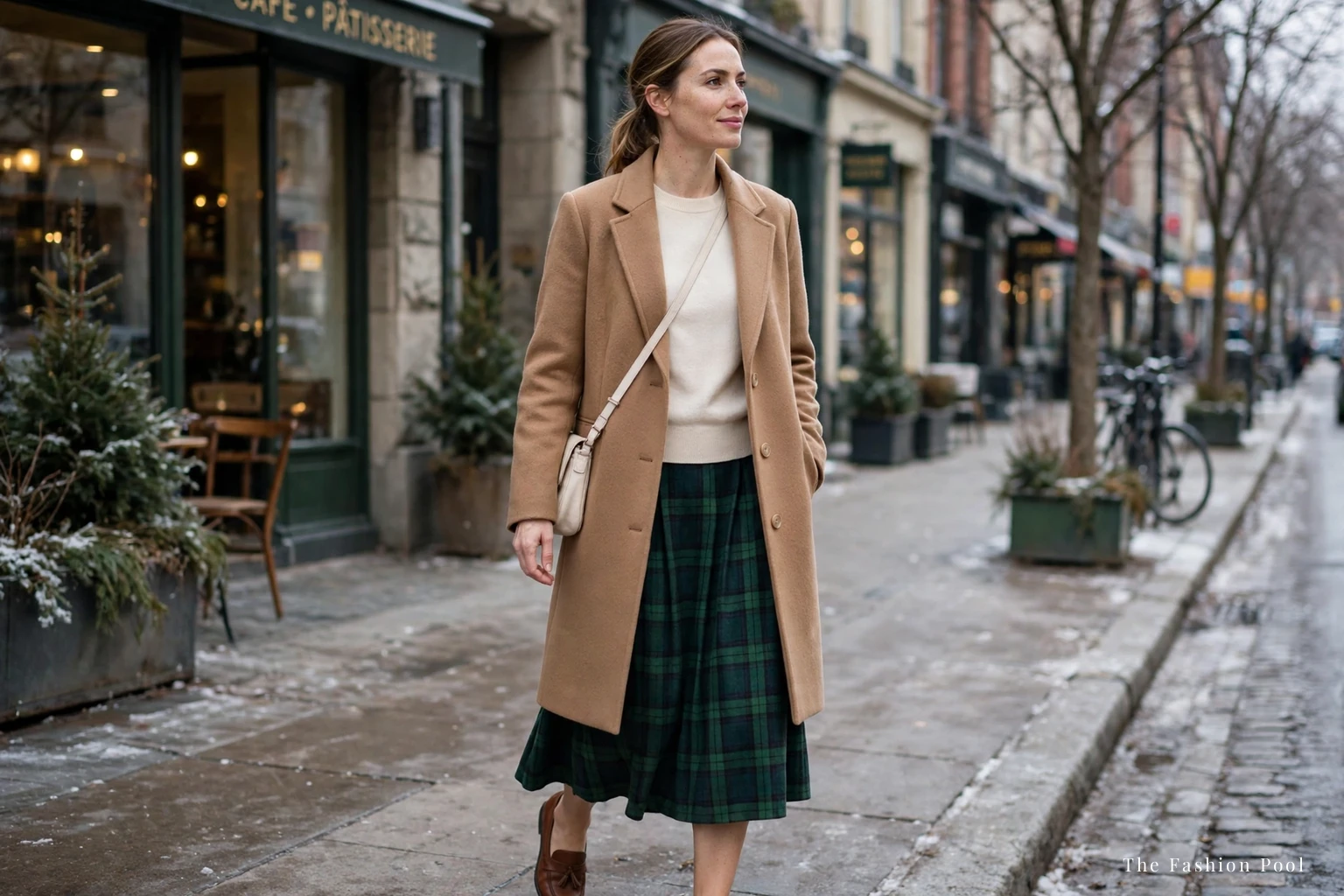
The midi is the easy check: a plaid midi skirt, a cream knit, loafers, a camel coat. The midi is the length that makes the check easy, because the midi is the length that does the least work: the skirt falls below the knee, the check has room to read, and the outfit is the check. The midi is the skirt that carries a large check best, because the large check needs space — and the midi is the space.
The knit is the quiet part: a cream knit, fine and smooth, tucked in at the front. The knit should be plain — no pattern, no texture, no color that argues with the check. A chunky knit with a plaid midi is the mistake: the bulk on top and the pattern below make the outfit top-heavy, and the proportions fight each other. A fine knit keeps the line clean, and the check is the only pattern in the outfit.
The shoes are the quiet part too: loafers, dark brown or black, flat or with a low heel. The loafers should be plain — no buckle, no shine, no color that argues with the check. For the taller version, Knee-high boots with jeans is the fit guide — and the boot should stay plain and dark, so the check is the only pattern in the outfit. A knee-high boot with a plaid midi is the cold-weather version of the loafer, and the boot is the quiet part.
The coat is the frame: a camel coat, long enough to cover the knit, plain enough to let the check show. Our camel coat guide covers the shape that works in camel, and the same shape — structured shoulder, clean lapel, no bulk — is what to wear over a plaid midi. The coat is open, the check shows, and the outfit is the check.
The mini: the bold check
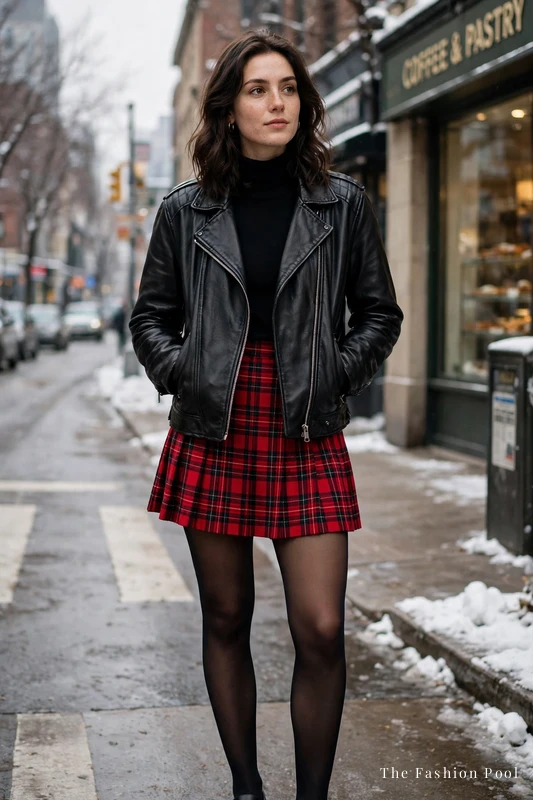
The mini is the bold check: a plaid mini skirt, a leather jacket, chunky loafers. The mini is the length that makes the check bold, because the mini is the length that shows the most check in the least space: the skirt is short, the check is small, and the outfit is the check. The mini is the skirt that carries a small check best, because the small check needs to be seen up close — and the mini is up close.
The jacket is the contrast: a black leather jacket, plain and smooth, worn open over the check. The jacket should be the opposite of the skirt — smooth where the skirt is patterned, dark where the skirt is colored, plain where the skirt is loud. A plaid jacket with a plaid mini is the mistake: two checks, and the outfit becomes a competition. A leather jacket with a plaid mini is the outfit: the leather is the quiet, the check is the statement, and the contrast is the point.
The shoes are the weight: chunky loafers, black, with a thick sole. The chunky loafer should be heavy enough to balance the mini — the mini is short, the check is loud, and the shoe needs to hold the outfit down. A delicate flat with a plaid mini is the mistake: the flat is too quiet, and the outfit floats away. A chunky loafer is the fix: the weight is the anchor, and the anchor is what keeps the outfit from floating.
The tights are the practical part: black tights, opaque, plain. The tights should be the quiet part — no pattern, no color, no shine. A patterned tight with a plaid mini is the mistake: the pattern fights the check, and the quiet is gone. A plain black tight is the fix: the legs are the quiet part, and the check keeps the outfit.
The coat and the scarf: the check without the skirt
The check does not need a skirt. A plaid coat or a plaid scarf carries the same check, and the same rule applies: one check at a time. The coat is the check’s biggest carrier, and the scarf is its smallest — and both are the outfit when the skirt stays in the closet.
The coat is the check’s frame: a plaid coat in forest green or burgundy, worn over a plain outfit. The coat should be the only check in the outfit — a plain knit, plain trousers, plain boots underneath. A plaid coat over a plaid skirt is the mistake: two checks, and the coat and the skirt argue. A plaid coat over plain trousers is the outfit: the coat is the statement, the trousers are the quiet, and the check has the room to itself. Our faux fur coat guide covers the shape that works over a party dress, and the same shape — the coat as the statement, the rest plain — is what to use for a plaid coat.
The scarf is the check’s detail: a plaid scarf in red or gray, worn with a plain coat. The scarf should be the only check in the outfit — a plain coat, a plain knit, plain trousers. A plaid scarf with a plaid coat is the mistake: two checks, and neither one wins. A plaid scarf with a plain camel coat is the outfit: the scarf is the statement, the coat is the quiet, and the check is the detail that makes the outfit. Gloves with a coat are the cold-weather finish — leather gloves, dark, plain — and the gloves are the detail that keeps the hands warm without adding a second pattern.

What not to pair with a check
What not to pair with a check is decided the same way as the one-check rule: by the pattern, not by the color. The wrong pairing is worse than no pairing at all, because the wrong pairing is the one everyone notices — and the outfit notices the wrong thing.
Do not pair a check with another pattern: no stripes, no florals, no polka dots, no animal print. A pattern with a pattern is a competition, and the check always loses — because the check is the pattern with the most history, and the second pattern is the one that looks like a mistake. Do not pair a check with a bright color: no bright red top with a burgundy check, no bright green top with a forest green check, no bright blue top with a gray check. A bright color fights the check’s color, and the outfit becomes a color argument. Do not pair a check with a shiny fabric: no satin top with a plaid skirt, no sequin jacket with a plaid coat. A shine fights the check’s matte, and the outfit becomes a texture argument.
Do not pair a check with a check in a different scale: a large check with a small check is still two checks, and two checks is the mistake. The scale does not save the pairing — the eye sees two patterns, and the outfit has no quiet left. One check, one scale, everything else plain.
Frequently asked questions
What should you wear with a plaid skirt?
One check at a time, everything else plain: a cream knit, a camel coat, loafers or knee-high boots. The check is the outfit’s voice, and it needs no second voice. A plain knit keeps the line clean, and the check is the only pattern in the outfit.
Can you wear plaid to the office?
Yes — a gray or forest green check, in a midi length, with a plain knit and loafers. The gray check is the quietest and the most useful, and the midi is the length that makes the check easy. Keep the rest of the outfit plain: no second pattern, no bright color, no shine.
Is a plaid skirt too young to wear?
No — the check is the age, not the skirt. A midi length with a fine knit and a camel coat reads as heritage, not as a school uniform. The mini with a leather jacket reads as bold, not as young. The length and the pairing decide the age, and the check decides the outfit.
What shoes go with a plaid skirt?
Loafers for the midi, chunky loafers for the mini, knee-high boots for the cold. The shoes should be plain — dark brown or black, no buckle, no shine — because the shoes are the quiet part, and the check does the talking. A knee-high boot is the cold-weather version — plain, dark, and quiet.
Can you wear two plaids together?
No — one check at a time, everything else quiet. A plaid skirt with a plaid coat is two statements, and two statements argue. A plaid coat over plain trousers is the outfit; a plaid scarf with a plain camel coat is the outfit. The check needs the room to itself.
What color top goes with a plaid skirt?
Cream for forest green, burgundy, and red checks; black for a gray check; camel for a burgundy check. The top should be plain and quiet, so the check is the only pattern in the outfit. A bright color fights the check’s color, and the outfit becomes a color argument.
A plaid skirt outfit is a check outfit, and the check is the outfit. One check at a time, everything else quiet — and the skirt is the vehicle, not the subject.