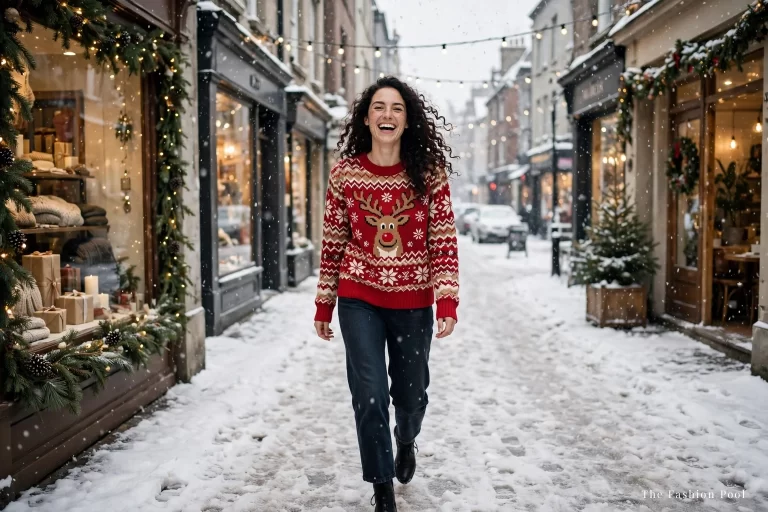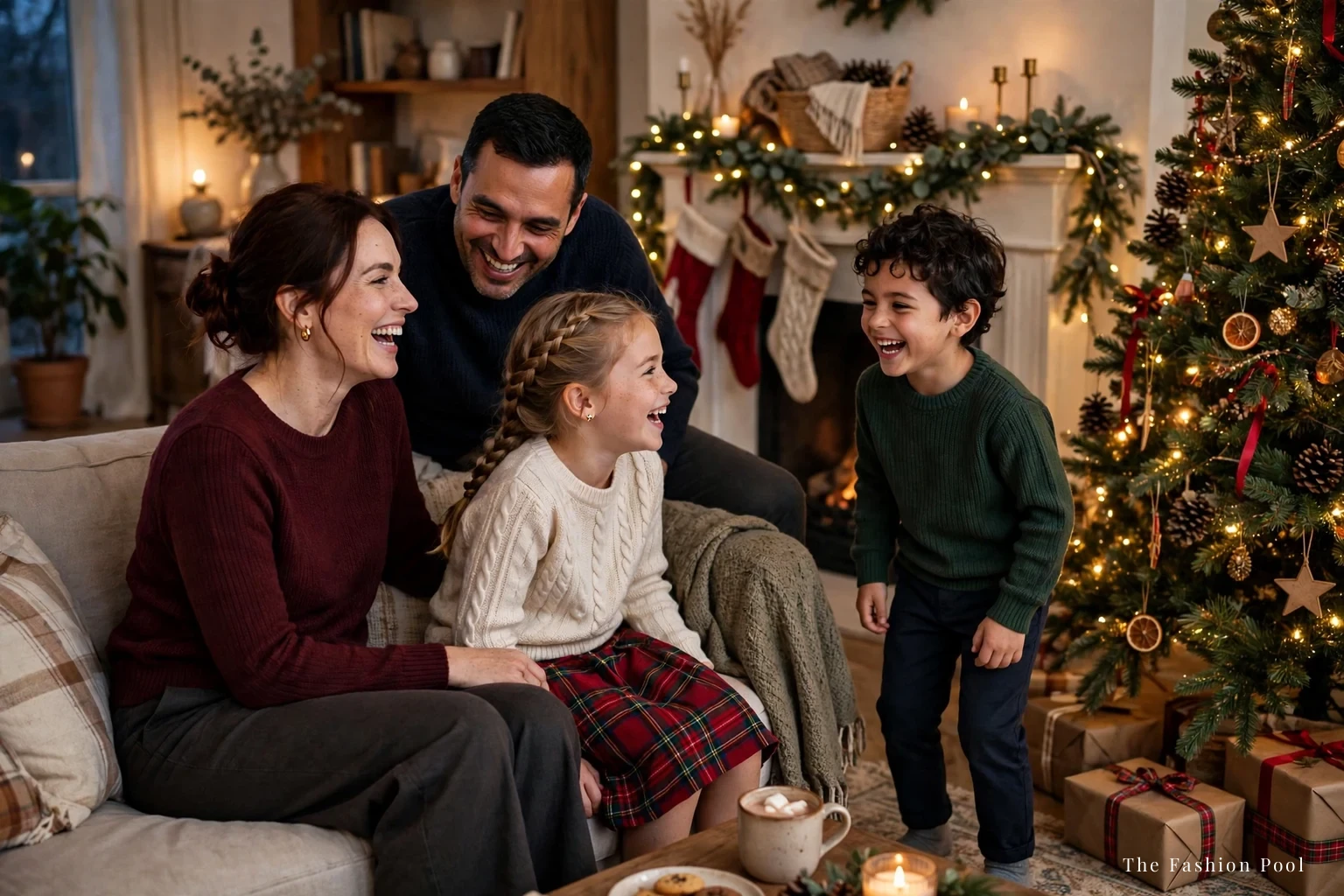
Family Christmas outfits are the hardest outfits of the year to get right, because they are not one outfit at all. They are ten, worn by ten people with ten different ideas of what Christmas should feel like. The grandmother wants warmth and a chair she can sit in for hours. The teenager wants to look festive without looking like a decoration. The toddler wants to move, eat, and nap, in that order. And the host wants an outfit that survives cooking, serving, and the sofa. This list gives each of them one outfit — ten family Christmas outfits, one per person, each built around that person’s Christmas problem.
The shared thread across the ten is a single festive note, repeated differently: burgundy or deep green, worn once per outfit — a burgundy cardigan here, a deep-green knit there, a burgundy lip somewhere else. That is coordination, not a uniform. Our holiday family photo guide works through the coordination rules for the photograph itself; this list is about the day, not the camera. The morning belongs to pajamas — our Christmas pajamas guide covers those.
How this list works
Each entry names the person, their problem, the outfit that solves it, and the finish. These family Christmas outfits are built from pieces most families already own, in colours that repeat across the group, so nobody needs ten new outfits. And every outfit has to work for the whole day, not just for the first ten minutes — an outfit that only works standing up in front of a mirror will fail by three in the afternoon.
1. The host: the outfit that cooks, serves, and sits
The host has the hardest job on Christmas Day, and the outfit has three jobs: survive the kitchen, look right at the table, and stay comfortable afterwards. Start with a burgundy fine-knit sweater and dark wide-leg trousers in charcoal. The knit is warm without bulk, the trousers give the waist room, and the combination looks deliberate at the table without feeling formal. Sleeves matter most: a fine knit with sleeves that end at the wrist stays out of the food, while a wide sleeve dips into everything.
Shoes are low block-heel ankle boots in black suede — steady on kitchen floors and comfortable for hours of standing. Hair goes up in a low knot, jewellery stays minimal. The lip finishes it: brown-red, one shade deeper than the sweater. Our Christmas dinner chart works through five dinners and five outfits, if the evening goes formal. The test is the sit-down: sit in it for ten minutes before anyone arrives.
2. The grandmother: warmth, ease, and a chair for hours
The grandmother’s problem is the opposite of the host’s. She is not moving all day; she is sitting, and sitting for hours in a cold room is what makes an outfit fail. It has to be warm, easy to get on and off, and comfortable in a chair — which rules out anything tight and any waistband that digs in when she sits.
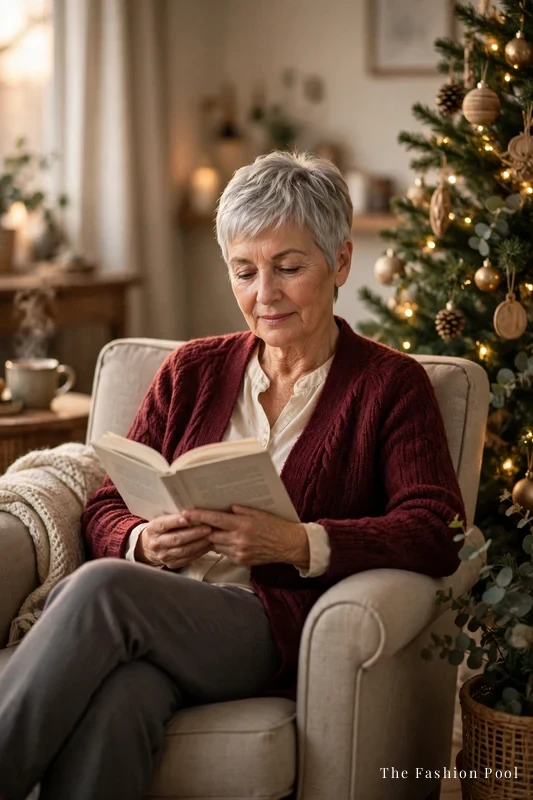
A burgundy cardigan over a cream blouse, with soft charcoal wide-leg trousers, does the job. The cardigan is the key piece: a buttoned cardigan opens and closes without going over the head, and it is a layer she can take off when the room warms up. The blouse should be soft cotton, not silk — silk slides around under a cardigan and needs adjusting every time she stands up. Shoes are flat, with grip, in black or dark brown, and warm socks are not optional. A small gold brooch and a shawl for the evening complete it.
3. The grandfather: smart without a suit
The grandfather wants to look like he made an effort, and he does not want to wear a suit. A suit feels like work and a tie feels like a costume. It needs to sit in the middle: smart enough for the table, relaxed enough for the sofa.
An unstructured navy blazer over a pale-blue shirt, with dark-grey trousers and brown leather shoes, is the middle. The blazer matters most: unstructured, with a soft shoulder and no padding, it reads as a jacket rather than a suit, and it can come off at the sofa without the outfit falling apart. The shirt is pale blue, not white — white next to navy is sharper than the day needs. No tie: a tie with a blazer and non-matching trousers still reads as dressed-up rather than relaxed, and it is the one piece he will tug at all afternoon.
The trousers should be dark grey, not black — black trousers with a navy blazer look like two halves of different suits. The last touches are a pocket square in the family’s festive note colour, folded flat rather than puffed, and a watch. Leave the waistcoat at home.
4. The father: relaxed, but put together
The father spends Christmas Day on a circuit: the sofa, the table, the garden with the children, the kitchen to help, the sofa again. His outfit must survive all of it without looking like he gave up, and the usual failure is the opposite — an outfit so casual it reads as pyjamas with shoes.
A deep green or burgundy crew-neck knit over a white shirt collar, with dark straight-leg jeans and clean dark leather boots, holds the line. The knit is the festive piece — deep green or burgundy, in a fine gauge, because a chunky knit looks bulky at the table. The white collar showing at the neck is what makes the outfit look deliberate rather than thrown on. The jeans are dark-wash and straight-leg, with no fading at the thigh and no rips.
Boots are dark leather, clean, with a low heel — not trainers, and not the boots he wears to walk the dog. A watch, and nothing else, finishes it. The test is the garden: step outside in it for ten minutes.
5. The teenage daughter: festive without costume
The teenage daughter’s problem is the one most families get wrong. She wants to look grown-up and festive, and the family wants her to look like a child in a party dress. It should let her feel like herself — which means no sequins head to toe, no puffed sleeves, no dress that looks like it came from the children’s department.
A forest-green satin midi skirt with a cream fine-knit sweater is the outfit. The satin gives the festive note, the knit keeps it grounded, and the combination looks like something she chose herself. The skirt should be midi length, not mini — midi looks grown-up at a family table. Black opaque tights, not sheer, and black ankle boots with a low heel, or Mary Janes.
Jewellery stays to one piece, not three: small gold hoops, or a fine chain, and nothing that dangles. Hair is down or half-up, her choice. The one rule worth holding is the single-festive-piece rule: the satin skirt is the festive piece, so everything else stays plain — one shine, not two.
6. The teenage son: the one who hates dressing up
The teenage son’s problem is simpler to state than to solve: he will refuse anything that feels formal. It must be a compromise he will actually wear — his own clothes, with one festive piece added.
A deep red or forest-green crew-neck sweater over a white shirt, with his dark jeans and clean dark boots, is the compromise. The sweater is the festive piece: deep red or forest green, in a fine gauge, worn over the white shirt so the collar shows — the same trick as the father’s outfit, and the same reason. Everything else is his: the jeans he likes, the boots he already owns. If he wants trainers, they should be the cleanest pair he owns.
There is no finish: no jewellery, no scarf, no extra piece — the sweater is the whole statement. The outfit works because it is almost his normal outfit, with one colour changed — and because the collar, the clean boots, and the fine gauge are the three things that stop it reading as a school-day outfit. If he agrees to the sweater, the day is won.
7. The school-age child: floor play and the table
The school-age child has two jobs on Christmas Day, and she needs two different outfits in one. She sits on the floor, builds things, eats with her hands, and then she sits at the table and is expected to look smart. It must survive the floor and still look right at the table — which rules out white and anything she cannot move in.
A red-and-green plaid cotton-blend skirt with a cream knit sweater, dark tights, and Mary Jane shoes does both jobs. The plaid is the festive note, the knit is soft and warm, and the skirt is the right length for the floor. Tights should be dark — navy or charcoal — because the floor is where tights get dirty. Shoes are Mary Janes with a strap: a strap keeps the shoe on during floor play.
A velvet hair bow in the family’s festive note colour is the only hair accessory. The fabrics should all be washable, because Christmas dinner with a school-age child ends with the outfit in the wash.
8. The toddler: comfort, stains, and naps
The toddler’s outfit is the one the whole family overthinks. The toddler does not care about Christmas, does not care about the photograph, and will spend the day eating, spilling, and falling asleep on someone’s lap. Build it for that day, not for the idea of it.
Soft cream knit dungarees over a long-sleeved top in deep red, with leggings underneath and socks with grip, is the outfit. Dungarees are the right shape: nothing tight at the waist, straps that stay put, and a front that takes the stains so the top underneath stays clean. The knit should be soft, with no scratchy seams and no tags. No buttons at the back — a toddler naps on laps, and a button is a hard lump under a sleeping child.
No sequins: they are scratchy, and a toddler will pull at them. No detachable bows, no small parts, nothing that can be pulled off and swallowed. Dinner needs one practical extra: a bib, so the outfit survives the meal.
9. The baby: the first Christmas
The baby’s first Christmas is the outfit the family photographs most and thinks about least. The baby needs softness, warmth, and safety — in that order — and everything else is decoration. It needs to be gentle against new skin, warm enough for a cold house, and free of anything small enough to be pulled off.
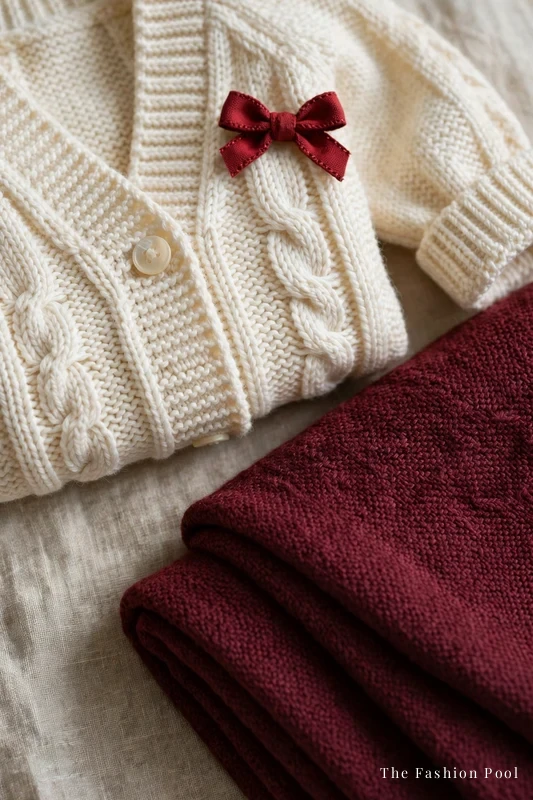
A cream knitted cardigan over a soft red romper, with a long-sleeved cotton vest underneath if the house is cold, is the outfit. The cardigan should button at the front, not pull over the head. The romper should be soft cotton, not wool against the skin — wool itches, and a baby who itches will cry. The cardigan can be wool, because it sits over the cotton, not against the skin.
A small red bow, sewn on so it cannot come off, is the one decoration. Nothing detachable, nothing with beads, nothing with a drawstring. For warmth through the day, add a soft blanket in the family’s festive note colour, folded over the baby’s legs.
10. The first-Christmas guest: meeting the family
The guest spending their first Christmas with the family has the most delicate problem on this list. They want to look like they belong, without looking like they tried too hard. It should be quiet, polished, and easy — and survive a journey and unknown floors.
A black or navy midi dress in matte crepe, with long sleeves, is the outfit. Matte crepe is the right fabric: it does not crease on a journey and it does not shine. The dress should be midi length, with a neckline that needs no adjusting. Under the dress, black opaque tights, and low block heels in black suede: steady on unknown floors and stairs.
The coat for arrival is the one statement piece: a red coat, worn open over the dress. Our red coat guide works through how to wear one without letting the colour take over. One small festive note finishes it — a red lip or a gold pendant, never both — and a small plain bag. Hair in a low bun or tied back travels best — anything loose will need redoing after the journey.
What not to do with family Christmas outfits
One mistake repeats every Christmas: letting a single loud piece set the dress code for everyone.
Let one person’s sequins set the dress code. If one person wears sequins head to toe, everyone else looks underdressed by comparison, and the day becomes about that one outfit. One sequin piece in the whole group is festive; two is a competition.
Frequently asked questions
Should a family match outfits for Christmas?
No — not for the day itself. One festive note, repeated differently across the group, is what this list does; the coordination rules for the photograph are in our family photo guide.
What should the family wear to Christmas dinner?
The host’s outfit from this list — a fine knit, wide-leg trousers, low block heels — and the same principle for everyone else. Our Christmas dinner chart works through five dinners and five outfits.
What should kids wear on Christmas Day?
Comfort first, dark colours second. A school-age child needs an outfit that survives the floor and still looks right at the table — a plaid skirt, a cream knit, dark tights, shoes with a strap. A toddler needs soft dungarees and a bib for dinner. Both need shoes they can run in.
What should grandparents wear to Christmas?
Warmth and ease. A buttoned cardigan over a soft blouse, soft charcoal wide-leg trousers, flat shoes with grip, and warm socks. The cardigan is the key piece: it opens without going over the head, and it comes off when the room warms up.
How do you dress a baby for their first Christmas?
Softly and safely. A cream knitted cardigan that buttons at the front, over a soft cotton romper — wool over cotton, never wool against new skin. No detachable parts, no beads, no drawstrings. A soft blanket in the family’s festive note colour keeps the baby warm.
What should you wear meeting your partner’s family for the first Christmas?
One festive note, one quiet base. A black or navy midi dress in matte crepe, low block heels, a red coat for arrival — a red lip or a gold pendant, never both. Hair that survives the journey and a small plain bag.
Ten people, ten problems, one day. Give each person the outfit that solves their problem and repeat one festive note across the group. That is what good family Christmas outfits do: they disappear, and the day takes their place.
Keep your style story going.
Find your next outfit idea, styling detail or wardrobe solution.
Explore the latest edit ↗