
A corduroy dress outfit solves the winter problem most dresses cannot: it is warm enough for a cold day and structured enough to look dressed up without trying. Most winter dresses ask you to choose — warmth or shape, comfort or polish. Corduroy refuses the trade. The ribs hold the shape so the dress does not cling, the cotton pile traps a little warmth, and the matte texture reads as considered.
In short: pick the dress by the day — shirt dress for work, pinafore for errands, A-line for dinner, long-sleeve midi for a cold snap, slip dress under a coat.
The mistake is buying one corduroy dress and wearing it for every winter day: the office shirt dress is wrong for a cold snap, and the layering slip dress looks unfinished on its own at dinner. The day decides the dress, and this guide matches five dress cuts to five winter days. The timing is good: on Pinterest Trends (logged in, US, last 90 days, checked 25 Nov 2026), “corduroy dress outfit” is up 7% on the week and 20% on the month, rising toward its usual late-November seasonal peak — 100 last November, about 75 now; the yearly figure is −10%, meaning interest is lower than at the same point last year.
How the chart works
One rule holds the whole guide together: a corduroy dress outfit starts with the day, not the dress. Find your day in the chart, and the cut, the layer, and the shoe follow.
| Dress cut | The day it fits | What goes with it | The shoe |
|---|---|---|---|
| Shirt dress | The workday | Fine knit or roll neck, leather belt | Ankle boots or loafers |
| Pinafore dress | Weekend errands | Striped tee or thin sweater, tights | Chelsea boots or sneakers |
| A-line dress | Dinner out | Fitted turtleneck underneath | Heeled ankle boots |
| Long-sleeve midi dress | The cold snap | Thermal top, tights | Knee-high boots |
| Sleeveless slip dress | Layered under a coat | Long-sleeve top, coat on top | Knee-high boots or ankle boots |
If you own two of the five, own the shirt dress and the long-sleeve midi.
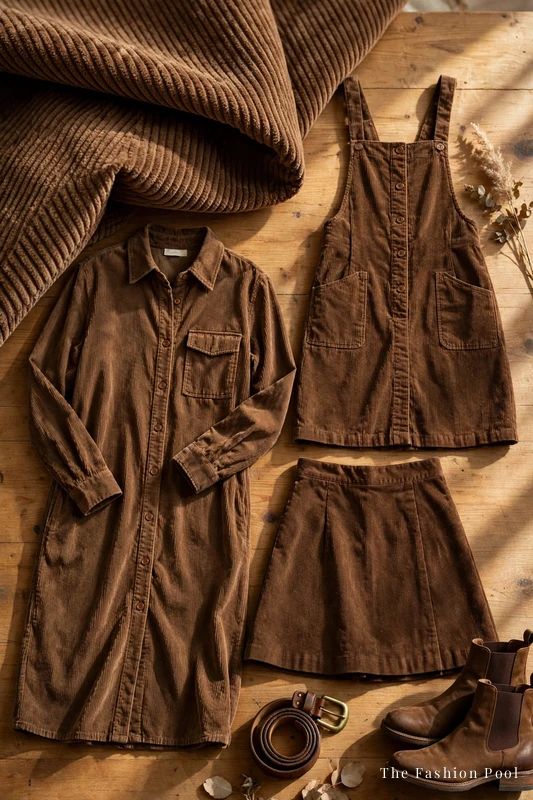
The shirt dress: the workday
The shirt dress is the workday dress, and the one to buy first. It has a collar, a button front, and a waist that can be belted or left loose — a shirt, cut long enough to be a dress. That shape is what makes it work at the office: it reads as deliberate and holds its line through a day of sitting. Buy it in brown, rust, or dark green — quiet enough for a meeting, warm enough for a winter afternoon.
Fit is the first decision. A shirt dress should skim, not cling: the buttons should lie flat when you sit. If the buttons pull, the dress is too small, and no belt will fix it. If it hangs straight from the shoulders with no waist, it reads as a coat, not a dress. Try it on sitting down — a workday dress spends most of its life in a chair.
What goes with a shirt dress is simple. A fine knit or roll neck underneath adds warmth without bulk on cold mornings; on a milder day, bare legs and ankle boots are enough. A thin leather belt at the waist stops the dress from reading as a uniform. Opaque black tights make it office-ready in January. The shoes are ankle boots or loafers, in brown leather or black — sneakers are wrong here.
Black hides the ribs and reads as heavy, so brown, rust, or dark green show the texture better — black still works if you prefer a plainer, darker dress. The shirt dress’s limit is the cold snap: on a freezing day, a single layer of corduroy is not enough dress, and that is the day the long-sleeve midi takes over.
The pinafore dress: weekend errands
The pinafore dress is the weekend dress — the one that makes errands feel like an outfit. It is sleeveless, with wide straps and a square neck, cut straight or slightly A-line, with patch pockets at the hips. The pinafore is a frame: the top underneath is the color, the pinafore is the shape. A brown or tan pinafore over a striped tee is the weekend version; over a thin black sweater, it works for a lunch out.
What goes under a pinafore is where the outfit is made. A striped long-sleeve tee is the classic choice, because the stripes break up the ribs and keep the dress from reading as a block of brown. A thin sweater in cream or navy is the warmer version. A fine knit roll neck is the coldest version — the neckline fills the square neck without bunching. What does not work is a thick, bulky knit: the straps sit on top of it, the shoulders pull, and the dress loses its line.
Opaque black tights make the pinafore work in January. The shoes are Chelsea boots — flat, pull-on, and they go with everything. Clean white sneakers work on a dry day — the one place sneakers belong in this guide. A cross-body bag is the right bag — the dress has pockets and the hands stay free. The pinafore’s limit is the smart day: for dinner or a date, the straps and pockets read as daytime. Wear the A-line dress instead.
If you already own corduroy pants, the pinafore is the dress that does not repeat them — our corduroy pants outfits guide covers the same fabric in trouser form.
The A-line dress: dinner out
The A-line dress is the dinner dress — the one that makes an evening look considered without any effort. It is fitted at the shoulders and waist, then flares gently to the knee: the shape that flatters the most bodies with the least fuss, because the flare moves when you walk. For dinner, buy it in dark brown or burgundy: rich enough for evening, matte enough to look expensive, and simple enough to let the shoes and the bag do the talking.
What goes with an A-line dress at dinner is restraint. A fitted turtleneck underneath is the warm version: it fills the dress’s neckline without adding bulk. On a warmer evening, bare arms are enough: corduroy holds its shape without sleeves, and the flare carries the outfit. Tights are the question most people get wrong: sheer black is right for dinner, opaque black reads as daytime. The shoes are heeled ankle boots, in black or dark brown leather, with a heel low enough to walk in and high enough to lift the hem. A low heel lifts the hem and keeps the A-line’s line best; flat boots still work, especially a sleek Chelsea or knee-high boot, but avoid a bulky flat boot that fights the flare.
The bag is small and structured — a top-handle bag or a clutch, not the cross-body bag from the weekend — and the jewelry is simple: small gold hoops or a thin chain, nothing that competes with the ribs. The A-line’s limit is the coat: a heavy coat presses the flare flat while it is on, so wear a long coat for the journey and take it off indoors — the flare recovers once the coat is off. If the evening is a party rather than a dinner, the dressier choice is sequins — our sequin outfit guide covers the same slot with shine instead of texture. Our Christmas Day outfit guide covers the day at home; this dress is for the evening out.
The long-sleeve midi dress: the cold snap
The long-sleeve midi dress is the cold-snap dress — the one that earns its place on the coldest days of the year. It has long sleeves, a midi length that ends below the knee, and a waist that can be belted or left loose. The midi length is what makes it work in the cold: it covers the knees, keeps the wind off the legs, and gives the tights something to work with. Buy it in brown or dark green — the length and the fabric together are the warmth. On the coldest day of the year, this is the corduroy dress outfit to reach for first.
What goes under a midi dress is the whole outfit. A thermal top underneath is the first layer, and it matters most: it sits against the skin, adds no visible bulk, and makes the difference between a dress that works in January and one that does not. A fine knit over the thermal, or a roll neck under the dress, is the second layer on the coldest days. Here the knit is a layer, not the outfit, and it must be fine enough to sit under the dress without bunching. Tights are not optional on a cold snap: opaque black tights, or fleece-lined tights on the coldest days.
The shoes are knee-high boots: they cover the gap between hem and ankle, so no skin meets the cold, and they hold the midi’s line from knee to foot. Ankle boots leave a gap of cold leg between hem and boot, and on a freezing day that gap is the outfit failing. A long coat over the top is the final layer — it should cover the hem, or it cuts the outfit in half. The midi’s limit is the mild day: on a cool afternoon it is too much dress. Save the midi for the cold that earns it.
The sleeveless slip dress: layered under a coat
The sleeveless slip dress is the layering dress — the one that makes a coat outfit work from the inside out. It is a simple slip dress with thin straps and a bias cut, falling to the knee or just below. On its own it is a summer dress — in winter it is never worn on its own. It is worn under things — a long-sleeve top underneath, a coat on top — and the dress is the middle layer that gives the outfit its shape. Buy it in brown or black: the dark color disappears under the layers, and the ribs show just enough at the hem and neckline.
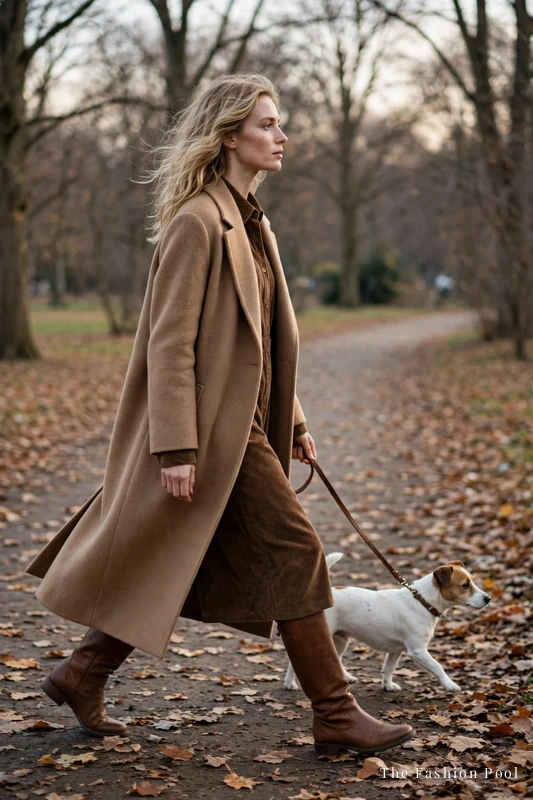
What goes under a slip dress is a long-sleeve top, and the top is the outfit’s color. A cream or navy tee under a brown slip dress is the everyday version; a fine knit roll neck under a black slip dress is the warmer version. The top should be fitted, not loose: a loose top bunches at the waist, and the dress loses its line. The coat on top is the other half of the outfit, and it should be long — a wool overcoat or a long camel coat that covers the hem. A short coat cuts the outfit at the waist and the dress disappears.
Tights are the slip dress’s partner, and the shoes are knee-high boots or ankle boots, depending on the coat. The slip dress’s limit is the day without a coat: indoors, with the coat off, it still works, but it is a quieter outfit than the shirt dress, and it needs the top to be a good one. The slip dress is the layering dress, not the standalone dress — it is at its best when the coat is part of the outfit. That is also why it is the dress for the walk: coat, dress, and boots together make a winter outfit that moves.
What not to pair with corduroy
Corduroy is a strong fabric, and it argues with other strong fabrics.
Velvet with corduroy is the first mistake: both are pile fabrics, both catch the light, and together they make the outfit look like two sofas arguing. Pick one pile fabric per outfit and let the other piece be smooth — leather, wool, cotton, denim. Shiny satin is the second mistake: it reflects the light the corduroy absorbs, and the two halves of the outfit belong to different evenings. A matte top is the fix, every time.
A chunky cable knit over a fitted corduroy dress is the third mistake: the knit is too thick for the dress’s line, the waist disappears, and the outfit has no waist at all. A fine knit is the fix — the dress keeps its shape and adds warmth without bulk. A wide belt on fine-wale corduroy is the fourth mistake: it cuts across the narrow ribs and makes the dress look divided. A thin belt is the fix, or no belt at all. Suede boots in the same brown as the dress is the fifth mistake: the two browns are close but not the same, and the outfit looks like it tried to match and missed. Black leather boots, or a brown clearly darker or lighter than the dress, are the fix — contrast on purpose.
Frequently asked questions
Can you wear a corduroy dress to work?
Yes. A corduroy shirt dress is the workday version: collar, button front, belted waist, in brown, rust, or dark green, with ankle boots or loafers. Keep the layer underneath thin — a fine knit or a roll neck — and keep the shoes office-appropriate. A pinafore is too casual for most offices.
What shoes go with a corduroy dress?
Ankle boots or loafers with a shirt dress, Chelsea boots or clean sneakers with a pinafore, heeled ankle boots with an A-line dress, knee-high boots with a midi or a slip dress. The rule is the dress’s formality: the smarter the dress, the smarter the shoe. White sneakers belong only with the pinafore.
Is corduroy warm enough for winter?
Yes, for most winter days. The ribbed cotton pile traps a little warmth, and a corduroy dress with tights is warmer than most smooth, unlined dresses. On a cold snap, add a thermal top underneath and fleece-lined tights — the dress alone is not enough for freezing days.
How do you stop corduroy from creasing?
You do not stop it entirely — corduroy creases at the seat and the elbows, and that is the fabric. Hang the dress rather than folding it, and steam it to ease creases. Some creasing at the seat is normal for corduroy — it softens as the dress is worn.
What do you wear under a corduroy dress in the cold?
A thermal top first, then a fine knit or a roll neck, then opaque tights — fleece-lined on the coldest days. Keep every layer thin: the warmth comes from the layers working together, not from one thick layer. A chunky knit under a fitted corduroy dress bunches at the waist and breaks the dress’s line.
Can you wear a corduroy dress to a dinner out?
Yes. An A-line corduroy dress in dark brown or burgundy, with a fitted turtleneck underneath, sheer black tights, and heeled ankle boots. Keep the bag small and the jewelry simple, and wear a long coat for the journey, then take it off indoors — a heavy coat presses the flare flat only while it is on.
A corduroy dress outfit is a match between the dress and the day: shirt dress for the workday, pinafore for the weekend, A-line for dinner, midi for the cold snap, slip dress under a coat. Read the day, pick the dress, and the outfit follows.
Keep your style story going.
Find your next outfit idea, styling detail or wardrobe solution.
Explore the latest edit ↗