
A velvet dress is the fastest way to look dressed up in December, and the easiest fabric to get wrong. It catches the light like no other party fabric, which is why it photographs so well — and it crushes, shows lint, and swallows jewellery like no other fabric either. The difference between a velvet dress that looks expensive and one that looks like a costume is rarely the price. It is three decisions, made in order: the cut, the quiet partner, and the finish.
This guide works through all three, with the fabric first — how its pile moves, how it takes light, how it creases when you sit — so the advice holds for any velvet dress.
Why velvet behaves differently from every other party fabric
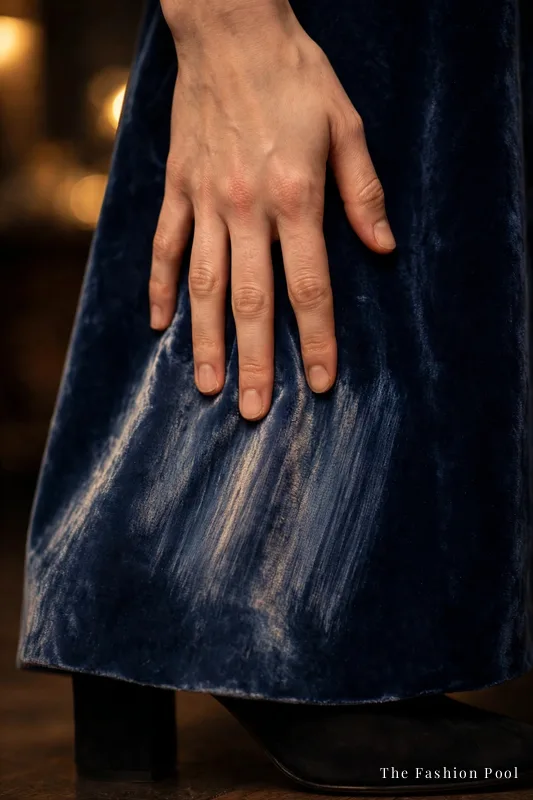
Velvet is a pile fabric: thousands of short fibres stand upright from a woven base. Brush the pile one way and the fibres lie flat and catch the light; brush it the other way and they stand up and drink it in, so the same dress can look two shades lighter or darker as you move. Satin reflects light evenly; velvet reflects it in patches.
That is also why velvet crushes. Sit down and your weight presses the pile flat where your body meets the chair; stand up and the flattened patch catches the light differently, so the crease reads as a pale mark. It is not a stain — just pile lying in a different direction — but in a photograph it looks like a mistake. Steam or a brush will usually lift it; an iron will not, because direct heat flattens pile permanently.
Weight matters as much as colour. Cotton velvet is the heaviest and most structured: it holds an A-line shape and leans daytime more than silk velvet, even in a dark colour. Silk velvet is the lightest and most fluid; it drapes beautifully and crushes most easily. Polyester velvet — what many high-street velvet dresses are made from — sits in the middle: it holds its shape and crushes less. Stretch velvet is the most forgiving fit and the least structured; it clings, so the cut has to do the shaping the fabric will not.
Colour reads deeper in velvet than in crepe or jersey, because the pile absorbs light one way and reflects it the other. Navy velvet looks almost black in a dim room and unmistakably blue by a window; plum reads as wine in lamplight and purple in daylight. Black velvet is the trickiest — in a dark room it can disappear entirely, leaving only the shape. Judge the colour in the light you will wear it in, not under a shop’s white ceiling lights.
Step 1: Choose the cut for the room
The cut decides the dress code before anything else does: velvet already reads as dressed up, and the cut pulls it back toward the occasion or pushes it further away. Three cuts cover almost every December room.
The A-line midi is the safest cut in velvet. It fits at the shoulders and waist, then falls away from the body to just below the knee, so the fabric never clings and the pile never has to stretch. In navy cotton velvet it is the most versatile velvet dress there is: a festive dinner, a drinks party, a family gathering, or — with the right shoes — a work party. It also photographs best, because the skirt holds its shape while you move. Choose long or three-quarter sleeves, and mind the hem: a midi ending at the widest part of the calf shortens the leg in photographs, so aim for just below the knee or below the calf, never at its widest point.
The wrap midi is the cut for a room where you will be sitting, eating, and photographed at a table. A wrap dress adjusts to the body instead of fighting it, which matters in velvet because the fabric gives less than jersey does. In black stretch velvet, a wrap midi with three-quarter sleeves and a V-neck is the dress for a long dinner: it stays comfortable through a meal, the skirt falls back into place when you stand, and the V-neck gives you somewhere to put the one quiet piece of jewellery. The risk is the gap: velvet is heavy, and an unsecured wrap will gape at the bust when you lean forward. A small stitch or a snap at the crossover, put in before the night, costs nothing and saves the evening. If the dress came with a tie belt, tie it at the side — a front bow in velvet is a large, heavy knot that photographs as a lump.
The slip dress is the evening cut, and the one that benefits most from a layer. A plum silk-velvet slip dress, cut on the bias, is the most beautiful version of this fabric and the least practical on its own: thin straps, no structure, pile that crushes the moment you sit. Treat it as the base of an outfit rather than the whole outfit. A fine knit top underneath in black or charcoal turns it into a daytime-leaning look; a tailored wool blazer over it makes it a dinner outfit. Our velvet blazer guide covers the blazer shapes — borrow the cut in wool, not velvet. A layer is strongly recommended here, more so than with a satin slip: satin slips, velvet grips, and a bare velvet slip can look unfinished at a formal evening event.
Whichever cut you choose, check three things before the night. Sit down in it: a dress that looks perfect standing can crease badly at the hip after twenty minutes in a chair. Walk in it: a midi too narrow at the hem pulls with every step. And look at it from behind: in a badly cut velvet dress the pile runs in different directions across the seams, and it shows as a visible shade change across the back.
Step 2: Balance the shine with one quiet piece
Velvet is a texture, not a shine — but it behaves like one. The pile catches light in patches, so the eye reads a velvet dress as the interesting thing in the room, and everything else has to be quieter than the dress. This is the step where velvet outfits most often fail, because the instinct is to add more: more sparkle, more jewellery, more texture. Velvet needs the opposite — one quiet partner, chosen well.
Start with the shoes, because they set the formality. Block heels in black suede or smooth leather are the safest partner for a midi: the suede is matte, the block heel is steady, and neither competes with the pile. What does not work is a high-shine shoe — patent leather or glitter — because the shine of the shoe and the light-play of the pile argue; a muted metallic, kept small, is the exception. Our holiday party shoes guide works through the choice by party, but the velvet-specific rule is simple: if the shoe catches the light, it is the wrong shoe. Ankle boots can work in daytime, in black suede with a low heel — but keep the shaft low and the colour dark.
Then the tights, because velvet and legs are a real decision. Opaque black tights are the practical answer for most rooms: they keep the leg warm, they give a clean line from hem to shoe, and they do not compete with the dress. Sheer tights are the riskier choice, not because of the look but because of the fabric: velvet grips, and sheer tights against a velvet hem can snag, pull, and ladder where the dress rubs. Fishnets and patterned tights fight the pile and should stay in the drawer.
Jewellery is where velvet punishes excess. The pile catches on anything with a claw, a prong, or a rough edge: a ring with a raised stone will snag the dress every time your hand brushes the skirt, and a bracelet with links will pull threads. Choose smooth jewellery — a plain gold bangle rather than a link bracelet, studs rather than drop earrings, a pendant on a fine chain worn outside the neckline. One piece is enough, and it should be the piece that catches the light, because the dress is already doing the texture work.
The bag should be small, smooth, and carried in the hand, not on the shoulder. A crossbody strap is velvet’s quiet enemy: it presses the pile flat in a band across the body, and the flattened band shows as a pale stripe that brushing rarely lifts mid-party. A small clutch or a top-handle bag in smooth leather, carried in the hand, avoids the problem entirely. If you must carry a bag on your shoulder, take it off the moment you arrive.
Step 3: Finish so it photographs well
Velvet is the most photogenic party fabric and the least forgiving of bad light. In warm lamplight, the pile glows and the dress looks rich and deep. In a camera flash, the same pile goes flat and pale, because the flash hits the fibres head-on and washes out the variation that makes velvet beautiful.
Stand where the light comes from the side, not from the front. A lamp to one side, or a window with evening light coming across the room, lets the pile show its depth: one side of the dress catches the light, the other falls into shadow, and the dress looks three-dimensional. Light from directly in front — a flash, a ceiling light overhead — flattens it. If you are posing, turn a quarter away from the light source, so the light rakes across the pile. The difference is a dress that looks like velvet against a dress that looks like flat cloth.
Steam the dress, never iron it, and do it the morning of the party. Hang the dress in the bathroom while a hot shower runs, or hold a steamer a few inches from the fabric and let the steam lift the pile. Steam relaxes the fibres and lifts crush marks from storage, from the journey, and from the hanger. An iron, even on a low setting, presses the pile flat and leaves a shiny patch that reads as damage in every photograph for the rest of the night. If the dress has been folded, steam it twice — once to lift the fold lines, and once more after it has hung for an hour, because velvet settles. A clothes brush, used gently against the nap, lifts lint and pet hair and evens out the pile.
Check the coat before you leave, because the coat is the first thing people see. A tailored wool coat in camel or charcoal sits well over a velvet dress; a faux fur coat is the festive version. Our faux fur coat guide covers choosing the shape first, and the rule applies here too: the coat should fit over the dress without crushing it. Try the coat and the dress together at home, not at the door — a coat that fits over a fine knit will not always fit over a velvet midi. Once you are inside, take the coat off: velvet needs the room’s light on it.
Do the sit test at home, in the shoes, with the bag. Put the whole outfit on, sit down in a chair, stand up, and look at the back of the dress in a mirror. The sit mark will be there — a pale patch where the pile flattened — and you need to know how visible it is and how quickly it lifts. A light brush against the nap, or ten minutes hanging, usually restores it. If the mark stays, the dress is too tight across the hip, and no styling will fix that. Better to learn it in the living room than at the party.

What not to pair with velvet
Velvet on velvet. A velvet dress with a velvet blazer, velvet shoes, or a velvet bag is too much of one texture: the pile has nothing matte to sit against. One velvet piece per outfit is the limit, and the dress is the piece.
Sequins or a satin skirt. Velvet already plays with light, so adding a sequin top or a satin skirt puts two light-catchers in one outfit, and they argue. Our Christmas party guide works through the one-shine method for a whole evening; the velvet version is simpler, because the dress does both jobs on its own.
Heavy jewellery that snags. Rings with raised stones, link bracelets, and textured chains all catch the pile — smooth jewellery only, and one piece only.
A crossbody bag. The strap mark is velvet’s most avoidable failure: a pale band across the body where the pile was pressed flat. Carry the bag in your hand.
Sheer tights against a velvet hem. The friction ladders them — opaque tights are the safer, warmer choice.
Frequently asked questions
Can I wear a velvet dress to a work party?
Yes, if the cut and the colour are restrained. A navy A-line midi in cotton velvet, with long or three-quarter sleeves, black suede block heels, and opaque tights, reads as polished rather than party-dressed. Avoid a slip dress, a very short hem, or a deep neckline.
What shoes go best with a velvet dress?
Black suede block heels are the safest choice: matte, steady, and they never argue with the pile. Pointed flats in black work for a long evening. Avoid patent leather or glitter shoes — a shiny shoe and a light-catching pile compete; a muted metallic is the exception.
Can I wear a velvet dress in daylight?
Yes. Velvet reads as richer in daylight than most party fabrics. A navy or plum velvet midi with a tailored coat and low boots is a daytime outfit. Black velvet is the hardest in daylight: it can look flat, so choose navy or plum if the party starts before dark.
How do I stop a velvet dress from crushing when I sit?
You cannot stop it entirely — pile flattens under weight. Choose a heavier cotton or polyester velvet, make sure the dress is not tight across the hip, and brush the pile gently against the nap after you stand up. Steam lifts crush marks; an iron makes them permanent.
What colours go with a velvet dress?
Navy, black, and plum are the easiest velvet colours because the pile deepens them. Emerald and burgundy are the classic Christmas choices — and the colours most likely to repeat around the room, so navy or plum stands out more. Keep the rest of the outfit matte and dark.
Can I wear a velvet dress if I am petite?
Yes — the cut matters more than the height. A knee-length A-line in velvet, with a defined waist and a heel, lengthens the leg better than a midi that ends at the widest part of the calf. Avoid a long, unstructured velvet dress, which can swallow a small frame. A wrap midi with a V-neck is usually the most flattering petite option.
The takeaway
A velvet dress is not a difficult outfit; it is a specific one. Choose the cut for the room, keep everything else matte and quiet, and finish it in the right light. Steam it in the morning, sit in it at home, and let the pile catch the lamplight.
Keep your style story going.
Find your next outfit idea, styling detail or wardrobe solution.
Explore the latest edit ↗