
A sheer top outfit works when the layer underneath is chosen first and everything else is built around it. Most sheer tops fail for one reason: the top goes on first and the question of what shows through it is answered afterwards, in a hurry. Reverse the order and the outfit stops being a gamble. Pick the layer underneath, balance the sheer with something solid on the bottom half, and finish it for the room you are walking into — three steps, in that order, and the top looks deliberate instead of accidental.
In short: a camisole or bodysuit in the same color family as the top, a solid bottom half with some structure, and one clear finish — a blazer for the office, bare arms and jewelry for the evening, a coat for the cold.
The timing is good for learning the method now. On Pinterest Trends (logged in, US, last 90 days, checked 25 Nov 2026), “sheer top outfit” is up 10% on the week, 6% on the month, and 10% on the year, rising out of a late-October dip — and Pinterest predicts peaks around 74 in the week ending 2 January 2027 and 75 in the week ending 6 February 2027. The figures are interest indexed 0–100, not absolute searches, and the predictions are estimates, not guarantees.
Step 1: Choose the layer underneath
The layer underneath is the outfit. A sheer top is transparent by design, so whatever sits beneath it is visible all day — it is the color, the coverage, and the shape of the outfit, and the sheer fabric is only the finish on top of it. Decide the underneath first, and the top becomes easy. Decide the top first, and the underneath becomes a problem you solve at the last minute.
Start with the three options that work, and pick by coverage. A camisole is the default: thin straps, a straight cut, and enough coverage for anywhere. A bodysuit is the neater version: it stays tucked, never rides up, and gives a clean line under a sheer top tucked into trousers. A fitted bralette made to be seen is the boldest version: it works when the sheer top is the point of the outfit — an evening out, a party — and it fails when the occasion needs more coverage than confidence. There is no wrong choice among the three, only a wrong occasion for each one.
Color is the decision that separates a sheer top outfit that looks planned from one that looks improvised. The rule is simple: the layer underneath should be in the same color family as the top — black only under black or dark tops, never under white. A white sheer top over a white camisole reads as one outfit — the layers soften into each other, and the sheer fabric reads as texture rather than transparency. A black sheer top over a black camisole does the same in reverse: the dark layers merge, and the outfit reads as evening. What looks improvised is a sheer top over a layer in an unrelated bright color — a red camisole under a white sheer top, for example, with black trousers and no red anywhere else. The eye goes straight to the mismatch.
Skin tone is the other color question. A nude camisole under a sheer top is the classic trick, and it works when the nude actually matches the wearer — close enough that the layer disappears. When the nude is wrong, it does the opposite: a pale nude on deep skin, or a deep nude on fair skin, reads as a separate flesh-colored garment, and the outfit looks unfinished. If the nude does not match, use black, white, or the top’s own color instead.
Opacity is the third decision, and it is a ladder, not a switch. At the top, a sheer top over an opaque camisole is wearable anywhere — the office, lunch, a family gathering. In the middle, a sheer top over a lace-edged camisole or a matching bodysuit is the evening version. At the bottom, a sheer top over a bralette is the party version, and it belongs at a party. The mistake is wearing the least opaque layer to the most formal occasion: a bralette at a work lunch is a misread room.
One check finishes Step 1, and it takes thirty seconds. Put the top and the layer on together, stand in front of a window in daylight, and look at the back as well as the front. A layer that looks opaque indoors can turn translucent against a window, and the back is where the layer gaps or rides up. If the outfit holds in daylight from the back, it will hold anywhere.
Step 2: Balance the sheer with something solid
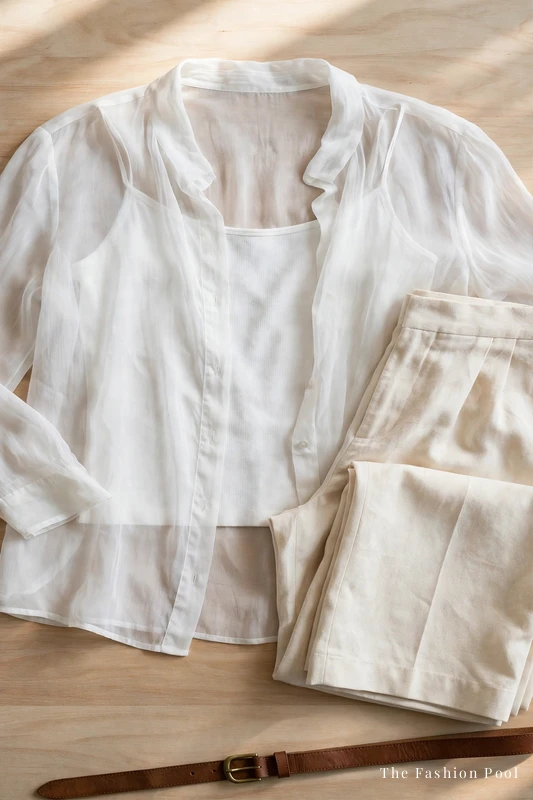
A sheer top is light, soft, and transparent. The bottom half has to be the opposite: solid, structured, and opaque. Two sheer pieces together — a sheer top with a sheer skirt, or a sheer top over sheer trousers — is a costume, not an outfit, and it leaves the eye with nowhere to rest. One sheer piece, balanced by something with weight, is the rule that holds the method together.
Tailored trousers are the easiest balance, and the one to reach for first. A black sheer top over a black camisole with high-waisted black trousers is the evening version: the trousers give the outfit its shape, the sheer top gives it its interest, and the long black line keeps the proportions calm. A fitted white sheer top over a white camisole with cream wide-leg trousers is the daytime version. The trousers should have some structure — a crease, a waistband, a straight leg — because structure is what the sheer top lacks.
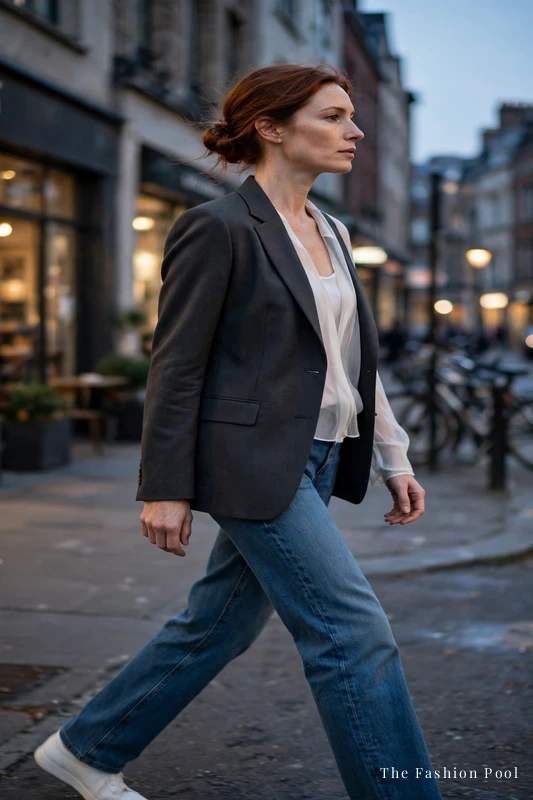
Denim is the second balance, and the one that makes a sheer top wearable on an ordinary day. A sheer top tucked into straight-leg jeans, with the camisole underneath and a belt at the waist, works for a casual dinner or a night out that is not a party. The denim does two jobs: it is opaque, so it grounds the outfit, and it is casual, so it takes the sheer top from evening to everyday. Dark-wash denim is the safer choice — it keeps the outfit in one register.
A skirt is the third balance, and the one that needs the most care. A sheer top with a pencil skirt is the office version: the skirt’s straight line and the top’s softness play against each other. A fitted sheer top with a pleated midi skirt is the softer version: the pleats move, the sheer floats, and the outfit is the one for a dinner or a wedding guest evening. What does not work is a sheer top with a short, flared skirt and bare legs — two light, moving pieces and nothing solid to hold them.
The proportion rule that ties Step 2 together is this: when the top is sheer and loose, the bottom should be fitted or structured; when the top is sheer and fitted, the bottom can be looser. A billowy sheer blouse over wide-leg trousers is too much fabric with no waist to anchor it. The same blouse tucked into a pencil skirt or straight-leg jeans has a waist, and the outfit has a line. A fitted sheer bodysuit top can take a wide-leg trouser or a full midi skirt, because the top is already giving the outfit its shape.
Step 3: Finish it for the room you are walking into
The same sheer top outfit changes its meaning with the finish, and the finish is chosen by the room. A sheer top with a camisole and tailored trousers is three different outfits depending on what goes over it and what goes on the feet — read the room, then finish the outfit for it.
For the office, the finish is a blazer. A sheer top under a tailored blazer worn buttoned, with the camisole underneath and tailored trousers or a pencil skirt, is the work version — the closed blazer covers the sheer fabric through the shoulders and arms, so what shows is the neckline and the cuffs, and the outfit reads as a blouse with texture. The blazer should be structured, not soft: a soft, draped blazer doubles the softness and the outfit loses its edge. The shoes are loafers or low-heeled pumps, the jewelry is one quiet piece, and the bag is structured. The rule for the office: the sheer top should never be the loudest thing in the outfit.
For the evening, the finish is the opposite: take the cover off and let the sheer top lead. A black sheer top over a black camisole, with tailored trousers and heeled ankle boots, needs almost nothing else — the top is the outfit, and the finish is the jewelry and the shoes. One statement piece is enough — earrings or a cuff bracelet; a necklace over a sheer neckline competes with the fabric and usually loses. If the evening is a party rather than a dinner, keep the shine to one piece: our sequin outfit guide covers the same slot with sequins instead of sheer, for the nights when sparkle is the point. For a Christmas party specifically, our Christmas party outfit guide works through the evening dress code in full.
For a cold day, the finish is a coat. A sheer top under a long wool coat, with a camisole underneath, tailored trousers, and knee-high boots, is a winter outfit — the coat does the warming and the sheer top does the looking, visible at the neckline and the cuffs. The coat should be long enough to cover the hem of the top, or the outfit is cut in half at the waist. The same coat-layering logic works with a dress instead of the top and trousers — our corduroy dress guide matches five dress cuts to five winter days.
For daytime, the finish is restraint. A white sheer top over a white camisole with straight-leg jeans and clean sneakers or loafers is the daytime version: the sheer is there, but nothing else in the outfit is trying to be noticed. The jewelry is minimal, the bag is a tote or a cross-body, and the hair is simple — the sheer top is the one interesting thing, and one is enough. Daytime is also where the tuck matters most: a sheer top left untucked over jeans drifts and reads as unfinished, while the same top tucked in with a belt reads as an outfit.
What not to do with a sheer top
Sheer fabric forgives very little, and the mistakes are specific. Five of them cover almost every sheer top outfit that goes wrong.
The first mistake is two sheer pieces at once. A sheer top with a sheer skirt or sheer trousers leaves the outfit with no solid piece to rest on, and the result reads as a costume. The fix is the Step 2 rule: one sheer piece per outfit, and everything else solid and opaque.
The second mistake is the wrong layer underneath — usually an everyday bra worn as if it were a camisole. An everyday bra under a sheer top is underwear showing through a top, and it reads that way no matter how expensive the bra is. The fix is a real layer: a camisole, a bodysuit, or a bralette made to be seen.
The third mistake is a sheer top in a color that fights the layer underneath. White sheer over a black camisole is not a contrast, it is a collision — the black shows through the white as a dark block. The fix is the Step 1 color rule: same color family, or black under black.
The fourth mistake is ignoring the back. Sheer tops gap at the back, ride up at the back, and turn translucent against a window at the back, and the wearer never sees any of it. The fix is the thirty-second check from Step 1: daylight, window, back view, before leaving.
The fifth mistake is treating a sheer top like a plain top and piling on accessories. A sheer top already has texture, movement, and visual interest — it does not need a statement necklace, statement earrings, a scarf, and a bold bag all at once. The fix is one finish: earrings or a cuff for the evening, a blazer for the office, a belt for daytime.
Frequently asked questions
What do you wear under a sheer top?
A camisole, a bodysuit, or a fitted bralette — chosen as a layer, not as underwear. A camisole is the default and works anywhere. A bodysuit stays tucked and gives the cleanest line. A bralette is the boldest option and belongs at a party or an evening out. The layer should be in the same color family as the top, or black under black.
Can you wear a sheer top to work?
Yes, with two conditions. First, the layer underneath must be opaque — a camisole or a bodysuit, not a bralette. Second, the sheer top should sit under a structured blazer worn buttoned, so what shows is the neckline and the cuffs, not the full sheer panel. With tailored trousers or a pencil skirt, loafers or low-heeled pumps, and one quiet piece, the outfit reads as a blouse with texture.
Is a sheer top appropriate for a daytime outfit?
Yes, when the rest of the outfit is quiet. A white sheer top over a white camisole with straight-leg jeans and loafers or clean sneakers is a daytime outfit — the sheer is the one interesting thing, and nothing else competes with it. Tuck the top in with a belt and keep the jewelry minimal.
How do you wear a sheer top in winter?
Layer it. A sheer top over a camisole, under a long wool coat, with tailored trousers and knee-high boots, is a winter outfit — the coat keeps you warm while the sheer shows at the neckline and the cuffs. Swap the camisole for a thermal camisole for extra warmth without bulk. The coat should be long enough to cover the hem of the top.
What bottoms go best with a sheer top?
Tailored trousers first, then straight-leg jeans, then a pencil skirt or a pleated midi. The bottom half should be solid, structured, and opaque — it is the balance to the sheer top. A billowy sheer top needs a fitted or structured bottom; a fitted sheer top can take a wider trouser or a fuller skirt. Avoid a second sheer piece on the bottom half, and a short flared skirt with bare legs.
How do I stop a sheer top from looking too revealing?
Three things, in order. Pick an opaque layer underneath in the same color family as the top, so the layers merge. Keep the outfit to one sheer piece, with a solid structured bottom half. And finish it for the room — a blazer for the office, a coat for the cold, a tuck and a belt for daytime. If it still feels too revealing, change the layer: swap the bralette for an opaque camisole or a bodysuit.
A sheer top outfit is a method, not a gamble: choose the layer underneath first, balance the sheer with something solid, and finish it for the room you are walking into. Get those three steps right and the top stops being the risky piece in the wardrobe.
Keep your style story going.
Find your next outfit idea, styling detail or wardrobe solution.
Explore the latest edit ↗