A comfy thanksgiving outfit starts with the waist, not the top. Most Thanksgiving outfits are chosen for how they look standing still — and then the day asks the outfit to sit through a long meal, stand at the stove, and settle onto the sofa for the afternoon. The waistband that felt fine at noon digs in by three. Thanksgiving at home is a long day, and a long day needs a comfort system, not a single comfortable piece.
This guide builds that system in three steps, in the order that matters: the waist first, because the waistband decides the day; the layers second, because soft layers are what you sit in for hours; and the finish third, because the shoes, the hair, and the small choices decide whether the outfit survives the afternoon. Each step is a decision you make once, in the morning, and then forget about. It is also a different day from a friends’ gathering: our Friendsgiving guide covers the friend-hosted potluck, with outfits for the host, the dish-bringer, and the plus-one. This article is the family version — one house, one long table, no change of outfit between the turkey and the pie.
Thanksgiving at home is a day you live in, mostly in your own house, with family, around one table. The cooking happens in the morning, the meal runs long, and the afternoon stretches out on the sofa, with a walk somewhere in between if the weather allows. The outfit has to cover all of it, from the first pan to the last slice, without a single adjustment.
| Step | The decision | The pick |
|---|---|---|
| 1 | The waist | Elastic, drawstring, smocked, knit dress |
| 2 | The layers | Soft knit, cardigan, wrap — nothing stiff |
| 3 | The finish | Slip-on shoes, hair up, no fussy extras |
Step 1: Pick the forgiving waist
The waistband decides the day. Everything else can be right — the color, the knit, the shoes — and a rigid waistband will still ruin the afternoon, because Thanksgiving is a meal that expands and a day that sits. A waistband that felt fine at noon is a different waistband by three, after the second helping and the third hour on the sofa. The fix is not willpower or a smaller meal. The fix is a waist that gives.
There are four forgiving waists, and they all work the same way: the waist adjusts to the body instead of the body adjusting to the waist. Elastic is the simplest — a soft waistband in a knit pant or a skirt, hidden under a top, that stretches without digging. Drawstring is the most adjustable — a cord you pull snug in the morning and loosen after dinner. Smocked is the prettiest — a gathered, stretchy band built into a dress, like the rust knit dress above, that holds its shape while it gives. And a knit dress with no waistband at all is the fourth: a dress that skims the waist instead of cinching it.
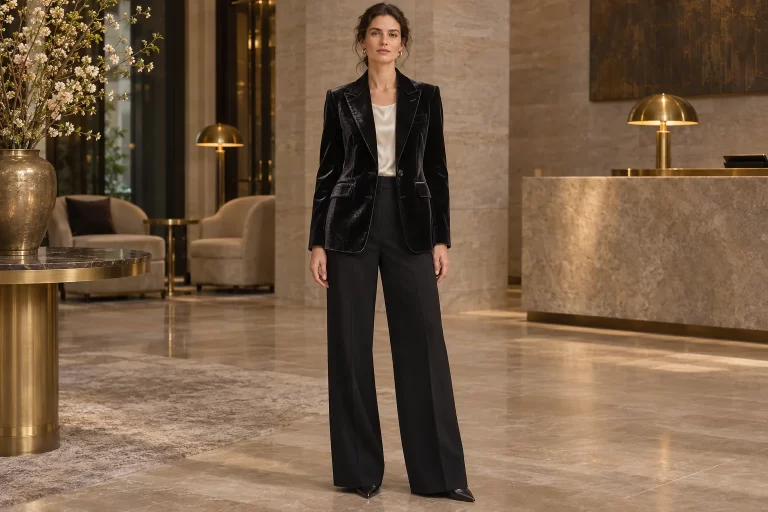
A rigid waistband — the tailored trouser, the buttoned jean, the belted dress — holds its shape and makes the body hold its shape too. It is fine for two hours at a restaurant. It is not fine for six hours at home, sitting, standing, cooking, eating, sitting again. The difference shows up quietly: a hand at the waistband, a top pulled down, a walk to the kitchen to loosen a button. A forgiving waist never asks for that.
A knit dress with a smocked waist is the easiest one-piece version: the dress is the outfit, and there is nothing to match. Soft wide-leg pants with a drawstring waist are the most adjustable: the pants move with the day, the top can be anything soft, and the drawstring is there when the meal is done. An elastic-waist knit skirt with a fine knit top reads most dressed-up: the skirt gives the outfit a shape while the elastic gives the waist its ease.
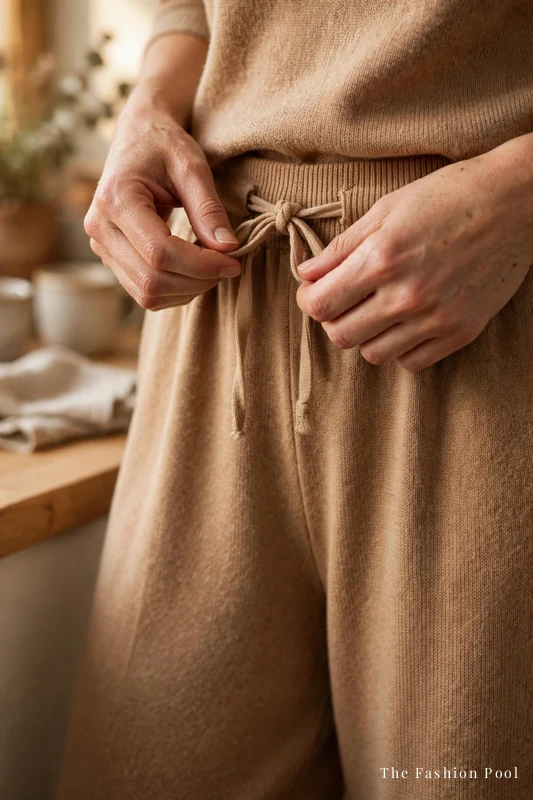
The drawstring is the one forgiving waist that is also a tool: on soft wide-leg pants, like the ones in the photo, you pull it snug while you cook and loosen it a notch after dinner, and the pants stay the same pants. Our faux leather leggings guide covers the stretchy-legging version: a forgiving waist with a soft leg, worn under a long top.
Jeans are the most common Thanksgiving bottom and the least forgiving one. Our Thanksgiving outfits with jeans covers the jeans route in full — dark denim, the right top, the outfit built around the jean. This article starts from the other end of the same family day: the waist is the starting point, not the jean. If your jeans have a forgiving waist — a stretch denim with give, or a drawstring-waist jean — the two guides agree. If the jeans are rigid, follow this guide: a rigid jean is the waistband that will ask for attention by mid-afternoon.
Step 2: Build soft layers
Once the waist is forgiving, the layers are next — and the rule is simple: nothing stiff. Thanksgiving at home is a sitting day, a cooking day, and a reaching day, and stiff tailoring fights all three. A structured blazer pulls at the shoulder when you reach for a dish. A crisp shirt creases at the waist when you sit for three hours. Soft layers do not fight the day; they move with it.
A soft layer is a knit, a cardigan, or a wrap — something with give in the fabric and room in the cut. Start with the base: a fine knit top in a warm color, close enough to layer under things, soft enough to sit in for hours. Over it, a cardigan — the layer that makes the outfit a Thanksgiving outfit rather than a Tuesday outfit. An oversized cardigan in cream, worn open over a rust knit top, is the version in the photograph in Step 3: the cardigan is the warmth, the color contrast is the outfit. A wrap top is the other version: the tie waist echoes the forgiving waist underneath.
The cardigan earns its place because it does two jobs at once, and it does them quietly. It is the warmth for a house that runs cool in the morning and warm by the afternoon — on in the morning, off by dinner, back on for the evening. And it is the texture: a chunky knit against a fine knit. Our chunky knit sweater guide covers the heavy-knit version of this layer in full — the weight, the drape, and the way a chunky knit carries an outfit.
Layering for a long sit is different from layering for a walk, and the difference is the shoulders and the waist. A layer that binds at the shoulder will pull every time you reach across the table; a layer that is tight at the waist will ride up every time you sit down. Put the layers on, sit in them, reach in them, and check. A cardigan that slips off the shoulder is one you will push back all day. The layers that pass are the ones you forget.
A rust knit top under a cream cardigan, a deep green knit under a camel wrap — soft layers carry color the way a stiff jacket never does, because the knit texture softens the color instead of sharpening it. Two colors are enough: one for the base, one for the layer over it.
The last layer decision is the one for the walk — to the car, around the block after dinner, to the neighbor’s door. A long cardigan that reaches the hip is usually enough for a short walk on a mild November day, and it is the layer that is already on. If the day is colder, a soft wrap coat over the cardigan keeps the outfit intact: on over everything, off at the door, and the layers underneath unchanged.
Step 3: Finish for a long at-home day
The finish is everything small: the shoes, the hair, and the accessories. The rule is the same as for the layers: nothing that needs attention. The finish is the part you set once and forget.
Thanksgiving at home is a shoes-off-or-on day in most houses, and the shoe has to work both ways: comfortable to stand in at the stove, easy to slip off at the door. Slip-on shoes are the answer — a soft loafer, a slip-on sneaker in a dark color, or a flat mule that goes on and off without a hand. A lace-up shoe is the wrong shoe for a house where the shoes come off. A heel is the wrong shoe for a day of standing at the stove and sitting on the sofa: it asks the foot to work all day, and the foot will notice by dinner.
Hair is the part of the outfit that falls apart first. A long day of cooking, eating, and sitting is a long day of steam and leaning back on a sofa — and hair worn down will end up in the food, on the face, and over the shoulders in every photograph. Hair up and out of the way is the finish that lasts: a low bun, a loose topknot, or a simple braid. A low bun reads most polished: it frames the face and stays put for hours. A topknot reads most relaxed, and it survives the sofa best, with nothing at the back of the head to press against a cushion.
Accessories third, and the rule is restraint. A long at-home day does not need jewelry that catches on a cardigan or dangles into a dish. One quiet piece is enough: small studs, a thin chain, or a simple ring. A long necklace will swing into the food; a dangling earring will catch on a knit and pull. The accessories that work at Thanksgiving are the ones you forget you are wearing.

The sofa is where the finish proves itself, and the photo above is the test: a cream cardigan over a rust knit top, soft wide-leg pants, feet up, a book in hand. Nothing is being adjusted. The hair is up in a topknot, out of the way. The shoes are off, because the day is inside now, and the feet are up on the sofa. Try it at home the way the photo shows it — sit cross-legged, feet up, for an hour — and check whether anything pulls, digs, or slips.
What not to wear to Thanksgiving
Some outfits fail the Thanksgiving test in ways that only show up after the meal. The rigid waistband is the first: the tailored trouser, the buttoned jean with no stretch, the belted dress pulled tight. It fits at noon and digs in by three, and the fix is a forgiving waist, which is Step 1. The stiff top is the second: the structured blazer, the crisp shirt, the tailored jacket that needs standing up straight. The heel is the third: the shoe that asks the foot to work all day, and the foot notices by dinner. The fussy accessory is the fourth: the long necklace that swings into the food, the dangling earring that catches on a knit. And the white top is the fifth: it starts the day spotless and wears the meal by dessert.
None of these is a bad outfit on another day. A rigid waistband is fine for a two-hour dinner out. A stiff blazer is fine for an office party. A heel is fine for an evening that ends at ten. But Thanksgiving at home is a long day in one house, and the outfit that works is the one built for the day it is worn. If it would need adjusting, loosening, or changing before the pie, it is the wrong outfit for this day.
Frequently asked questions
What is a comfy Thanksgiving outfit?
A comfy thanksgiving outfit is a comfort system for a long at-home family day: a forgiving waist, soft layers, and a finish made for hours at home (slip-on shoes, hair up, one quiet accessory). The waist decides the day, the layers decide the sitting, and the finish decides whether you stop thinking about the outfit.
Can I wear jeans to Thanksgiving?
Yes, if the waist is forgiving — a stretch denim with give, or a drawstring-waist jean. A rigid jean with no stretch is the waistband that digs in by mid-afternoon. Our Thanksgiving outfits with jeans covers the jeans route in full. If the jeans are rigid, follow this guide instead.
What should I wear to Thanksgiving dinner at home?
A knit dress with a smocked waist, or soft wide-leg pants with a drawstring waist and a fine knit top, plus a cardigan for the cool morning, taken off as the house warms up. Slip-on shoes, hair up, and one quiet accessory. The outfit should cover the cooking, the meal, and the afternoon on the sofa.
Is a knit dress comfortable for Thanksgiving?
Yes — a knit dress with a smocked waist or no waistband at all is one of the most comfortable Thanksgiving outfits, because nothing rigid digs in after the meal. Add a cardigan over it for the walk.
What shoes should I wear for Thanksgiving at home?
Slip-on shoes: a soft loafer, a slip-on sneaker in a dark color, or a flat mule. They go on and off without a hand, which matters where the shoes come off at the door, and they are comfortable enough to stand in at the stove. Avoid heels for a long at-home day, and avoid lace-ups if the shoes will come off more than once.
Can I wear leggings to Thanksgiving dinner?
Yes, if they are the forgiving-waist kind — a stretch legging with a soft waistband, worn under a long top or a knit dress that covers the hip. Our faux leather leggings guide covers the stretchy-legging version of the same idea. Avoid a legging with a rigid waistband or a short top: the top should cover the waist.
A comfy thanksgiving outfit is not a look. It is a system: a waist that gives, layers that sit, and a finish that stays out of the way. Pick the waist first, build the soft layers over it, finish for the long day — and then forget about the outfit and enjoy the day.
Keep your style story going.
Find your next outfit idea, styling detail or wardrobe solution.
Explore the latest edit ↗