A cabin weekend outfit fails in one of two ways: it is either a ski outfit worn indoors, or pyjamas worn outdoors. It is cold, so the warmest thing feels right; it is private, so nobody seems to be looking. Then the photographs arrive.
The fix is to dress deliberately, once per moment. A cabin weekend has five moments — Friday arrival, fireside evening, Saturday walk, Saturday dinner, Sunday departure — and each has its own outfit. Ten looks below, two per moment — the last is the morning dress restyled for the road, not a tenth new outfit. The test for every one: would this outfit work by the fire, at the table, and out of the front door? If it only works because nobody at the cabin is looking, it does not.
Pinterest interest in the cabin weekend outfit peaked twice this autumn — at 100 on Pinterest’s 0-to-100 index in the week ending 14 October 2026, and again at 98 in the week ending 11 November — and has eased since, to 60 in the week ending 25 November. Those are interest-index readings from logged-in Pinterest Trends (US, checked 28 November 2026), not search counts, and no growth percentages were shown. The audience is 87% female, with the 25–34 age group the largest at 49%. December is cabin season in the sense that the weekends themselves run through December — the Pinterest readings above run only to 25 November, so no December figure is claimed here.
The put-together test
One cabin piece per outfit, and the cabin piece is the only thing allowed to be rustic. Flannel, chunky knit, plaid, shearling, waxed cotton — or one deep woodland colour, or one rich winter texture such as velvet — pick one, and let it be the thing that says cabin, and let it do a job as well as look the part: warmth, weatherproofing, or grip. A cabin weekend outfit is finished everywhere else: proper shoes, a real coat, hair done, jewellery worn properly.
Run the fireside-to-door test before you pack: picture the outfit by the fire, then at the cabin dinner table, then stepping out of the front door — without changing shoes or coat. If it holds up in all three places, pack it; if it only works in one of them, leave it behind. Pack for five moments, not for three days: a bag packed by day holds one outfit per day, repeated across moments; a bag packed by moment holds one outfit for each moment, with nothing repeated.
Friday arrival
1. The arrival: cream knit, dark jeans, camel coat
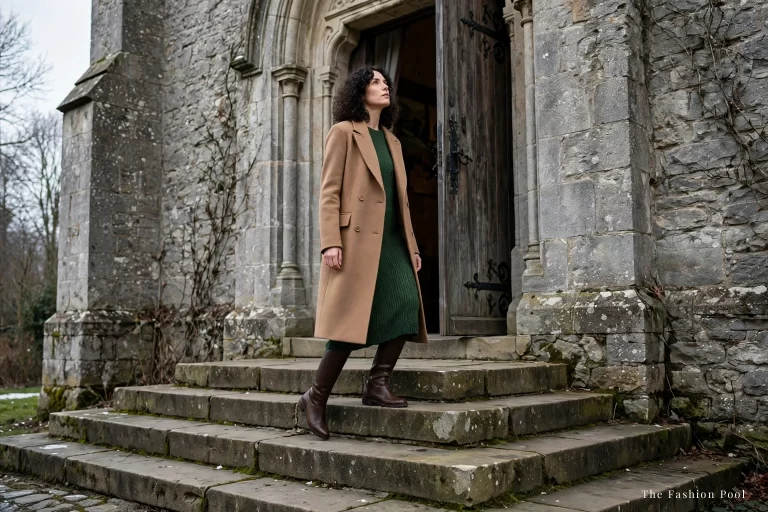
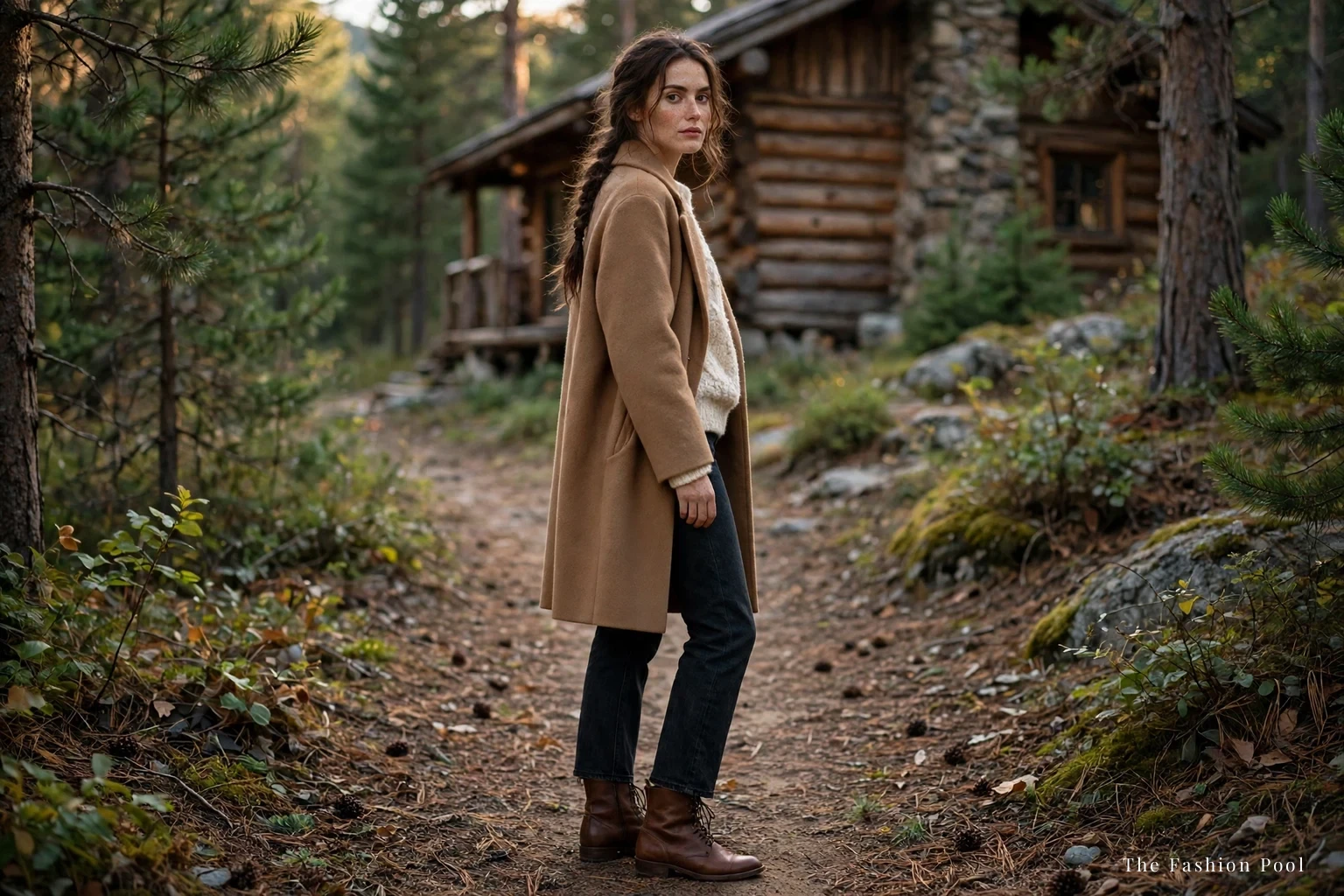
The first outfit sets the tone: a cream fine-knit jumper, dark straight-leg jeans, brown leather ankle boots with a low block heel, and a camel wool coat worn open. The cabin piece is the knit — cream, fine, soft — and everything else is plain and dark, so the knit is what the eye finds first.
The coat matters most at arrival: it is the first thing everyone sees and the last thing you take off. Camel wool sits well over dark jeans and reads clearly in the arrival photograph. The boots should be leather, not suede: the ground is muddy, and suede remembers mud.
2. The arrival, after dark: plaid scarf, wool coat, leather boots
The second arrival outfit is for the weekend that starts late, when the light is gone: a plaid scarf in deep red and navy wool, a plain charcoal wool coat, a black fine-knit top, dark jeans and black leather ankle boots. The cabin piece is the scarf — plaid, wool, the colour of the weekend — and the plain charcoal coat leaves it the only pattern in the outfit.
The scarf is both the cabin piece and the warmth: wear it outside the coat, looped once, ends hanging evenly. The boots should be flat or low-heeled: the arrival walk is over uneven ground in the dark, and a heel on gravel is a twisted ankle waiting to happen. Our plaid skirt guide shows how one plaid piece carries an outfit — the same idea here, with the scarf as the single plaid piece.
Fireside evening
3. The fireside: chunky knit, dark jeans, shearling slippers
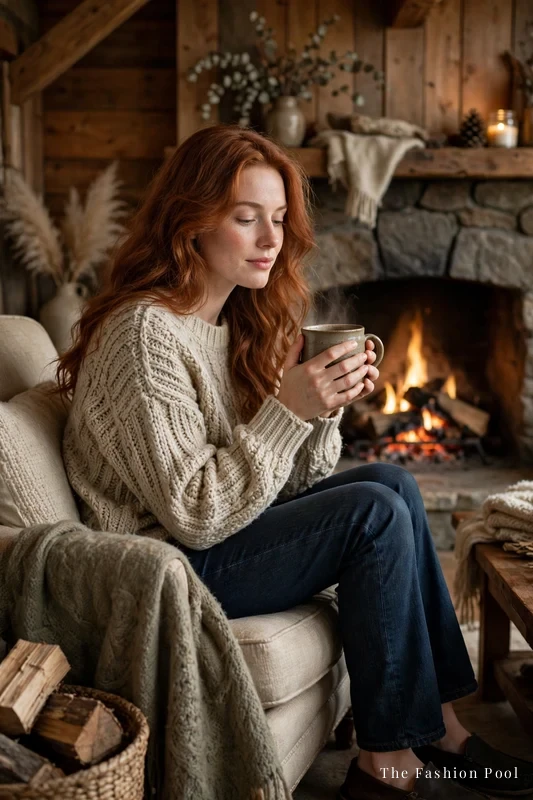
The fireside is the moment most people relax the test — and the moment it matters most, because the fireside photographs are the ones that get kept: a chunky knit jumper in oatmeal, dark straight-leg jeans, and plain dark leather slippers — indoors only, by the fire. The cabin piece is the knit, and the jeans are what keep the outfit from becoming loungewear: dark, straight, neat, with a proper waistband and no elastic.
The knit is the decision that makes or breaks this outfit: a chunky knit in oatmeal is the fireside piece, while a bright colour or a novelty pattern reads as a Christmas jumper by the fire, and a Christmas jumper by the fire is a different article. Our chunky knit guide covers the knit shapes — borrow the cream crewneck, not the novelty. The slippers stay indoors.
4. The fireside, dressed up: flannel shirt, knit dress, tights
The fireside outfit for the evening when the weekend wants to feel like an occasion, not a night in: a flannel shirt in deep green and navy, worn open over a black fine-knit midi dress, with black opaque tights and dark leather ankle boots. The cabin piece is the flannel — the shirt, not the dress — and the dress is what makes it an evening outfit rather than a lounging one.
The shirt is the layer, not the outfit: worn open, sleeves to the elbow, over a dress that is complete on its own. Worn closed, the flannel covers the dress and hides it; worn open, the black dress shows and the flannel frames it.
Saturday walk
5. The woodland walk: waxed jacket, knit, jeans, walking boots
The walk is the most practical moment of the weekend, and the hardest to look put together in: a waxed cotton jacket in olive or dark green, a cream fine-knit jumper, dark straight-leg jeans and brown leather walking boots with a lugged sole. The cabin piece is the jacket — waxed cotton, the country piece — and everything underneath is plain, dark and neat.
Get the boots right and the rest follows: a lugged sole, a low heel, a boot that grips mud and wet leaves. Brown leather, plain, with a proper sole — that is the boot. A scarf should be plain wool in a dark colour, tucked into the jacket.
6. The village walk: parka, knit dress, tights, boots
The walk for the morning that ends in the village — coffee, a shop, a look around: a dark parka, a dark green fine-knit midi dress, black opaque tights and dark leather knee-high boots with a flat sole. The cabin piece is the knit dress — the knit is the cabin cue — and the parka is simply the weather layer over it; the dress underneath is what makes the outfit work indoors, when the parka comes off.
The dress is the point: a walk that ends in a café needs an outfit underneath the coat, and a knit dress with tights survives both. The tights should be opaque and black, and the boots flat — a heeled boot on a village pavement in winter is a slip waiting to happen. If the walk turns snowy, our snow day guide covers warm, dry and steady for a day out in snow.
Saturday dinner
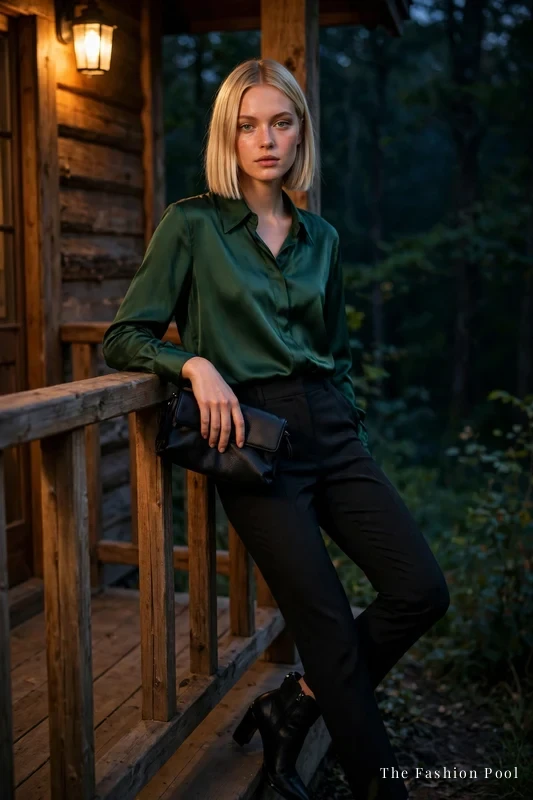
7. The cabin dinner: satin blouse, dark trousers, heeled boots
The dinner is the most dressed-up moment of the weekend: a satin blouse in deep green or burgundy, dark tailored trousers, and black heeled ankle boots with a block heel. The cabin piece is the colour — deep green, the colour of the trees outside — and the satin is the festive piece, the thing that makes it a dinner outfit rather than a walk outfit.
Choose the blouse for lamplight, not for a ballroom: satin, not sequin, because satin holds a soft sheen in a small lamplit room while sequins glitter constantly. The trousers should be tailored and dark, and the boots heeled but block — the floor is wood and the evening is long.
8. The dinner out: velvet top, dark jeans, heeled ankle boots
The dinner for the evening when the table is in the village, not the cabin: a velvet top in black or deep plum, dark straight-leg jeans, black heeled ankle boots and a small black clutch. The cabin piece is the velvet — the texture of the weekend — and the jeans keep the outfit grounded: dark, straight, neat, with no fading and no distressing.
The top is the whole outfit’s idea: velvet reads as dressed up, and a velvet top over dark jeans is the most reliable version of it. The jeans should be dark enough to read as trousers in lamplight, and the boots heeled, with a block heel you can stand in for the whole evening. The clutch is small — a phone, a card, a lipstick — and dark. The coat is tailored wool for this dinner; for a faux-fur version instead, our faux fur coat guide covers choosing the shape first.
Sunday departure
9. The lazy morning: knit dress, tights, boots
The Sunday morning is the moment most people relax the test a second time — and the moment it matters most, because the departure photographs are the ones that get kept: a fine-knit midi dress in charcoal or navy, black opaque tights and dark leather ankle boots with a low block heel. The cabin piece is the knit dress itself — soft, warm, the shape of a slow morning — and the tights and boots keep it an outfit rather than a dressing gown.
The dress should be fine-knit, not chunky: a chunky knit dress in the morning is a blanket with sleeves, and a fine-knit dress is an outfit. The boots should be leather, not suede — the ground is still muddy. The coat is the camel wool coat from Friday, worn open over the dress: the weekend starts and ends in the same coat.
10. The drive home: the morning dress, restyled for the road
The last look of the weekend is the one worn longest, and photographed least — which is why it is the easiest to get wrong: the same fine-knit dress from the morning, the camel wool coat, and the plaid scarf from Friday night, with the dark leather ankle boots. The scarf is the cabin piece here — plaid, wool, the colour of the weekend — and the knit dress underneath is the plain base carried over from the morning, not a second cabin piece.
The drive home is a sitting outfit, with different rules: nothing that digs in at the waist, nothing that rides up, nothing that needs adjusting every twenty minutes. The knit dress has no waistband to dig in; the scarf can be loosened or taken off; the boots have the same low block heel as the morning, low enough to drive in.
What makes a cabin outfit look put together
One cabin piece, everything else finished — and the failures all break the rule the same way.
The first failure is the second cabin piece: flannel with a chunky knit, a chunky knit with a plaid scarf, a plaid scarf with shearling boots — each pair is a theme, and a theme is a costume. One rustic piece per outfit, and slippers by the fire do not count as a second one only if they are plain leather, not shearling. The second failure is the unfinished piece: pyjama bottoms as trousers, slippers worn outside, a coat that is really a blanket.
The third failure is the wrong shoes: leather boots with a proper sole are the answer at every moment except the fireside. The fourth is the coat that does not fit the outfit: try the coat and the outfit together at home, not at the door — a coat that crushes the outfit underneath it has already failed.
What not to pack
A second cabin piece in every outfit. One flannel shirt is a cabin piece; three flannel shirts is a uniform — and two rustic pieces in one outfit is a costume, not a cabin look. Pack one cabin piece per moment, and let the rest of the bag be plain, dark and finished.
Heels you cannot walk in. A stiletto on gravel, a heeled boot on a woodland path — the ground at a cabin is not a pavement. Pack one heeled boot with a block heel for dinner, and flat boots for everything else.
A coat chosen only for warmth, not for the outfit. The coat is the first thing people see at every moment. A tailored wool coat in camel or charcoal is the safest choice, and it should fit over the thickest thing in the bag without crushing it.
Anything you have never sat in. A neckline that needs checking, a skirt that rides up, shoes that hurt after an hour — all of it shows up only when the outfit is worn, not when it is tried on. Try it on at home and sit down in it: whatever needs fixing will tell you in the living room, where it costs nothing, instead of at the cabin, where it costs the weekend.
Frequently asked questions
What do I wear to a cabin weekend?
Pack by moment, not by day: an arrival, a fireside, a walk, a dinner and a departure outfit, each with a single cabin piece and everything else finished.
Can I wear jeans to a cabin dinner?
Yes, if they are dark, straight and neat, with no fading and no distressing. Dark jeans with a velvet top and heeled ankle boots read as a dinner outfit.
What shoes do I pack for a cabin weekend?
Four pairs: brown leather walking boots with a lugged sole for the woodland walk, dark leather knee-high boots with a flat sole for the village walk, black leather ankle boots with a low block heel for arrival and the cabin dinner — the heeled ankle boots for dinner out are the same pair, worn with a block heel — and plain dark leather slippers that stay indoors by the fire.
What do I wear by the fire?
A chunky knit in oatmeal with dark straight-leg jeans, or a flannel shirt worn open over a black knit dress. The fireside is the moment most people relax the test — and the moment it matters most.
What coat works at a cabin?
A tailored wool coat in camel or charcoal: it sits well over dark jeans and knit dresses.
What do I wear for the drive home?
The same fine-knit dress from the Sunday morning, the camel wool coat, and the plaid scarf from Friday night. A drive-home outfit is a sitting outfit: nothing that digs in at the waist, nothing that rides up, and boots with the same low block heel, low enough to drive in.
A cabin weekend outfit is not a costume and not a surrender. It is one cabin piece, worn on purpose, with everything else finished — proper shoes, a real coat, hair done — at all five moments of the weekend. Pack by moment, run the fireside-to-door test, and the photographs will look like a weekend that was planned.
Keep your style story going.
Find your next outfit idea, styling detail or wardrobe solution.
Explore the latest edit ↗