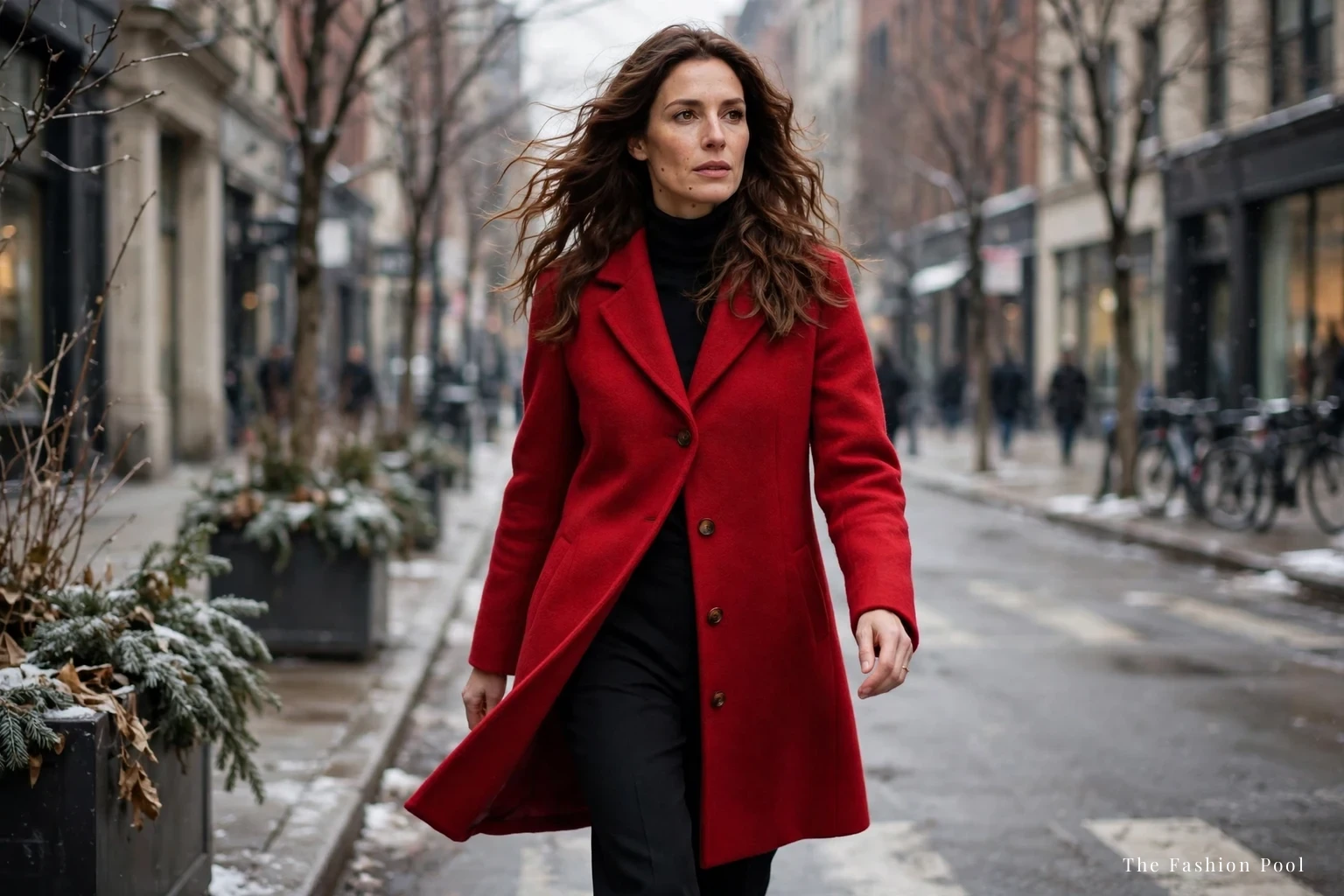
A red coat outfit announces itself before you say a word. A red dress is a colour you wear; a red coat is a colour you arrive in — a large coloured surface that everyone sees from across the street, in the doorway, and in every photograph taken before you have even sat down. That is why a red coat goes wrong more often than a red dress: there is simply more of it to balance.
The fix is not to tone the coat down. It is to build the outfit in three steps, in this order: choose the red for the room you are going to, balance it with one quiet base, and finish it so it photographs well. Skip a step and the outfit falls apart. Follow them and the coat does what it is supposed to do — make an ordinary winter outfit look deliberate.
Step 1: Choose the red for the room
Not all reds are the same, and on a coat the difference matters more than on any smaller garment, because there is so much surface for the shade to show. Four reds cover almost every coat you will find.
True red is the neutral red — neither warm nor cool, the red of a pillar box. It suits most skin tones and most rooms, which is why it is the safest first red coat. Blue-red leans cool and slightly dark, the red of cranberries; it looks richest in the evening and suits cool skin best. Brick red leans warm and slightly orange, the red of terracotta; it is the easiest red in daylight and suits warm skin best. Burgundy-red is the deepest of the four, close to wine; it reads as the most formal and the most forgiving in warm indoor light.
Match the red to your skin before you match it to your wardrobe. As a rough guide, cool skin — veins that look blue at the wrist, skin that burns before it tans — takes a blue-red. Warm skin — veins that look green, skin that tans easily — takes a brick red. Deep skin takes a true red or a burgundy-red, which stays vivid against a deeper complexion. If you are unsure, use the jaw test: hold the coat against your jaw in daylight, not under shop lights, and look at your face. The right red makes your skin look clearer; the wrong one makes it look tired.
Then match the red to the light it will be seen in. Red deepens under warm light, so a brick red that looks fresh in daylight can look orange by candlelight, and a blue-red that looks severe in daylight turns rich in the evening. Ask where the coat will spend most of its time. A coat for daytime errands, school runs and Christmas markets wants a brick red or a true red, which holds up outdoors. A coat for evening arrivals wants a blue-red or a burgundy-red, which deepens well in warm rooms. If the coat has to do both, true red is the compromise — the most even-tempered of the four across both kinds of light.
The cut matters as much as the shade, because the cut decides how much red there is. A single-breasted coat that ends at the knee is the most versatile red coat: enough surface to make the statement, not so much that it overwhelms a smaller frame. If a red coat feels like too much statement, our camel coat guide plays the same outerwear role in a quieter colour. A wrap or belted coat defines the waist under a loud colour, which helps, because an unbelted red coat can read as one large block. Our faux fur coat guide works through the same waist problem for a coat with even more volume. A longline coat that reaches the calf is an evening coat — it needs a heel to carry the length, and it wants the quietest base of the three cuts. A shorter red coat that ends at the hip reads as daytime in most shades, because it shows more of the outfit underneath.
Step 2: Balance the colour with one quiet base
Once the red is chosen, a red coat outfit needs everything underneath it to go quiet. The rule is one neutral family for the whole base — black, charcoal, navy, cream, or dark denim — not a mix of two. A black base under a red coat is the sharpest version; navy is the softest; cream is the lightest and the one that needs the most care, because cream next to red shows every mark. Pick the family that suits the room from step 1 and stay inside it.
The test for step 2 is the reveal: open the coat and look at the outfit underneath as if the coat were not there. It has to be finished on its own, because the coat comes off at the door and the evening continues without it. A red coat over a half-finished outfit fails because the coat does the work outside and the outfit underneath does nothing inside. Put the base together first, then add the coat, not the other way round.
The neckline zone is where the balance is won or lost. The coat’s collar sits against your face, so what you wear at the neck decides whether the red flatters you or fights you. A scarf is the buffer: in your base colour, in a plain knit, worn so it sits between the red collar and your skin. It does two jobs at once — it warms the outfit and it stops the red from sitting directly against your face, which matters for photographs as well as for comfort. Never a red scarf with a red coat, and never a green one: the first turns the coat into a set, the second makes the whole outfit read as a Christmas cliché.
The bottom half follows the same rule. Black trousers are the sharpest choice under a red coat, and the easiest, because they ground the colour without arguing with it. Navy trousers soften it. A skirt with dark tights works for the evening, and the tights should be opaque — sheer tights show bare skin below the hem and break the dark line the coat sets up. Dark-wash jeans are the daytime version: straight leg, no fading at the thigh, no rips. Light-wash jeans are the one denim to avoid: the pale blue competes with the red and the outfit ends up with two loud ideas.
Shoes finish the outfit from the ground up, so choose them for the coat’s length, not for the outfit underneath. A knee-length red coat takes black suede ankle boots, which finish the leg cleanly. A longline coat takes knee-high boots, which keep the leg line unbroken below the hem. Evening takes low block heels in dark suede — steady on winter pavements and quiet enough to let the coat lead. Red shoes are out — the coat is already the red, and the same rule covers the scarf and the bag below. Avoid white shoes too: a pale shoe under a long red coat draws the eye to your feet instead of the coat.
Step 3: Finish for the camera
A red coat is photographed more than any other coat, because it is the first thing anyone sees — on the street, in the doorway, in the arrival photograph. Our Christmas party guide works through the arrival moment for an evening party. Step 3 is about that photograph, and it starts before you leave the house.
Red casts colour. In a photograph, a large red surface throws a warm tint onto the skin nearest to it — the neck, the jaw, the ears — and warm indoor light makes it stronger. That is the one problem a red coat outfit has that a red dress does not: the surface is so large that the cast reaches the face. The scarf from step 2 is the fix for the neck: a scarf in your base colour between the collar and the face breaks the cast where the coat meets the skin. Matte fabrics underneath help too. A satin top under a red coat catches the light and competes with the coat; a fine knit or a plain crepe top stays quiet and lets the coat hold the photograph. Check the coat in both kinds of light before the evening: daylight by a window, and warm light where the photographs will be taken. If the red looks different in the two, trust the warm light — that is the light the photographs will have.
Then plan the coat-off moment. At the door, the coat comes off, and the outfit underneath has to be the outfit — not an afterthought the coat was hiding. Our red dress guide works through the dress side of that moment in full, and a deep red dress under a red coat is a combination to avoid: two reds, two statements, and the coat wins while the dress disappears. Under a red coat, the evening dress should be black or navy — one of the quiet family from step 2. Our velvet dress guide covers the evening version of that choice, and velvet under wool is a combination that works because the two textures stay in different registers.
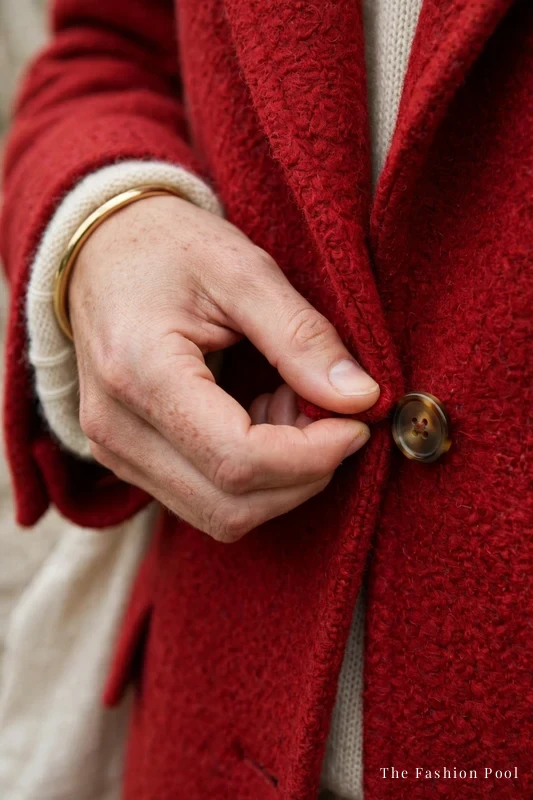
Jewellery stays minimal, and the metal follows the red from step 1: gold with warm reds, silver with blue-reds. Choose either a gold bangle or a silver pendant on a fine chain — one piece, not two — and nothing that dangles into the collar. The bag is small and plain, black or nude, carried in the hand rather than over the shoulder, so the coat’s shoulder line stays clean. Gloves take the quiet base colour, not the coat colour: black gloves with a black base, charcoal with charcoal.
Hair should sit outside the collar, not under it. Hair tucked inside a coat collar comes out flattened and flyaway in dry winter air by the time the coat comes off. A low bun or a low ponytail keeps the hair clear of the collar and shows the neckline of the outfit underneath. Hair down works too, as long as it falls outside the coat — check from the side before you leave, because hair that looks fine from the front often sits inside the collar at the back.
Finish with the mirror check, in this order: coat buttoned, coat open, and from the side. Buttoned, the red should read as one clean line from shoulder to hem, with no competing colour breaking it at the waist. Open, the quiet base should read as one outfit, not two halves. From the side, the coat should fall straight, with the hem clearing your shoes and the scarf sitting flat. If anything pulls, bunches, or shows a second colour where you did not plan one, fix it now — a red coat shows every problem the mirror finds, because the eye goes to the red first and then to whatever is wrong next to it.

What not to pair with a red coat
Some combinations fail a red coat outfit before the evening starts, and they all fail the same way: they give the coat something to argue with.
Green. A green scarf, green gloves, or a green bag with a red coat reads as a Christmas costume, not an outfit. The pairing is too loaded to rescue, even in a deep forest green. If green is the colour you want, wear it another day, without the red coat.
A second red. A red scarf, a red bag, or red shoes next to a red coat turns the coat into part of a set, and a set is always less interesting than a single statement. The coat is the red. Let it stand alone.
Orange and pink. Both are warm colours that argue with red instead of calming it. Orange sits too close to a brick red to read as a separate colour; pink fights a true red for attention. Neither one quiets the coat, and both of them compete with it.
Shiny patent leather. A wool coat is matte. Patent shoes or a patent bag next to it create a shine the coat cannot match, and the eye goes to the shine instead of the colour. Matte suede or smooth leather keeps the attention where it belongs.
A busy print underneath. The coat is the statement, so the base should be plain. A patterned top or a checked scarf under a red coat reads as two ideas at once, and the coat loses. Save the print for a day when the coat stays at home.
Bare ankles with a long red coat. A long coat that ends at the calf with bare skin below it looks cold as well as unfinished. Tights or boots that meet the hem keep the leg line going.
Frequently asked questions
What colour goes under a red coat?
One neutral family — black, charcoal, navy, cream, or dark denim — with black the sharpest and navy the softest. Use the reveal test from Step 2: open the coat and check that the outfit underneath is finished on its own.
Can I wear red lipstick with a red coat?
Yes, if the lip is a different red from the coat — one shade deeper, never an exact match. The scarf sits between the collar and your face, so the lip reads against your skin rather than against the wool. Our red dress guide works through the lip logic in full.
What shoes go with a red coat?
Black suede ankle boots for a knee-length coat, knee-high boots for a longline coat, and low block heels in dark suede for the evening — chosen for the coat’s length, as in Step 2.
Is a red coat too much for the office?
No, if the coat is the only statement. Choose a knee-length, single-breasted red coat over a quiet base — black trousers, a black knit, plain boots — with no red accessories and no shine. Save the longline evening version, and any second red, for after work. The coat reads as confident at work precisely because everything around it is calm.
Which red suits my skin tone?
Cool skin suits a blue-red, warm skin a brick red, and deep skin a true red or a burgundy-red — see Step 1 for the full shade guide and the jaw test.
Can I wear a red coat with jeans?
Yes — dark-wash, straight-leg jeans with quiet shoes and a plain knit, as in Step 2. Light-wash jeans, rips, and fading at the thigh all compete with the coat.
Choose the red for the room, give it one quiet base, and finish it so it photographs well. Let the coat be the only loud piece, and it will do the rest.
Keep your style story going.
Find your next outfit idea, styling detail or wardrobe solution.
Explore the latest edit ↗