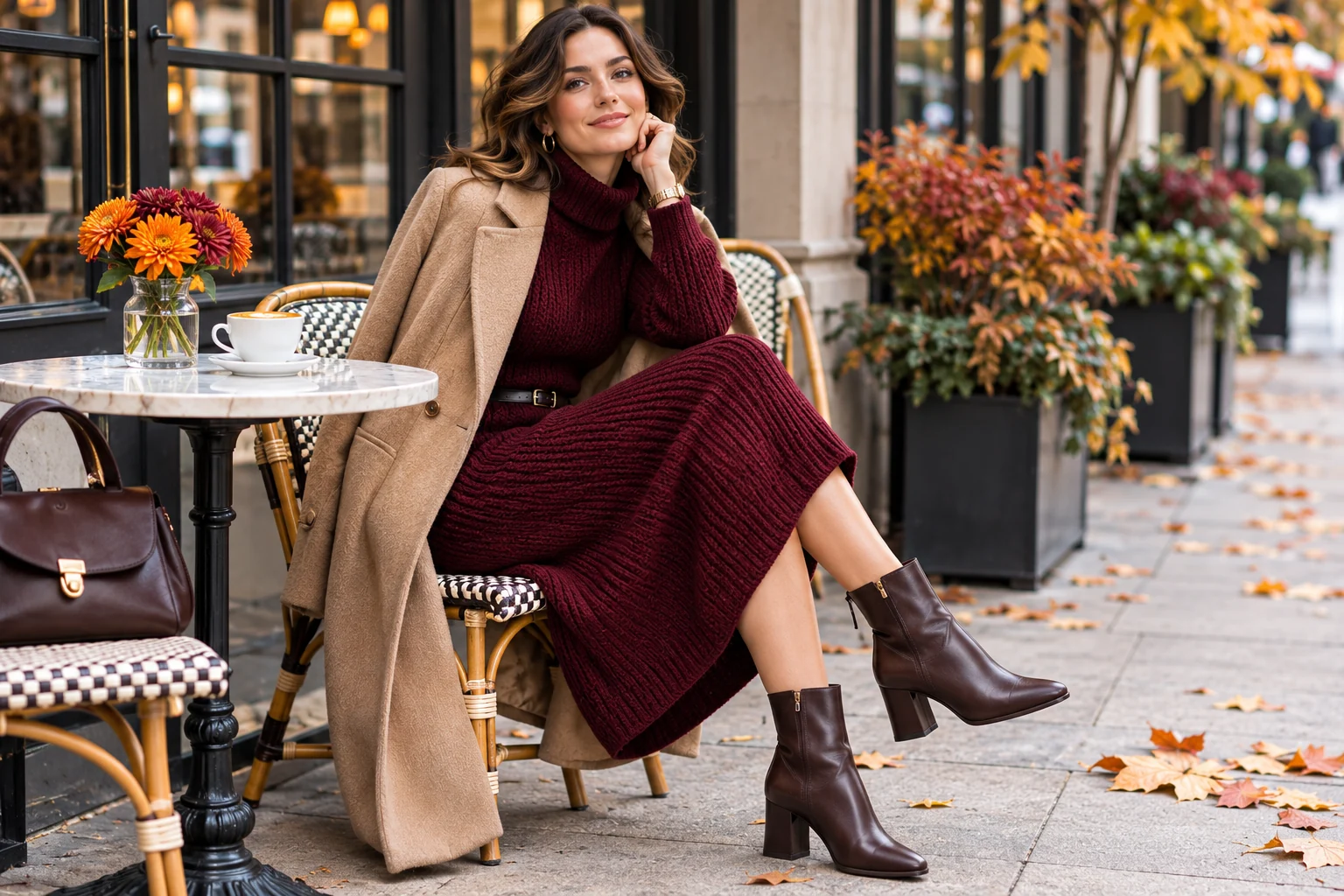
A knit midi dress with ankle boots can be one of the easiest cold-weather outfits to repeat, but the details determine whether the dress drapes smoothly and the boots look intentional. The trick is to consider the space between the hem and the boot shaft, the weight of the knit, and the kind of day you are dressing for—not to buy a matching set.
For a reliable starting point, wear a cream ribbed midi dress with dark-brown ankle boots and a camel coat. For a cleaner work look, combine a charcoal knit dress, black ankle boots, and a tailored blazer. For relaxed weekends, try a burgundy knit dress, sturdy flat boots, and a light neutral coat. Each combination can be adjusted for your climate, comfort, and preferred amount of shape.
Start with the three fit checks that matter most
Before choosing a coat or bag, put on the dress and boots together. Walk a few steps and sit down. A combination that looks balanced while standing may catch at the calves, twist around the knees, or feel restrictive when you move. You should be able to wear the outfit through an ordinary day, not just for a photograph.
- Check the dress hem: a midi dress can end just below the knee or closer to mid-calf. Notice where it meets the top of your boots and whether the line feels deliberate.
- Check the boot shaft: close-fitting shafts usually sit neatly under a longer hem. A wider, more structured boot may work better when a little of the upper boot remains visible.
- Check the knit: a fine rib, smooth jersey, or substantial cable knit will hang differently. Let the fabric decide how much room you need around your legs and under a coat.
There is no universal hem length for every height. The useful question is whether the visible space, footwear shape, and dress silhouette work together on you. If the boot top catches the dress when you walk, try a slightly different boot height or a dress with a freer skirt rather than assuming the outfit cannot work.
Three ways to style a knit dress with ankle boots
These three formulas use different colors, textures, and footwear so they solve different dressing needs. The featured combination is polished and warm; the second is office-friendly; the third is practical for a casual day. You can borrow the proportions without copying the precise shades or buying new pieces.
1. Cream ribbed midi dress, brown ankle boots, and a camel coat
Wear: an ivory or cream long-sleeve ribbed midi dress, dark chocolate leather ankle boots with a comfortable low heel, a straight camel coat, and a medium-brown shoulder bag. Keep jewelry modest, such as small gold hoops. The dress brings visible knit texture while the coat adds a smoother outer layer.
This is a useful formula for lunch out, an informal office, or a city afternoon when you want a pulled-together look without combining many separates. The different brown shades do not need to match perfectly. Dark boots ground the paler dress; the camel coat connects the two. Leave the coat open when the temperature allows so the dress is visible from neckline to hem.
Choose a boot with enough room at the ankle for walking and a dress hem that does not repeatedly catch on the boot top. If the ribbed fabric clings more than you prefer, try a slightly thicker knit or a silhouette that falls straighter rather than stretching tightly across the legs. A long coat can echo the line of the midi dress; a shorter coat also works when you want to show more of the dress.
Adjust it: exchange the heeled boot for a flat leather ankle boot on walking-heavy days. If it is colder, add a thin warm base layer that lies smoothly under the knit and tights that coordinate with the boots. If the coat is already generous, avoid piling on thick scarves that make the upper half difficult to move in.

2. Charcoal knit dress, black ankle boots, and a tailored blazer
Wear: a charcoal-gray fine-knit midi dress, sleek black ankle boots with a stable block heel, a black or charcoal tailored blazer, and a structured black bag. A simple metallic earring can brighten the look without competing with the clean lines. This outfit suits a workday with a business-casual dress code or a dinner where you want a sharper shape.
The difference from the first formula is structure. A blazer gives the shoulders definition; the fine-knit dress creates an uninterrupted vertical line; black boots make the bottom feel connected to the jacket. A small heel can look refined, but it is optional. Flat ankle boots with a slim profile can work just as well if you will be standing or commuting.
Try the blazer with the dress both open and lightly fastened. The right choice depends on where the jacket ends relative to your waist and hip, not an abstract rule about body type. If you prefer a looser dress, a neat blazer can provide enough shape without a belt. If the dress is close-fitting, allow enough ease for sitting and moving comfortably. Avoid a boot shaft that creates a visible bump beneath a narrow hem.
Adjust it: switch to opaque charcoal tights when warmth or dress code calls for covered legs. Swap the blazer for a knee-length black coat outdoors. A burgundy handbag can add a single accent, but you do not need an accent color if the monochrome combination already feels complete.
3. Burgundy knit dress, flat ankle boots, and an ivory coat
Wear: a deep burgundy knit midi dress with a gently relaxed skirt, flat dark-brown ankle boots with a practical sole, an ivory or oatmeal coat, and a small crossbody bag. This formula is less formal and works for a weekend market, casual meetup, or a walking day in cool, dry weather.
Here the contrast comes from a rich color against a pale coat. A fuller skirt and flat boots create an easy rhythm as you walk. The important detail is that the hem can move over the boot top without getting trapped. A shorter or slightly wider dress hem is often simpler than a very narrow ribbed skirt when the boots are substantial.
Let the dress be the main color statement. Brown boots and a quiet bag support the burgundy, while the lighter coat keeps the outfit from feeling too dark. A cream scarf can echo the coat if you need extra warmth. If you dislike light outerwear, dark charcoal or chocolate can replace ivory while leaving the dress-and-boot combination intact.
Adjust it: when surfaces are wet or slippery, choose boots designed for those conditions instead of assuming every fashion boot has suitable traction. For extra warmth use tights that sit comfortably under the dress. If you prefer a cleaner silhouette, use a straight dark-brown boot rather than a chunky lug sole.
How to make the hem and boot shaft work together
A frequent styling problem is a dress hem that lands directly on a bulky boot shaft. As you move, fabric can bunch and the dress may lose its smooth line. The solution is usually a small adjustment to proportion rather than a completely new outfit. Put the boots on first, then check the dress from the front and side while standing and walking.
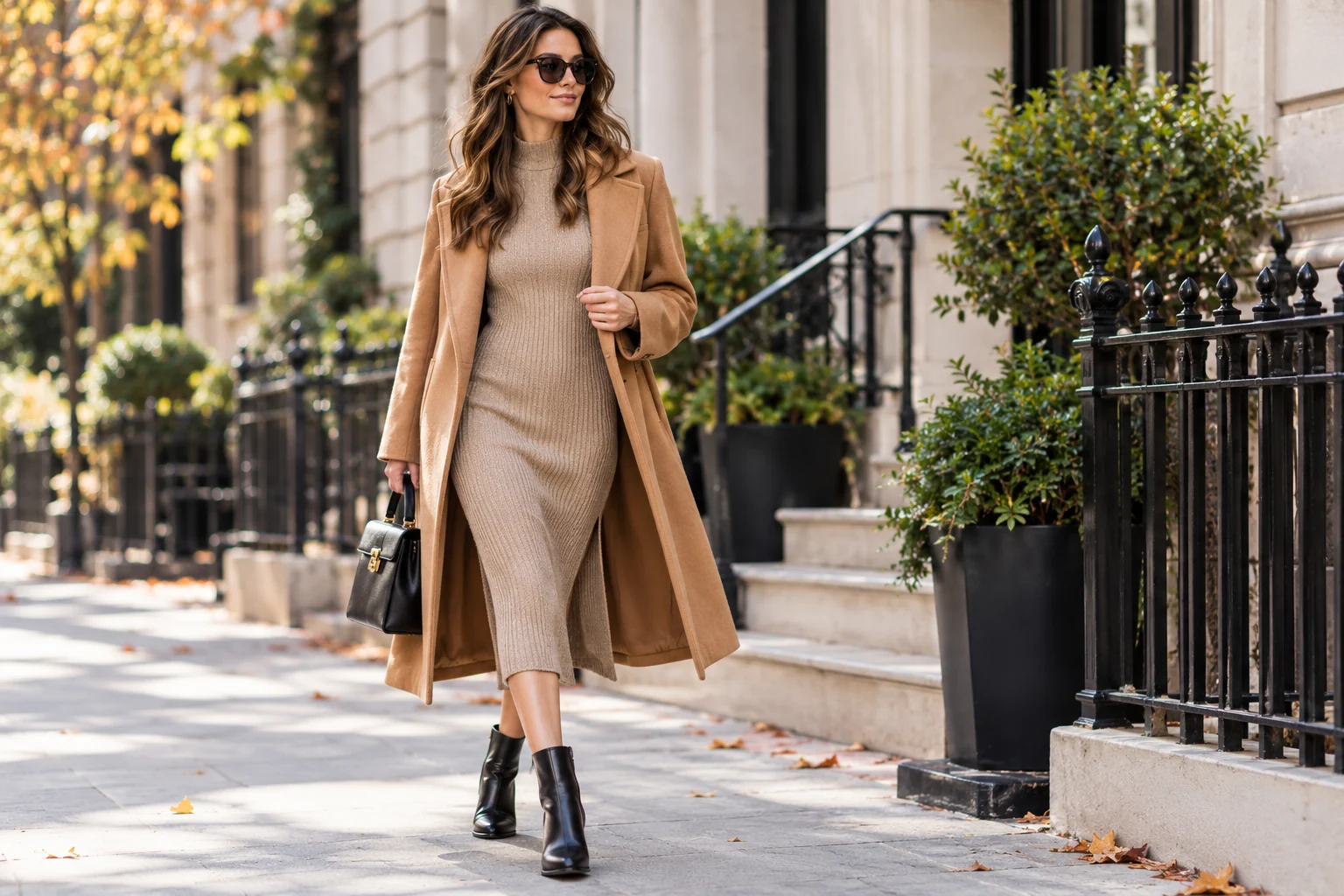
When the hem sits above the boot
A modest gap can show the shape of both pieces clearly. In cooler weather, tights bridge that gap without drawing unnecessary attention to a strip of bare skin. Match tights approximately to the boots for a continuous appearance or use a complementary dark shade when you want the separation visible. Comfort and weather protection should guide that choice.
When the hem covers the boot top
This can look streamlined with a slimmer boot and a dress that falls freely. Move around to confirm the hem does not snag or ride up. If it catches, try a smoother shaft, a lower boot opening, or a skirt with more ease. The exact amount of overlap is less important than the way the two garments behave in motion.
When you prefer a chunky boot
A sturdier boot can work well with a relaxed or textured knit dress. Let a little of the boot’s shape show and keep the dress comfortable around your calves. A chunky boot may look visually heavy with a very delicate knit, so repeat some substance in the outfit through a heavier coat or bag. This is a styling option, not a fixed rule.
Choose the right layers for the season and setting
Knitted fabric does not guarantee warmth. A thin knit dress with an open neckline can feel colder than a properly layered outfit in the same color. Read the garment’s fiber and care information, consider wind and precipitation, and choose layers based on your actual local conditions. In serious winter weather, functional outerwear matters more than a coordinated coat photograph.
For milder fall days, a blazer or light coat may be enough. For colder days, use a comfortable base layer, tights when needed, and a lined coat that closes without stretching over the dress. If a turtleneck dress makes your neckline feel crowded, opt for a crewneck dress with a scarf you can remove indoors. Keep the scarf from overwhelming any high collar.
Shoes should also suit the day. A block heel may be practical for a short walk and office hours; a supportive flat boot is often easier for long distances. Check fit with the socks or tights you intend to wear. Boots that pinch when you try them on will not become better simply because they complete the color palette.
For more general cool-weather ideas, our cold-weather business-casual wardrobe guide shows how a small set of pieces can support different outfits. If you prefer a longer coat, the scarf-with-coat guide offers additional neckline options without needing to purchase a new coat.
Small styling decisions that change the result
Use a belt only when it helps your comfort and shape
A knit dress does not require a belt. If your dress already follows your preferred silhouette, leave it alone. For a straight, relaxed dress, a soft belt can bring definition; test it while sitting to ensure it does not bunch the knit. Avoid cinching delicate stitches so tightly that the fabric pulls unevenly.
Keep the bag proportional to what you carry
A structured shoulder bag feels more tailored, while a crossbody is practical when your hands are occupied. Neither is intrinsically more stylish. Choose one with straps that sit comfortably over the coat and enough capacity for your essentials. If the bag rubs against a delicate knitted dress, consider carrying it over the outer coat rather than directly against the fabric.
Make color combinations repeatable
Start with the dress, boots, and one outer layer. A cream dress with brown boots gives soft contrast; charcoal with black gives a cleaner line; burgundy with cream makes the dress the focus. Repeating the boot color in your bag is optional. If you have only black boots, use them across several knit dresses and adjust the outer layer instead of buying more footwear.
Quick troubleshooting before you head out
If a dress twists around your legs, inspect its fit and the knit’s stretch. If tights cling to the skirt, experiment with a different lining, slip, or fabric pairing rather than tugging the dress down throughout the day. If the boot shaft catches the hem, change one of those two heights. If the outfit feels too dressy, choose flatter boots and a softer bag; if it feels too casual, try a structured jacket.
Photographs are useful for checking proportion, but they should not be the only test. Sit in the dress, walk in the boots, and check the weather. A comfortable, repeatable combination is more valuable than a perfectly coordinated outfit that needs constant adjusting.
Frequently Asked Questions
Can I wear ankle boots with a ribbed knit midi dress?
Yes. A ribbed midi dress can pair nicely with ankle boots, especially when the dress hangs smoothly around the calves and the boot shaft does not catch the hem. Try a slimmer leather boot for a tidy line. If the ribbing feels clingy, choose a heavier knit or a less fitted cut. Comfort matters more than making the dress look perfectly straight.
Should tights match the boots or the dress?
Either can work. Tights close to the boot color often make the lower half feel continuous, which is useful when there is a gap between the dress and boot. Matching the dress instead can create a more tonal look. Choose a level of opacity that suits the weather and your comfort, rather than treating exact color matching as mandatory.
Do flat ankle boots work with a knit dress?
Absolutely. Flat ankle boots can look polished with a knit dress if the silhouette is comfortable and the hem falls neatly. A smooth flat boot suits fine knits, while a slightly sturdier style can balance a relaxed dress. Consider the amount of walking and the ground conditions. A safe, supportive sole is more useful than a heel chosen only for appearance.
What coat length looks good over a knit midi dress?
A knee-length or longer coat is a simple starting point because it relates naturally to a midi hem. A shorter jacket can also work, particularly when you want to show the dress’s shape. Try the pieces together and look at how the hems move while you walk. The best length is one that feels comfortable, practical, and visually intentional to you.
How do I prevent a knit dress from clinging to tights?
Start with the garment labels and how the fabrics interact. Some knits cling more when worn over certain tights, especially in dry conditions. A suitable smooth slip or a different tights material can help the dress move more freely, provided the dress has enough ease. Avoid using products that could damage delicate fibers; follow the dress’s care instructions.
Can a knit dress and ankle boots look appropriate for work?
They can, depending on your workplace’s dress code. A charcoal fine-knit midi dress, tidy black ankle boots, and a tailored blazer make a useful business-casual formula. Avoid assuming every office has identical expectations. If the dress is too close-fitting for your comfort, choose a straighter cut; if heels are impractical, simple flat boots are a reasonable alternative.
Conclusion
The easiest way to style a knit dress with ankle boots is to work from the hem upward: choose boots that let the dress move freely, then add a layer that suits the day’s setting and weather. Cream and brown offer soft polish, charcoal and black feel tailored, and burgundy with a light coat makes an easy weekend look. Try one formula using the dress and boots you already own, then refine the details for real life.