A winter hat outfit starts with the hat, not the coat. The hat is the piece people see first, the piece that decides the outfit’s mood, and the piece that sets the rules for everything underneath it. Choose the hat first, and the outfit follows. Choose the outfit first, and the hat fights it.
This guide works from one rule, and the rule is simple: the hat decides the outfit. The hat decides the color, the hat decides the texture, the hat decides the formality — and the coat, the knit, the boots, and the bag all follow the hat’s lead. A hat that leads makes the outfit; a hat that follows the outfit is the one that looks like an afterthought.
The hat is the last thing you put on and the first thing you decide. You choose the hat, and the coat, the knit, the boots follow — and the hat is the piece that decides whether they work together. A hat chosen last can save an outfit that does not quite work; a hat chosen first can make an outfit that does not need saving. The hat is the finishing decision, and the finishing decision is the one that decides the outfit.
The hat decides the outfit
The hat decides the outfit because the hat is the highest thing in the outfit, and the highest thing is the thing the eye meets first. The eye meets the hat before the coat, before the knit, before the boots — and the hat’s color is the color the eye remembers. A red hat with a camel coat is a red outfit; a black hat with a camel coat is a black outfit. The hat’s color is the outfit’s color, and the outfit’s color is the hat’s.
Texture follows the same rule: the hat’s texture should be the only instance of that texture in the outfit. A knit beanie with a chunky knit sweater is two knits, and two knits argue. A knit beanie with a smooth coat is one knit, and one knit is the outfit. The hat’s texture is the outfit’s texture only when it stands alone — never its competition.
Formality comes next: a beanie is the everyday hat, a beret is the dressy hat, a bucket hat is the warm hat, a wide-brim is the statement hat. The formality of the hat is the formality of the outfit, and the outfit’s formality should match the hat’s. A beanie with a velvet dress is a formality argument; a beret with a velvet dress is a formality agreement. The hat sets the level, and the outfit meets it.
Silhouette comes last: a wide hat asks for a straight coat, a close hat asks for any coat. A wide-brim with a wide coat is two wides, and two wides argue; a wide-brim with a straight coat is one wide, and one wide is the outfit. A beanie with any coat is one close thing, and one close thing is the outfit. The hat’s width is the outfit’s width only when it stands alone — never its competition.
The beanie: the everyday hat
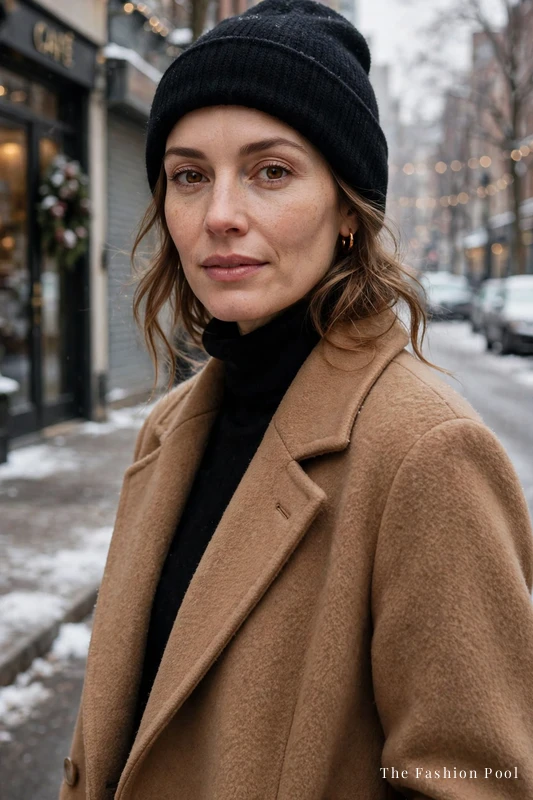
The beanie is the everyday hat, and the everyday hat is the easiest hat to wear. The beanie is warm, plain, and quiet — it sits close to the head, it covers the ears, and it asks nothing of the outfit except that the outfit be as quiet as it is. A beanie with a camel coat is the outfit — the beanie is the warmth, the coat is the frame, and the two of them do not compete because only one of them is a hat.
The beanie’s color should be the outfit’s quiet color: black, gray, cream, navy. A bright beanie with a bright coat is two brights, and two brights argue. A bright beanie with a plain coat is one bright, and one bright is the outfit. The beanie is the hat that disappears into the outfit, and the disappearing hat is the one that works every day.
The beanie’s knit should be fine and smooth, not chunky. A chunky beanie with a chunky knit sweater is two bulks, and two bulks make the outfit top-heavy. A fine beanie with a fine knit is one knit, and one knit is the outfit. The beanie is the hat that keeps the head warm without changing the outfit’s shape, and the shape is the outfit’s.
The beanie’s fold is the detail that decides the outfit: a folded cuff is the beanie’s edge, and the edge should be neat. A beanie with a folded cuff sits close and looks finished; a beanie without a fold sits loose, and the looseness is the look. The fold should be one turn, not two — one turn is the edge, two turns are the bulk. A beanie’s fold is the hat’s only detail, and the detail should be quiet.
Our camel coat guide covers the shape that works in camel, and the same shape — a long line, a clean front, no bulk — is what to wear under a beanie. The coat is the quiet layer, the beanie is the warmth, and the outfit is the two of them together.
The beret: the dressy hat
The beret is the dressy hat, and the dressy hat is the one that changes the outfit’s mood. The beret is flat, soft, and tilted — it sits on one side of the head, and the tilt is the outfit’s angle. A beret with a velvet blazer is the outfit — the beret is the mood, the blazer is the structure, and the two of them agree because both of them are dressy.
The beret’s color should be the outfit’s deep color: burgundy, forest green, black, navy. A burgundy beret with a camel coat works — the burgundy is the depth, the camel is the frame, and the two colors do not compete because only one of them is a hat. A burgundy beret with a burgundy coat is two burgundies, and two burgundies argue. The beret needs a coat that is not its own color.
The beret’s tilt is the detail that sets the angle: tilted to one side, the beret is dressy; worn straight, the beret is plain. The tilt should be slight — a small angle, not a big one — and the angle is the outfit’s angle. A beret worn straight is a hat without a mood, and a hat without a mood is a hat without a reason.
The beret’s material is the softness that makes it dressy: wool felt, soft and flat, with no stiffness. A stiff beret is a hat that stands away from the head, and a hat that stands away is a hat that does not belong. A soft beret sits close to the head, and the closeness is the dressiness. The beret’s softness is the outfit’s softness — and the outfit should be as soft as the beret.
Gloves with a coat are the cold-weather finish — leather gloves, dark, plain — and the gloves are the detail that keeps the hands warm without adding a second statement. The gloves should be dark and plain, because the beret is the statement, and the statement should be alone.
The bucket hat: the warm hat
The bucket hat is the warm hat, and the warm hat is the one that covers the most. The bucket hat is wide, soft, and low — it covers the ears, it covers the forehead, and it keeps the wind out of the face. A bucket hat with a dark coat is the outfit — the bucket hat is the warmth, the coat is the quiet layer, and the two of them do not compete because only one of them is a hat.
The bucket hat’s material should be the outfit’s warm material: wool, faux fur, fleece. A wool bucket hat with a wool coat is two wools, and two wools argue. A wool bucket hat with a smooth coat is one wool, and one wool is the outfit. The bucket hat’s material is the outfit’s warmth, and the warmth should be in one place, not two.
The bucket hat’s brim is the detail that does the warming: a wide brim is the warm hat’s brim, and the brim should be low enough to cover the ears. A brim that is too short is a hat that does not warm, and a hat that does not warm is a hat without a reason. The bucket hat is the hat that warms the most, and the warming is the reason for it.
The bucket hat is the coldest-day hat, and the coldest day is the day it earns its place. On a mild day the bucket hat is too much hat; on the coldest day it is the only hat warm enough. The bucket hat should be saved for the coldest days, and the coldest days are the ones when the wind is up and the ears are cold. A bucket hat on a mild day has no job to do; a bucket hat on the coldest day is the outfit’s warmth.
For the taller version, Knee-high boots with jeans is the fit guide — and the boot should stay plain and dark, so the hat is the only statement in the outfit. A knee-high boot with a bucket hat is the cold-weather version of the ankle boot, and the boot is the quiet part of the outfit.
The wide-brim: the statement hat
The wide-brim is the statement hat, and the statement hat is the one that is the outfit. The wide-brim is broad, bold, and unmistakable — it frames the face, it shades the eyes, and it is the first thing anyone sees. A wide-brim with a plain coat works — the wide-brim is the statement, the coat is the quiet, and the two of them agree because only one of them is loud.
The wide-brim’s color should be the outfit’s quiet color: black, camel, dark brown. A black wide-brim with a camel coat is the outfit — the black is the statement, the camel is the quiet layer, and the two colors do not compete because only one of them is a hat. A red wide-brim with a red coat is two reds, and two reds argue. The wide-brim needs a coat that lets it be the statement.
The wide-brim’s brim is the outfit’s line: a broad brim is a broad line, and the broad line should be the outfit’s only broad line. A wide-brim with a wide coat is two wides, and the two widths fight each other. A wide-brim with a straight coat is one wide, and one wide is the outfit. The wide-brim is the hat that is the outfit, and the outfit is the hat.
The wide-brim frames the face, and the framing is the reason for it. The brim shades the eyes, it softens the light, and it makes the face the photograph’s subject. A wide-brim in the photograph is the frame, and the face is the picture inside it. The wide-brim is the hat that photographs best, and the photograph is the reason the wide-brim is the statement hat.
Our faux fur coat guide covers the shape that works over a party dress, and the same shape — one statement piece, everything else quiet — is what to use for a wide-brim. The coat is the quiet layer, the wide-brim is the statement, and the photograph is the two of them together.

What not to pair with a hat
What not to pair with a hat is decided the same way as the hat rule: by the hat, not by the outfit. The wrong pairing is worse than no pairing at all, because the wrong pairing is the one everyone notices — and the hat notices the wrong thing.
Do not pair a hat with another hat: no beanie under a bucket hat, no beret under a wide-brim, no two hats at once. A hat with a hat is a competition, and the hat always loses — because the hat is the piece with the most presence, and the second hat is the one that looks like a mistake. Do not pair a hat with a loud scarf: no patterned scarf with a patterned hat, no bright scarf with a bright hat. A loud scarf fights the hat’s statement, and the outfit becomes a color argument. Do not pair a hat with a hood: no hood up over a beanie, no hood up over a beret. A hood over a hat is two covers, and two covers argue. Do not pair a hat with hair that fights it: no high ponytail under a beanie, no big curls under a beret. The hair should sit under the hat, not against it.
Frequently asked questions
Which winter hat is warmest?
The bucket hat: it covers the ears and the forehead, and its wide brim keeps the wind out of the face. A wool bucket hat with a smooth coat is the warmest combination — the warmth is in one place, and the one place is the hat.
Can you wear a beret with a casual outfit?
Yes — a beret with a camel coat and straight-leg jeans is the casual beret. The beret is the dressy piece, and the casual pieces are the ones that let it be dressy without being formal. Keep the rest of the outfit plain: no second statement, no bright color, no shine.
Does a winter hat ruin your hair?
No — if the hair is planned for the hat. A low ponytail or loose hair sits under a beanie; a low bun sits under a beret. The hair should sit under the hat, not against it, and the hat should be the outfit’s top, not the hair’s enemy.
What color hat goes with a camel coat?
Any deep color: burgundy, forest green, black, navy. The hat’s color is the outfit’s color, and the coat is the frame — so the hat should be the color you want the outfit to be. A bright hat with a camel coat is one bright, and one bright is the outfit.
Can you wear a wide-brim hat in the snow?
Yes — a felt wide-brim with a plain dark coat is the snow’s hat. The wide brim keeps the snow out of the eyes, and the felt keeps the head warm. Keep the coat plain and dark, because the wide-brim is the statement, and the statement stands alone.
How do you keep a hat from slipping?
Choose the hat for the head, not for the outfit: a beanie should sit close, a beret should sit tilted, a bucket hat should sit low. A hat that slips is a hat that does not fit, and a hat that does not fit is a hat that fights the outfit all day.
A winter hat outfit is a hat outfit, and the hat is the outfit. Let the hat decide — and the outfit follows.
Keep your style story going.
Find your next outfit idea, styling detail or wardrobe solution.
Explore the latest edit ↗