An apres ski outfit is decided on the mountain, not in the lodge. The hour after the last run — the fireside, the lodge bar, the walk to dinner — is when the outfit matters. The base layer you skied in is either a top you can wear to a table, or underwear you have to hide. Après-ski is not a second outfit. It is the first outfit, changed.
In short: ski in a base layer worth showing, carry a knit, jeans and lodge boots in your bag, and give yourself ten minutes in the boot room. Shell, ski boots, helmet and goggles off; base, socks and mid-layer stay; knit, dark jeans and warm boots on, coat over the top. That is the difference between a rewarding hour and a damp, cold one.
The timing is now. On Pinterest Trends (logged in, US, checked 25 Nov 2026), “apres ski outfit” sits at about 99 to 100 on Pinterest’s 0-to-100 interest index — its highest point in the last 90 days, up from about 9 in August. Last year the same term spiked to 100 in late November and early December. These are interest-index readings, not search counts; no weekly, monthly or yearly growth percentages were shown on the pages checked. Late November is when it peaked last year.
Before: the slopes outfit
The slopes outfit has two jobs: to keep you warm, dry and moving in the morning, and to become a lodge outfit in the afternoon. The morning job usually wins — a base layer that wicks sweat, a mid-layer that holds heat, a shell that keeps the snow out. Choose the base like a top, because by four o’clock, it is one.
The base layer is the decision everything else hangs on. A thermal top in a solid, dark color — black, charcoal, deep navy, dark green — is a top. A thermal top in white, or with a loud logo across the chest, or in a shiny fabric, is underwear. It matters because the base layer stays on through the changeover. Merino wool is the best version — warm, dry, and it does not hold odor the way synthetics do — but any close-fitting thermal in a dark solid color works. The test: would you wear it as a top under a cardigan at home?
The mid-layer is the second piece that stays: a thin fleece or lightweight insulated layer in a dark color — the warmth on the mountain and a deliberate second layer under the knit. A mid-layer in neon, hot pink or high-vis yellow photographs as ski gear and fights the knit. Keep it dark and quiet.
Ski socks are the piece nobody plans and everybody feels. A proper ski sock — long, cushioned at the shin, snug at the ankle — is warm, and it is also the sock the lodge boots go over. An ordinary cotton sock is damp by midday, cold by four o’clock, and bunches inside a lodge boot. Keep the ski sock on for the changeover: it is why the lodge boots feel comfortable.
The shell jacket, ski trousers, helmet, goggles and gloves come off: they are built for wind and snow, not for a room. A shell jacket is cut wide and loud, designed to be seen from a lift — in a lodge it is a tent with a zip. Ski trousers are the same: built to move and shed snow, and wrong at a table. The helmet and goggles are the most obvious, but the gloves are the one people forget, and cold hands at the table give the changeover away. All five go in the locker or the boot room.
The changeover: the ten-minute swap
The changeover is the whole article in ten minutes, planned in the morning, not invented at four o’clock. The lodge outfit is packed in the morning, in the same bag as the spare gloves, and waits in the locker.
Where it happens is worth deciding before the first run. Most lodges have a boot room or locker room with benches, hooks and a mirror — the best version, because the ski boots come off on a bench and the lodge boots go on dry feet. Some lodges have only a hallway or a corner by the door, which works if the knit is on top of the bag. Whatever the place: the changeover happens before the fireside, not after it. Once you are sitting by the fire in ski trousers, you are not getting up.
What comes off is the hard shell of the day: shell jacket, ski trousers, ski boots, helmet, goggles and gloves. The ski boots change the day most — heavy, rigid, every step a small negotiation. Taking them off turns the day from sport into evening: unbuckle fully, pull the liner tongue forward, step out, and put the lodge boots on.
What stays is the soft core: the base layer, the ski socks, and the mid-layer if the room is cold. The base layer is the top now; the socks are the warmth inside the lodge boots; the mid-layer is the extra layer under the knit, and it comes off at dinner if the room is warm. Nothing else stays.
What goes on is the lodge outfit, three pieces in this order: the knit, the bottom half, the boots. The knit goes over the base layer — the warmest, softest thing in the bag, and the piece that turns the thermal into an outfit. The bottom half goes on next, dark and dry: dark jeans, corduroy trousers, or knit trousers packed flat. The boots go on last — warm, dry, made for walking, not for clipping into a binding. The coat goes over the top. Ten minutes, three pieces plus the coat, and the ski day is over.
After: the lodge look
The lodge look is built from the three pieces that went on in the changeover: the knit is the warmth and the color, the bottom half is the shape, the boots are the finish. Get the three right and the outfit works at the fireside, at the bar and at dinner.
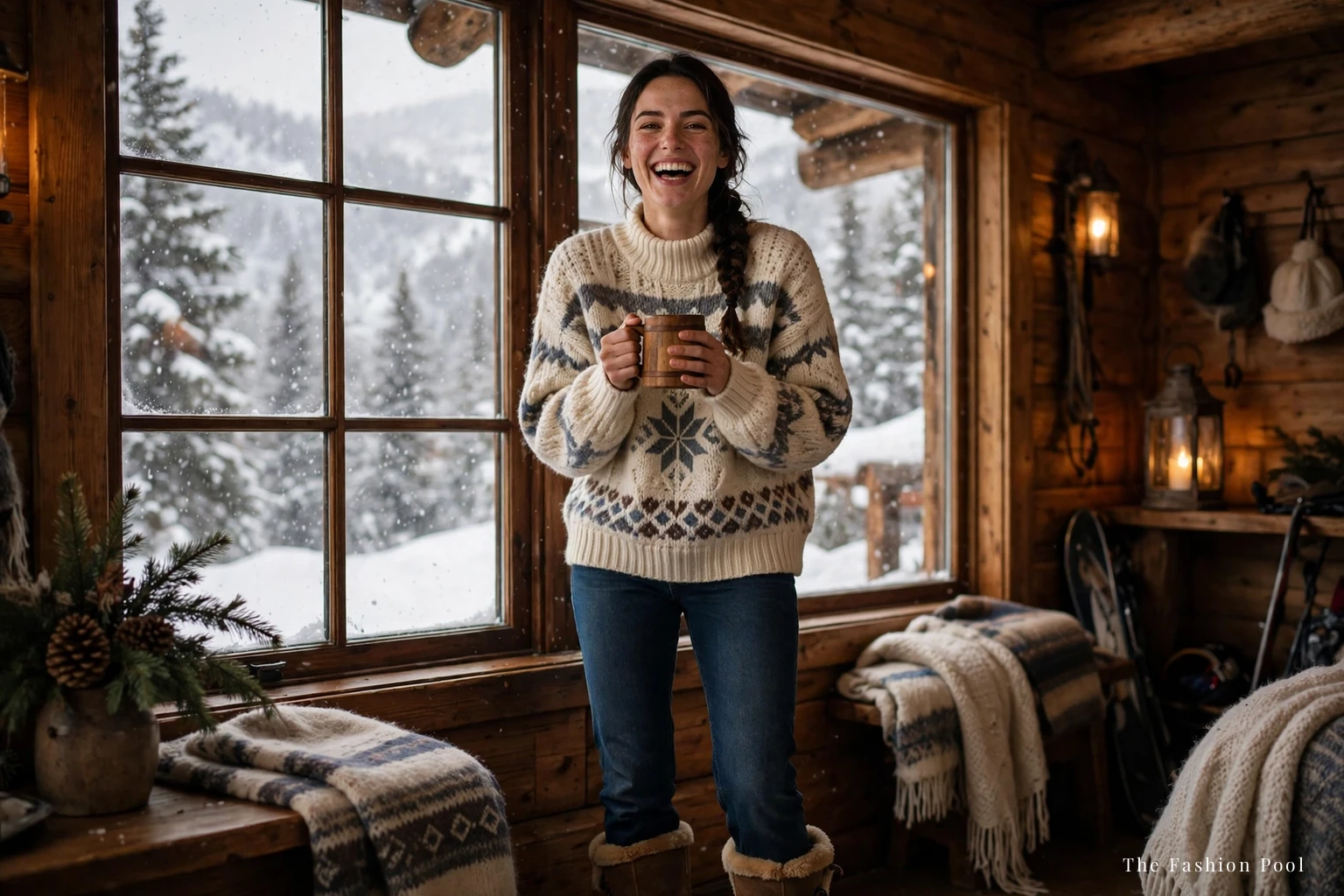
The knit is the piece people photograph, so it should carry the most character. A chunky knit in cream or oatmeal is the classic: soft, warm, and it photographs well against dark wood. A fair isle knit is the festive version — the pattern does the talking, so the rest of the outfit stays quiet. Our chunky knit sweater guide works through the knit shapes that hold up in cold weather, and the same rules apply here: the knit should be thick enough to be the outfit, not a layer waiting for a jacket. A thin, tight knit that shows the base layer does not work.
The bottom half decides whether the outfit reads as a lodge outfit or as ski gear that stayed on. Dark jeans are the easiest choice: warm with the ski socks underneath, right with a chunky knit, and they photograph as an outfit rather than as kit. Corduroy trousers are the softer version — the texture reads as winter, and dark brown or deep green corduroy with a cream knit is the lodge combination. Knit trousers are the warmest version, when they are thick, dark, and cut like trousers rather than leggings. A ski trouser kept on does not work. Change it.
The boots finish the outfit, and they are the piece most people get wrong, because the temptation is to keep the ski boots on “just for the walk.” Après-ski boots are warm, dry, and made for walking indoors: shearling-lined boots, padded snow boots, or chunky lug-sole boots in a dark color. Shearling-lined boots are the warmest and the most lodge-like. Lug-sole boots are the practical version for the walk to dinner — the grip matters on ice. Whatever the boot: warm, dry, made for walking. Ski boots are none of those in a lodge.
The coat is the finish for the walk between rooms: long enough to cover the knit, warm enough for the walk, and quiet enough that the outfit underneath still leads when it comes off. A long puffer is the warmest version in falling snow. A faux fur coat is the festive version — it suits the lodge the way a tailored coat suits a cocktail party, and it makes the arrival itself the statement. Our faux fur coat guide sets out the shape to choose first. The coat comes off at the door — if the outfit only looks finished with the coat on, the outfit is wrong.
The finish is small, and it is the difference between an outfit and a kit change. The beanie comes off — a ski beanie photographs as the mountain, and hair that has been under a beanie all day needs a shake and a brush, not a hat. A low bun or a loose braid survives a beanie and still looks deliberate by the fire. The gloves come off with the shell, and the gloves with a coat guide covers the walk, not the table. The bag is a small cross-body, carried in the morning bag and swapped in at the changeover — not the ski backpack, which stays in the locker with the shell.
After, by lodge moment
The same apres ski outfit works in three rooms, and each room asks for one small adjustment: the fireside, the lodge dinner, and the village walk.
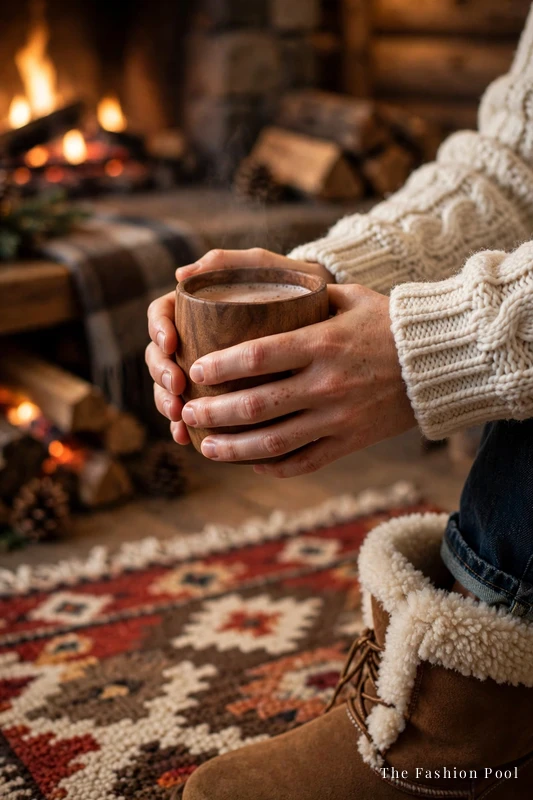
The fireside is the warmest room and the most relaxed one. The coat is off and on the hook, the knit is the outfit, and the ski boots are by the fire drying. This is where the knit does its work: a chunky knit in cream, a fair isle with the pattern showing, a turtleneck with the collar up. The mistake is keeping the coat on: a coat by a fire overheats. Hang the coat, keep the knit, and let the fire do the heating.
The lodge dinner is the dressiest room, and it asks for one change: the knit gets neater, and the mid-layer comes off. A turtleneck under a blazer is the dinner version, but only if a blazer was packed as an optional extra in the morning — and if not, a dark, fine knit is the simpler version. The dinner table is a long sit, so the bottom half has to sit well: dark jeans that give at the waist, corduroy that does not bind, knit trousers chosen for sitting. The base layer shows most at dinner, at the neck and the wrist, so it should be the dark solid one chosen in the morning. One warm note — a gold earring, a deep red lip — is the dinner finish.
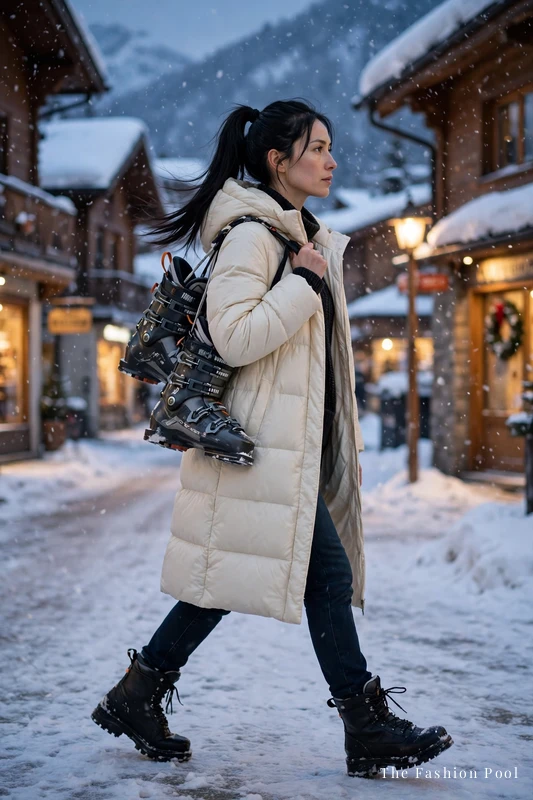
The village walk is the coldest room, because it is not a room at all: the street between the lodge and dinner, in the dark, in the snow. The coat goes back on, the gloves go back on, and the boots earn their keep — the lug sole on ice, the shearling lining on a cold pavement. The knit stays under the coat, and the coat should close over it: a coat that does not close over a chunky knit is the wrong coat for the walk. Our snow day outfit guide works through the same cold-walk logic. Walk it warm, and the dinner starts well.
What not to wear to après-ski
Five mistakes cover almost every apres ski outfit that goes wrong, and all five are avoidable in the morning.
The first mistake is keeping the ski boots on. They are heavy, rigid, and built to clip into a binding — in a lodge they clomp on hard floors, and they announce at once that the changeover was skipped. The fix: lodge boots in the bag.
The second mistake is keeping the shell jacket on. A shell jacket is cut for wind and snow, not for sitting at a table, and it photographs as ski gear where everyone else has changed. The fix: the shell goes in the locker, the knit goes on, and a real coat goes over the top.
The third mistake is a base layer chosen like underwear. A white thermal, a shiny synthetic, a top with a loud logo — all of them show at the neck and the wrist at dinner, and all read as underwear rather than as a top. The fix: a dark, solid, close-fitting thermal that would pass as a top under a cardigan at home.
The fourth mistake is cotton. A cotton base layer, cotton socks, a cotton tee under the shell — cotton holds sweat, stays damp, and is cold by four o’clock. The fix is the fabric rule: wool or a proper wicking synthetic next to the skin, and nothing cotton in the layers that touch the body. A damp cotton base layer is why so many après-ski hours feel cold, and it is fixed in the morning, not at the fireside.
The fifth mistake is no change at all — skiing until the lifts close, walking into the lodge in full kit, and sitting by the fire in ski trousers. It is the most common mistake and the easiest to avoid, because it is a planning mistake, not a styling one. The fix is the bag, packed in the morning: a knit, a bottom half, and lodge boots, waiting in the locker.
Frequently asked questions
Can I wear my ski base layer to après-ski?
Yes — if it was chosen for it. A dark, solid, close-fitting thermal in merino wool or a wicking synthetic reads as a top under a knit. A white thermal, a shiny fabric, or a top with a loud logo reads as underwear.
What boots should I wear to après-ski?
Warm, dry boots for walking: shearling-lined boots, padded snow boots, or chunky lug-sole boots in a dark color. Do not wear ski boots in the lodge — heavy, rigid, and impossible to miss at a table.
Do I have to change out of ski trousers?
Yes. Even black ski trousers read as ski gear at a table, because of the cut, the shine and the ankle gaiter. Dark jeans, corduroy trousers, or thick knit trousers are the lodge bottom half — packed in the morning.
What if there is no locker room?
Change where you can: a boot room bench, a hallway corner, or the car. Pack the bag so the knit is on top, and swap before the fireside.
Can I wear jeans to après-ski?
Yes — dark jeans are the easiest lodge bottom half: warm with ski socks underneath, right with a chunky knit, and they photograph as an outfit rather than as kit. Light-wash jeans show every mark from the day and read as daytime.
What coat do I wear over an après-ski outfit?
A long puffer for the warmest, most practical version in falling snow, or a faux fur coat for the festive version. Take the coat off at the door; the knit and jeans underneath should carry the outfit on their own.
An apres ski outfit is one outfit with two lives: the base layer you ski in, and the lodge look it becomes with a ten-minute swap. Ski in a base worth showing, pack the knit, the jeans and the boots in the morning, and change before the fireside.
Keep your style story going.
Find your next outfit idea, styling detail or wardrobe solution.
Explore the latest edit ↗