An ugly christmas sweater outfit works when the sweater is the joke and the outfit is the punchline. The sweater brings the reindeer, the snowman, the blinking lights, and the rest of the outfit stays out of its way, so the joke lands instead of getting lost in a pile of competing ideas. Most ugly sweater outfits fail the same way: the wearer adds a second joke, a third texture, a loud shoe, and by the time the photo is taken nobody can tell what the joke was. This guide fixes that with three modes, and the three modes are the steps: ironic, polished, and cozy. Pick the mode that matches the room you are walking into, build the outfit around it, and the sweater does the rest.
The timing helps. National Ugly Christmas Sweater Day falls on Friday 18 December 2026, and the office party, the family photo, and the neighborhood gathering all stack up in the same two weeks, so one sweater usually has to survive three very different rooms. That is why the modes matter: the same reindeer sweater reads as a gag at the contest, as a pattern at dinner, and as comfort at home, and the difference is everything underneath and around it. The sweater never changes. The outfit does.
One line holds all three modes together: one loud piece, everything else calm. The sweater is the loud piece, the only one, and the jeans, the skirt, the shoes, and the tights all stay plain, dark, and quiet, so the joke has a stage instead of a crowd.
Step 1: Ironic — the joke worn straight
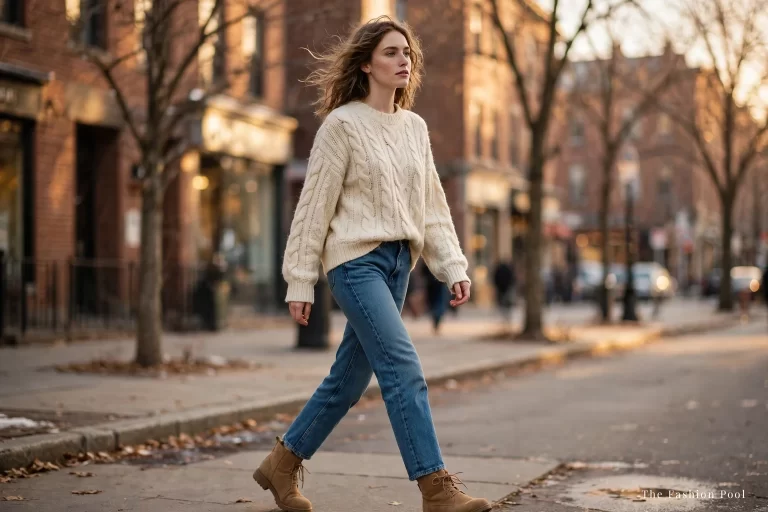
The ironic mode is the sweater worn exactly as the joke intends: a reindeer sweater, dark jeans, ankle boots, nothing else competing. This is the office contest look and the casual party look, and it works because the sweater is the whole visual. Choose the loudest sweater you own, the one with the reindeer front and center, the pom-pom nose, the snowflakes across the chest, and then stop choosing. The joke is already in the room; the outfit’s job is to give it somewhere to stand.
Dark jeans are the right bottom because they disappear. A dark straight-leg jean in a plain wash holds the sweater’s shape without adding a second idea, and the dark color keeps the eye on the print instead of the leg. Light-wash jeans argue with a bright sweater, two pale, busy surfaces, and a patterned jean is a second joke wearing trousers. Keep the jean dark, plain, and straight, and the sweater owns the outfit.
If the sweater is oversized, one small adjustment keeps it from swallowing the outfit: a front tuck — the front center of the hem caught in the waistband, so the waist shows and the sweater keeps its length at the back. That is the only fit trick the ironic mode needs. No belt, no cinching, no rolling the sleeves to the elbow. The sweater is supposed to look a little oversized, that is part of the joke, and the front tuck is what keeps the oversize from turning into a shapeless block.
Ankle boots finish the mode: plain black or dark brown, low heel or flat, no buckles, no studs, no second print. The boots are the quietest part of the outfit, and they should look like it. Hair stays simple, down or tied back, and earrings stay small, because the sweater already has a reindeer on it and nobody needs a second reindeer on the ear. The ironic mode is the easiest of the three to wear and the easiest to ruin, and the ruin is always the same: one more joke. A novelty hat, a light-up necklace, a pair of elf socks peeking out, each one is funny on its own, and together they turn the outfit into a costume rack. One joke, worn straight, is the one most likely to win the contest. Two jokes cancel each other out.
The contest itself rewards the straight reading. Arrive in the sweater, let the print do the talking, and stand where the light hits it, because a joke sweater photographed in a dim corner is a joke nobody heard. The vote goes to the sweater people can read from across the room, not to the outfit with the most pieces: big print, dark bottom, plain boots, nothing in the way. If the contest has a photo round, the same outfit works, because the camera sees what the room sees.
Step 2: Polished — the joke dressed up
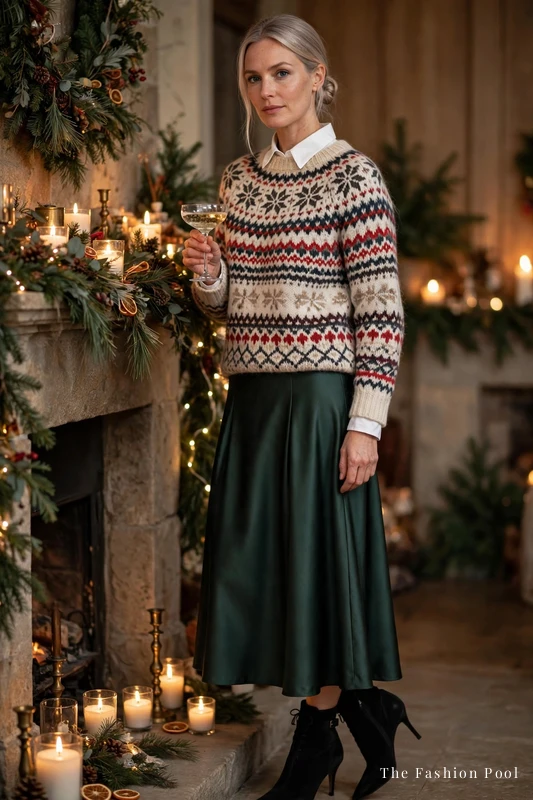
The polished mode takes the same joke and dresses it up: a Fair Isle sweater, a satin midi skirt, and a collared shirt underneath. Fair Isle is the pattern that lets the sweater behave, the geometric diamonds and snowflakes read as a winter print rather than a gag, so the outfit can walk into a dinner or a family photo without anyone wondering whether the wearer is in costume. The joke is still there, in the pattern, but it is wearing its good shoes.
The collared shirt underneath is what makes the mode read as polished. A plain white or pale blue collar peeking above the sweater’s neckline and a cuff showing at the wrist turns a novelty knit into a layered outfit, the way a collar turns any sweater into something deliberate. The shirt should be crisp and plain, no second pattern, no contrasting color that fights the Fair Isle. The collar is the frame; the sweater is the picture.
The satin midi skirt is the mode’s second half. The satin skirt gives the outfit its shine against the knit’s matte surface, and the midi hem leaves a gap of leg above the shoe, so the outfit reads as two pieces, not one long block of knit. A dark satin skirt, black, deep green, burgundy, keeps the palette quiet and lets the Fair Isle carry the color. A bright satin skirt with a bright Fair Isle is two loud pieces arguing with each other. Heeled boots or pointed flats finish the skirt, with opaque tights in black or a dark tone that echoes the skirt.
Where the polished mode earns its keep is the office party and the family photo. At the office party it reads as festive without reading as a costume, which is exactly the line an office party outfit has to walk. Our office holiday party guide covers that line in full, and the polished mode is the version of it built around a sweater. For the walk there, a velvet blazer over the Fair Isle keeps the outfit warm without hiding the collar. Our velvet blazer guide covers the shape that works in velvet, and inside, the collar and the satin carry the outfit. In the family photo, the polished mode photographs the way a good outfit should: the pattern reads at a distance, the collar reads up close, and nobody in the picture is wearing a joke that only works from three feet away.
Hair and makeup stay as quiet as the rest of the outfit. A low bun or a smooth blowout keeps the collar visible, because hair falling over the neckline hides the very detail that makes the mode polished. Makeup follows the same logic: one quiet choice, a deep lip or a soft eye, never both at full strength, because the Fair Isle is already the color in the outfit. Small studs or a thin chain are the only jewelry the mode needs; anything bigger fights the collar for the space around the neck.
Step 3: Cozy — the joke at home
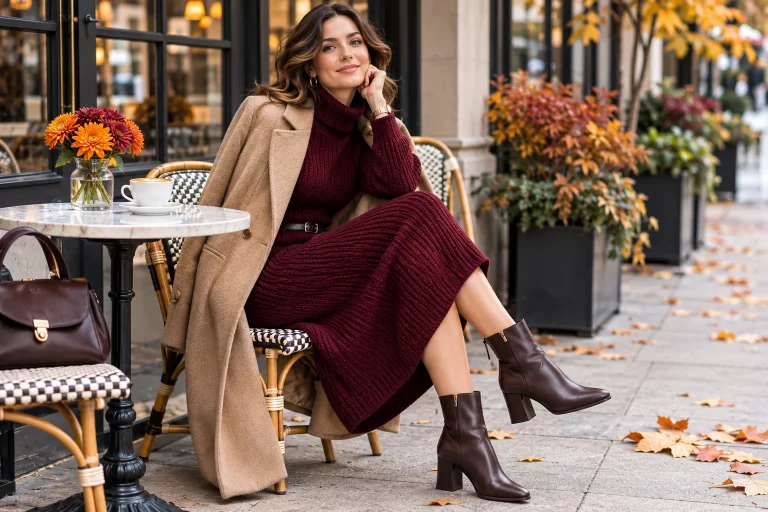
The cozy mode is the joke at home: a sweater dress, tights, and knee boots, worn for the family morning, the movie night, and the day that never leaves the house except for the market. A sweater dress carries the print across the whole outfit, the reindeer or the snowflakes run from shoulder to hem, so the joke is bigger here than in either of the other modes, and the rest of the outfit has to be quieter to match. Opaque tights in black or dark brown, plain knee boots, no jewelry louder than a stud earring. The dress is the joke; everything else is the blanket.
Tights decide whether the cozy mode works. A sheer tight under a sweater dress looks unfinished in December, the leg shows, the cold shows, and the outfit reads as a summer dress that got lost. An opaque tight, 80 denier or thereabouts, keeps the leg warm and gives the dress a clean base, and the dark color ties the dress to the boots. If the dress is long enough to cover the knee, the tights still matter: they are the layer between the dress and the cold, and a cold morning is the wrong time to find out they were too thin.
Knee boots are the cozy mode’s shoe because they do two jobs: they keep the leg warm on the walk to the market, and they give the sweater dress a finished line from hem to foot. A plain knee boot in dark brown or black, flat or low-heeled, is the right one. Our guide to wearing knee-high boots with jeans covers the fit that keeps the line clean, and the same fit applies over tights: no bunching at the ankle, no gap between the boot top and the dress hem. Ankle boots work indoors, and slippers work for the hours that stay inside, but the knee boot is the one that lets the outfit leave the house.

Matching sets are the cozy mode’s second version. A knit sweater and matching knit bottoms, the same print and color, worn as a set, is the outfit for the morning the whole family is in sweaters anyway: the set is one idea worn twice, not two ideas competing. Keep the set plain everywhere else: plain socks or slippers, no scarf, no hat, no second print. A matching set with a patterned scarf is a pattern on top of a pattern, and the joke drowns in it. The set is the joke; let it be the only one.
The market walk is the cozy mode’s real test, and it is the reason the boots matter more than the slippers. The sweater dress with tights and knee boots walks out the door, stands in line, carries the bag home, and never once looks like pajamas, because the boots and the tights give the dress a public line. Indoors, the same dress with the boots kicked off and thick socks on is the movie-night version, and nothing about the outfit has to change except the shoes. That is the cozy mode’s whole trick: one dress, two shoes, and the joke stays funny all day.
What not to pair with the joke
Every failed ugly sweater outfit fails the same way: a second novelty joins the first, and the two of them argue until nobody can hear the joke. The second novelty is the most common mistake, novelty earrings with a novelty sweater, a light-up necklace over a light-up sweater, a Santa hat on top of a Santa sweater. Each piece is funny alone. Together they are a costume, and a costume is not an outfit. If the sweater is the joke, the accessories stay plain: small earrings, a plain ring, nothing that lights up, nothing shaped like a holiday.
Sequins, print, and patterned tights together are the second failure, and it is the loudest one. A sequin skirt under a printed sweater with patterned tights is three loud pieces in one outfit. Each of the three can work with the sweater on its own, sequins with a plain sweater, a print with plain tights, patterned tights with a plain knit, but all three at once is an outfit shouting over itself. Pick one shine or one pattern to sit beside the sweater, and let the other two stay in the drawer.
The third failure is subtler: a second print that is not a novelty at all. A plaid skirt under a Fair Isle sweater, a striped shirt under a snowman sweater, a checked scarf over a reindeer print, the second print is not a joke, but it is still a second idea, and it still steals the eye from the sweater. The sweater’s print needs plain partners: a solid skirt, a solid shirt, a solid scarf. Plain does not mean boring here; plain means the joke has a stage. An outfit built on one idea photographs well and is the one the room remembers. An outfit with two loud pieces photographs as a blur.
Frequently asked questions
Can you wear an ugly Christmas sweater to the office contest?
Yes, the ironic mode is built for it: a reindeer sweater, dark jeans, ankle boots, and nothing else competing. Keep the accessories plain and skip the second novelty, because the contest is judged on the sweater, and a second joke splits the vote. If the office is formal, the polished mode, Fair Isle, satin midi skirt, collared shirt underneath, reads as festive, not as a costume.
What should you wear for family photos in an ugly Christmas sweater?
The polished mode photographs best: the Fair Isle pattern reads at a distance, the collar reads up close, and the satin skirt gives the photo a shine. Avoid a sweater whose joke only works from three feet away. A tiny slogan or a small detail disappears in a group photo, while a big reindeer or a bold Fair Isle reads from the back row.
What should you wear under an ugly Christmas sweater?
A plain collared shirt for the polished mode, so the collar and cuffs show, or a plain thermal or long-sleeve tee for the ironic and cozy modes, so the sweater stays warm without adding bulk. Keep the layer plain and close-fitting: a second pattern under the sweater competes with the print, and a bulky layer shows at the neckline and the cuffs.
What shoes go with an ugly Christmas sweater outfit?
Plain ankle boots for the ironic mode, heeled ankle boots or pointed flats for the polished mode, and knee boots for the cozy sweater dress. In every mode the shoe stays plain and dark. The sweater is the loud piece, and a loud shoe is a second joke at the wrong end of the outfit.
Can you wear tights with an ugly Christmas sweater?
Yes, opaque tights are the right partner for the sweater dress in the cozy mode and for the satin midi skirt in the polished mode. Choose black or a dark color that matches the skirt or the shoe, and skip patterned tights with a printed sweater: the print and the pattern argue, and the leg becomes a second joke.
How do you wash an ugly Christmas sweater?
Turn it inside out, wash it cold on a gentle cycle, and lay it flat to dry. Heat and tumbling shrink the knit and loosen the appliqué, the pom-poms, and any light-up wiring. Sweaters with sewn-on decorations or battery packs need the batteries removed first, and a hand wash is the safer choice for any sweater with glued-on pieces.
An ugly christmas sweater outfit is a joke with a straight face: pick the mode that matches the room, wear the sweater like you mean it, and let it tell the joke. The outfit is the punchline.
Keep your style story going.
Find your next outfit idea, styling detail or wardrobe solution.
Explore the latest edit ↗