A men’s winter coat outfit starts with the cold outside, not with the coat in the closet. Most men buy one heavy coat and wear it through every kind of winter day, then wonder why the same coat feels perfect on a snowy Saturday and wrong on a dry Tuesday. The coat is not the problem. The cold is different on those two days, and a coat built for one kind of cold is the wrong tool for the other. Winter is not one kind of cold. It is a wet cold, a windy cold, a dry cold, a standing-around cold, and a cold that only lasts for the walk from the car to the door. Five colds, five coats. This guide matches each one to its coat, and shows what to wear under it, so the outfit works on the day it is worn.
The cold decides the coat
One rule holds the whole guide together: read the day first — not the calendar, not the outfit underneath, not the coat nearest the door. Read the day first — how cold it is, whether it is wet or dry, how long you will be outside — and the coat picks itself. The chart below is the whole guide in one place: find your day in it, and the coat, the cold, and the layer underneath follow.
| Coat | The cold it is for | The day it fits | What goes under it |
|---|---|---|---|
| Parka | Wet, windy, everyday cold | Errands, the commute, the school run | Crew neck sweater or flannel shirt, jeans or dark pants |
| Puffer | The coldest days, standing still | Snow days, the game, waiting outside | Thin layers only — a crew neck or a thermal, never bulk |
| Wool overcoat | Dry cold, smart days | The office, dinner, a date | Collared shirt and a fine knit, or a sweater vest |
| Sherpa bomber | Mild cold, short trips | The coffee run, the weekend walk | A henley or a plain tee, jeans |
| Fleece trucker | Cool, not cold | The mild afternoon, layered under a heavier coat | A flannel shirt, jeans or chinos |
The chart is a starting point, not a law: a parka on a mild day is too much coat, and an overcoat in a snowstorm is the wrong coat. If you own two of the five, own the parka and the overcoat.
The parka: the everyday coat
The parka is the coat winter was built around, and it is the one to buy first if you buy only one. It is long enough to cover the hips, hooded, and cut to move in — built for the days mostly outdoors: the commute, the errands, the walk with the dog, the school run in the rain. A parka is a working coat, not a statement coat: its job is to keep the wind and the wet out while the man inside it gets on with the day.
Length is what makes a parka a parka: a good one ends at mid-thigh or just above the knee, long enough to cover a sweater and keep the wind out at the waist, short enough to sit in a car. The hood should be a real one, deep enough to cover the ears, and the pockets matter: two deep hand pockets and an inside pocket for a phone and keys.
What goes under a parka is simple: the parka does the heavy work. A crew neck sweater in a dark color, a flannel shirt, or a henley under a sweater — the layers underneath can be ordinary, since the coat carries the warmth. Jeans are the natural partner, dark and straight, and dark pants work just as well for the office version. The shoes are boots: plain leather boots for the wet days, clean dark boots for the dry ones. Sneakers work on a dry day, but they give up the moment the ground gets wet.
Navy, olive, and black are the three colors that work, and navy is the most useful: it goes with jeans and dark pants, with brown boots and black boots, and it hides salt and slush better than black. Bright colors belong on a ski slope, not on a street. The parka’s limit is the smart day: for a dinner or a date it reads as practical, not polished, and that is the coat doing its own job well.
The puffer: the warmest coat
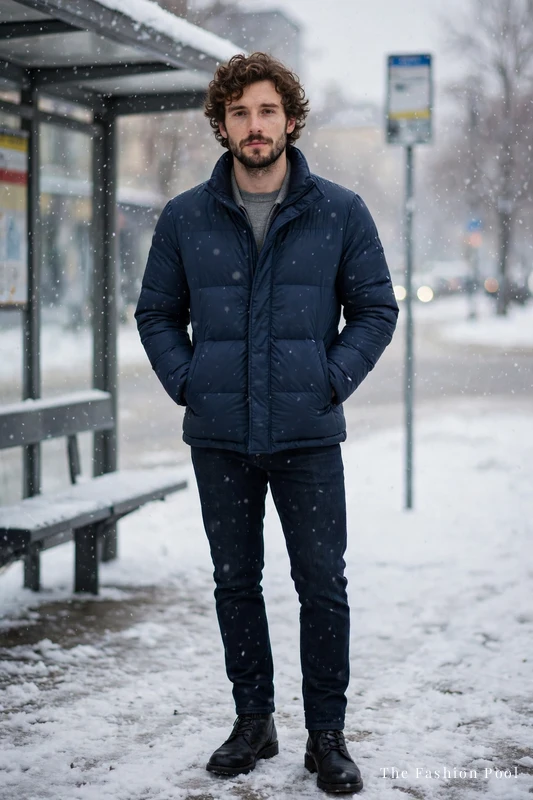
The puffer is one of the warmest coats a man can buy, and the simplest to understand: it is built to trap warm air. The baffles — the stitched sections across the body — hold the insulation in place, and the insulation holds the heat. That is why the puffer is the coat for the coldest days: the snow days, the outdoor game, the long wait on a freezing platform.
Fit is the first decision, and the one men get wrong most often. A puffer should fit close enough that the baffles sit against the body, not balloon around it. Too big, and it becomes a sleeping bag with arms. Too small, and the baffles stretch flat and the coat stops being warm. Try it on over the layers you will actually wear under it — a crew neck, a thermal — and zip it up. If the zip pulls, it is too small.
What goes under a puffer is the opposite of what most men expect: less, not more. The puffer is the warmth, so the layers underneath should be thin. A crew neck sweater, a thermal top, or a long-sleeve tee is enough. A thick knit under a puffer is two warmths fighting for the same space: the man sweats on the walk and freezes when he stops. Give the puffer a thin layer to work with, and it keeps you warm.
Length matters here too. A hip-length puffer is the everyday version, for the commute and the errands. A longer puffer, to mid-thigh or the knee, is the right choice for standing still outside — the game, the sledding hill, the winter market — because a longer coat covers the legs when you are not moving enough to warm them. A matte puffer in black, navy, or dark green reads as a coat, not as sports gear. Wear it with plain leather boots for wet days and clean dark boots for dry ones. The puffer’s limit is the mild day: on a cool day it is too much coat. Save it for the cold that earns it.
The wool overcoat: the smart coat
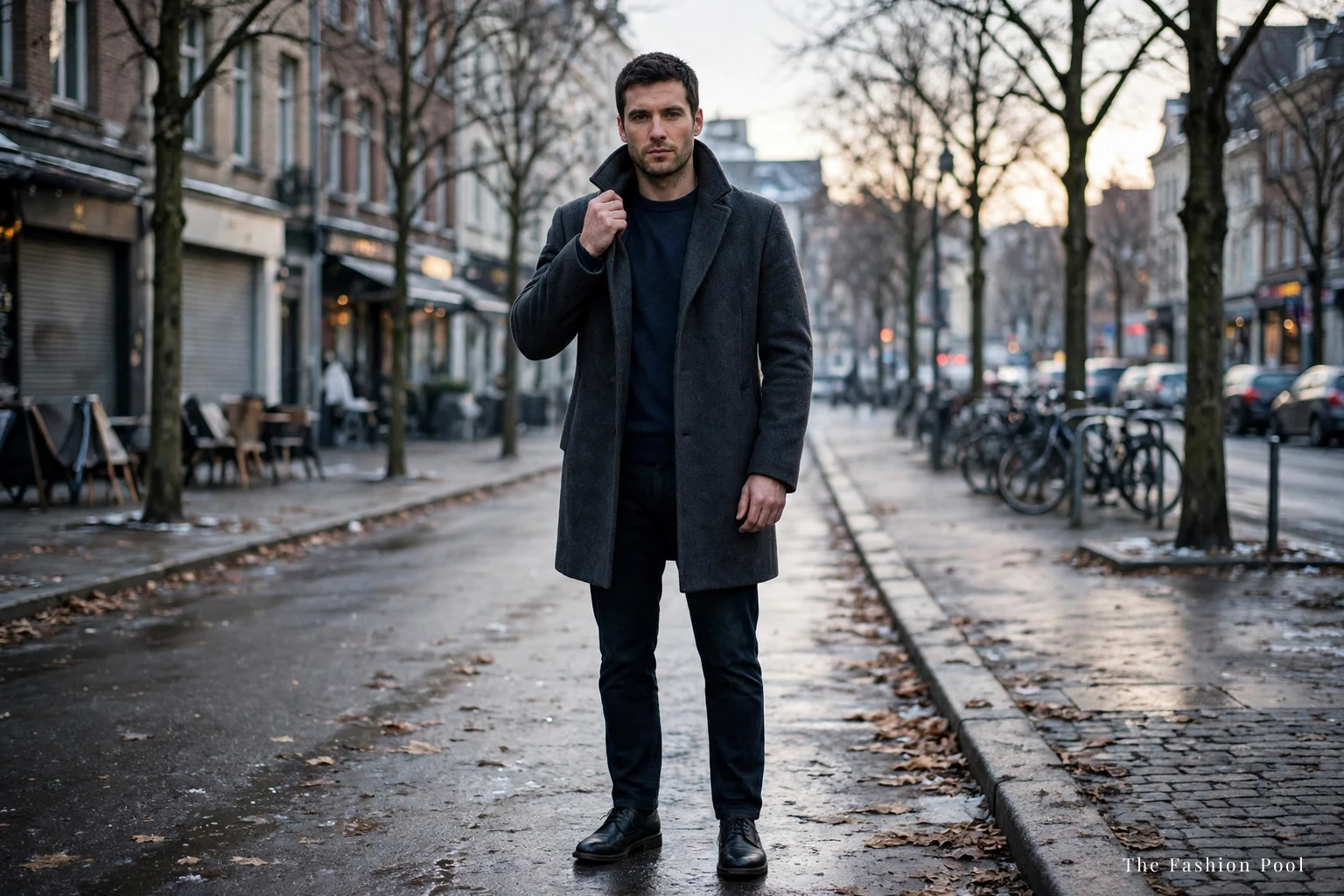
The wool overcoat is the smart coat, and it is the one that makes the rest of the outfit look considered. It is long, clean, and quiet, and it turns an ordinary outfit underneath into something that looks planned. A charcoal overcoat over a sweater and dark pants is the outfit for the office, the dinner, the date. The overcoat says the man thought about the day before he left the house.
Length is the overcoat’s defining feature: it should end at or just above the knee, long enough to cover a jacket and give the outfit a single clean line, short enough to walk in. Check the shoulders too: they should sit at the shoulders, not droop, and the coat should button over a jacket without straining. Try it on over the thickest layer you will wear under it — a crew neck sweater, a sweater vest over a collared shirt — and button it.
What goes under an overcoat is where the outfit is made. A collared shirt with a fine knit over it is the classic version, and a sweater vest over a collared shirt is the version that adds warmth without bulk. A plain crew neck sweater is the simpler version. The color rule is simple: the coat is the quiet piece, and the layer underneath is where the color lives. A charcoal coat over a navy knit, a camel coat over a cream sweater — one quiet coat, one color underneath, nothing competing. Our guide to styling a camel coat covers the lightest of the three classic colors; the same straight knee-length shape is what to look for in charcoal and navy too.
The shoes are leather shoes or clean dark boots. A wool overcoat with white sneakers is an outfit arguing with itself: the coat says smart, the shoes say weekend. A scarf is the overcoat’s natural partner: plain or quietly patterned, tucked into the coat rather than hanging loose. The overcoat’s limit is the wet cold: rain soaks wool, the shoulders sag, and the coat takes a day to dry. On a wet day, wear the parka.
The sherpa bomber and the fleece trucker: the short coats
The last two coats are the short ones, for a different kind of winter day: the mild cold, the short trip, the afternoon that is cool rather than cold. Neither one is a coat for a snowstorm — both are for the days when a heavy coat would be too much, and no coat at all would be too little.
The sherpa bomber
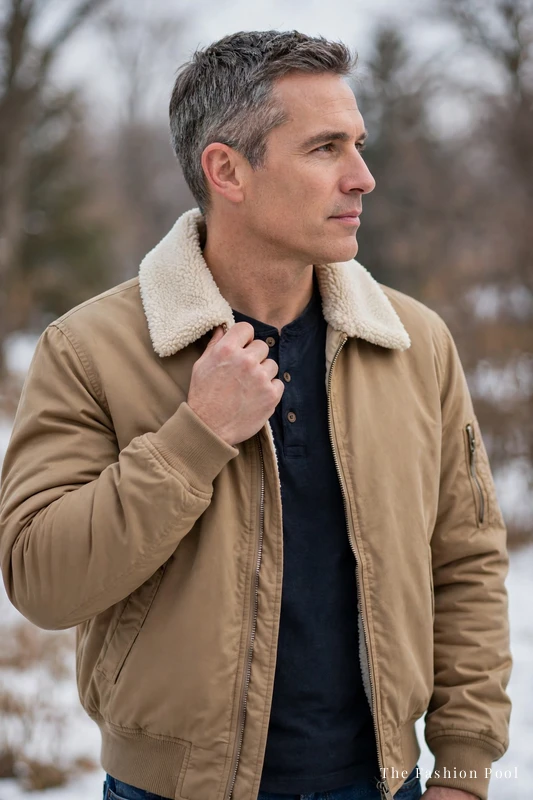
The sherpa bomber is the cozy one. It is short, ending at the waist, with a soft sherpa-fleece lining throughout, showing at the collar and cuffs — the coat for the weekend: the coffee run, the walk to the market, the afternoon at the park. It is warm for its size, because the fleece lining traps heat close to the body — but the warmth stops at the waist, and the legs are on their own. That is why it is a short-trip coat, not an all-day one.
Wear it with jeans and a henley or a plain tee underneath. The layers under it should be casual too — a henley in a dark color, a plain crew neck tee, nothing with a collar that fights the fleece collar. The shoes are boots or clean sneakers; the color is usually tan, brown, or dark green. The fit rule is the waistband: a bomber should end at the waistband of the pants. Above it, the coat rides up; below it, the shape is lost.
The fleece trucker
The fleece trucker is the lightest coat in this guide, and the most useful as a layer. It is a trucker jacket — a straight, button-front shape with chest pockets — lined with fleece, for the cool day, the mild afternoon, the evening that starts warm and ends cold. On its own, it handles the kind of cold that needs a layer, not a coat; under a parka, it adds warmth without bulk.
Wear it over a flannel shirt, with jeans or chinos. Our guide to wearing an overshirt covers the light-layer idea. The trucker is a workwear shape, and it pairs with workwear layers: flannel, denim, canvas, plain tees. It does not pair with a collared dress shirt or smart pants: the shape is casual from collar to hem. The fleece trucker’s limit is the cold itself. It is not a coat for a freezing day, and it is not a coat for standing still outside. It is a coat for moving, for the walk, for the mild afternoon, and for the layer under a heavier coat.
What not to wear under a coat
The coat is only half the outfit: what goes under it decides whether it works, and the mistakes are usually the same — bulk, the wrong shape, or two ideas arguing.
A thick, bulky knit under a fitted coat is the first mistake: the coat will not button, the shoulders pull, and the knit bunches at the waist. The fix is a fine knit, not a thinner coat. A chunky cable knit belongs under a parka, which has room for it, not under an overcoat, which does not. A suit jacket under a puffer is the second mistake: the puffer crushes the jacket’s shoulders, the lapels bunch under the zip, and the outfit arrives looking slept in. If the day needs a suit jacket, it needs an overcoat.
Shorts under a winter coat is the third mistake: a heavy coat on top and bare legs below is an outfit that gave up halfway. A thin shirt with nothing under it is the fourth mistake, the one men make on the mild days: a single thin shirt under a coat is not a layer, it is a hope, and the first cold wind finds it. A thermal top under the shirt, or a fine knit over it, makes the coat work, and adds no visible bulk. The fifth mistake is the scarf worn wrong: a long scarf hanging loose outside a short coat, flapping in the wind. A scarf belongs tucked into the coat, ends inside, or wrapped once around the neck and tucked in.
Frequently asked questions
Which winter coat is warmest for men?
The puffer. Its baffles hold insulation in place, and the insulation holds warm air against the body — the coat for the coldest days and for standing still outside. A longer puffer, to mid-thigh or the knee, is warmer still, because it covers the legs walking would have kept warm.
Can a man wear a puffer to a smart dinner?
No. A puffer is a casual coat, and it reads as sporty even in a matte finish. Wear the wool overcoat for a dinner, a date, or any room where the coat is noticed first. The puffer is the coat for the coldest days, not the smartest ones.
What should a man wear under a winter coat?
It depends on the coat. Under a puffer, wear thin layers — a crew neck or a thermal — because the puffer is the warmth. Under a wool overcoat, wear a collared shirt with a fine knit, or a sweater vest over a collared shirt. Under a parka, an ordinary crew neck sweater or a flannel shirt is enough.
How long should a men’s winter coat be?
A parka should end at mid-thigh or just above the knee. A wool overcoat should end at or just above the knee. A puffer for standing still should reach mid-thigh or the knee; a hip-length puffer suits the commute. A sherpa bomber or a fleece trucker should end at the waistband of the pants.
Can a man wear a parka every day?
Yes. The parka is the everyday coat, built for the commute, the errands, and the wet, windy cold. Its limit is the smart day: for a dinner or a date, wear the wool overcoat instead, because a parka reads as practical, not polished.
What shoes go with a men’s winter coat?
Boots with a parka or a puffer — plain leather for wet days, clean dark for dry ones. Leather shoes or clean dark boots with a wool overcoat. Boots or clean sneakers with a sherpa bomber or a fleece trucker. White sneakers are wrong under an overcoat, and wet sneakers undo a parka outfit at the ankles.
A men’s winter coat outfit is a match between the coat and the cold: the parka for the everyday wet cold, the puffer for the coldest days, the wool overcoat for the smart dry cold, the short coats for the mild days in between. Read the day, pick the coat, and the outfit underneath follows.
Keep your style story going.
Find your next outfit idea, styling detail or wardrobe solution.
Explore the latest edit ↗